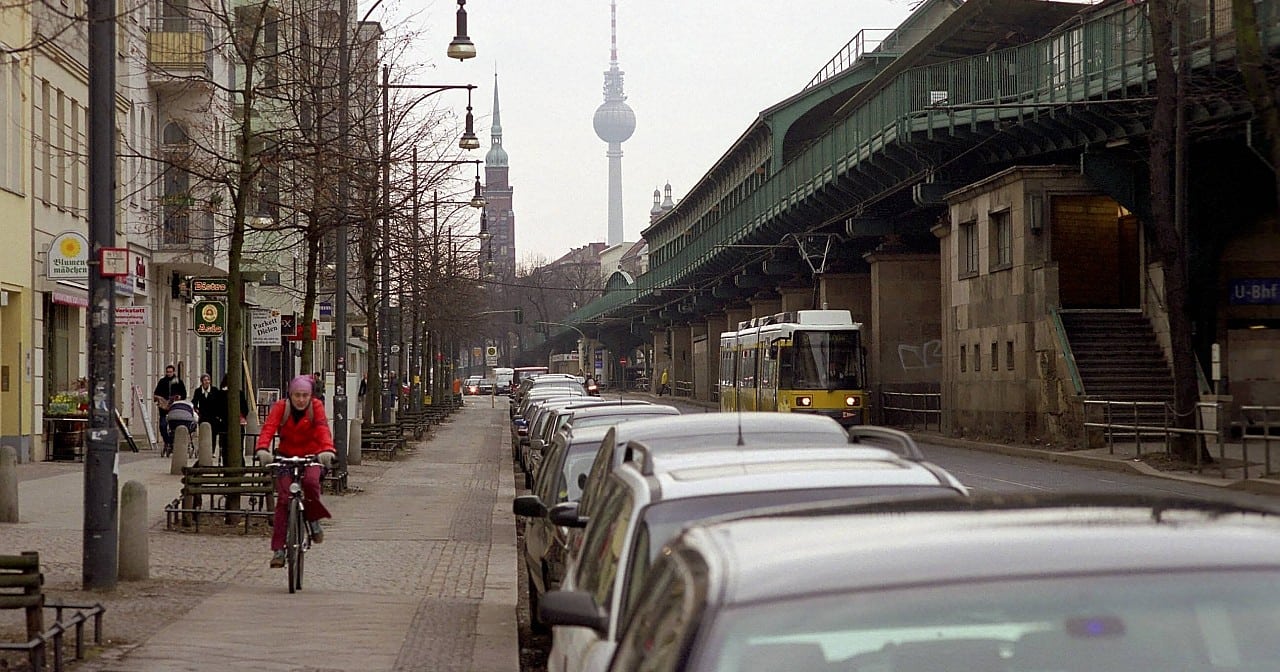
Reading the novel titled “Guten Morgen, Berlin” (Amazon-Affiliate-Link) instantly made me think of Peter Fox’s Berlin anthem “Schwarz zu blau,” and I found myself humming, “you can be so beautifully ugly.” It’s a cliché clash of beauty and ugliness that also threads through the novel, but that’s not all. Rather, the work offers an honest and moving love story, a portrait of the city, and a journey of self-discovery.
Music occupies a central role for the protagonist as a compass of memory — and with it, the book, which centers on the recollections of a gay man about his early years in Berlin. No wonder the book opens with musical references that carry through, even before the first sentence: The epigraph, “Once upon a time [•] we were happy then,” at least for the two Berlin-bound protagonists, Steffen from Munich and Torsten from Dresden, does not forecast permanence. They meet in the Treibhaus sauna. And from that moment, you’re caught in Haß’s cartography of a city that, in the 1990s, offered its residents a raft of new spaces in which to grow and express themselves.
Nearness as a Weakness, Lust as a Strength
A gay, male narrator — his struggles are anticipated: acceptance within family, dating, trust issues, HIV/AIDS. Closeness appears as a vulnerability, while sexual desire becomes a strength. It’s illuminating when Steffen looks back on his youth — a classically psychological moment. A character with the courage to explore himself. One of the bravest steps one can take. He isn’t always successful. The book invites the reader to ride along toward the end as the narrator, in a sober turn, calls himself a donkey. A figure the reader cannot approach uncritically when he admits: “This is not a history book, but a blurred, unclear view through a fogged window, hungover, this is a mash, a feeling.” And yet the book invites with its countless scene-specific references to crack open a history book and research which places were inspired by reality, which still exist, and when exactly Café Anal closed. The narrator won’t say it.
The book’s most impressive achievement lies precisely in being a cultural-historical treasure chest. After reading, you not only grasp how odd it is to rent pornography in a video store’s separate departments, but you also learn what the Valley of the Clueless refers to, how a homophobic commercial can etch itself into memory, or what the striking memorial concept “Bus Stop” signified. A portfolio of serious and entertaining topics: highly recommended!
Nostalgia Pure?
Berlin. Gay. Scene. The only thing missing is sex. There’s plenty of it, and here the author reveals another facet of his versatility: sex is a recurring element of the novel, told well and in varied ways. Sometimes it’s described euphemistically as pleasure, at other times the narrator recalls leaving his friend’s apartment “semen-stained.” A key scene for Steffen is accompanied by a very detailed description. The author’s repertoire — at times sweet, at times funny, at times philosophical — is, overall, highly entertaining.
A certain heaviness emerges when the reader senses that they may have missed a “slower” Berlin, a city that offered housing and heterotopias on every corner. (Heterotopias is Michel Foucault’s term for “other spaces” where social orders twist in new ways.) This sense intensifies whenever the narrator links that era to the past. For that past is over: “Oh yes, to be young again.” Pure nostalgia? There are also funny benefits to the retrospective narrator who has lived through decades of gay life. For example, when he reads online the line, “You are somebody’s reason to masturbate.” Sometimes new media can provoke a smile, but the novel clearly reminds us: life is experienced in the analog
Felix Haß himself is, like Steffen, a Munich-born writer who moved to Berlin in 1995. After the crime trilogy Angst ist stärker als der Tod (Fear Is Stronger Than Death) (2015), Sein letzter Schritt (His Last Step) (2017), and Blank (2021), this novel steps outside the crime genre.
Felix Haß: Guten Morgen, Berlin. Novel. 208 pages. Querverlag. Berlin 2026. Paperback: €20.00 (ISBN 978-3-89656-367-5). E-book: €12.99