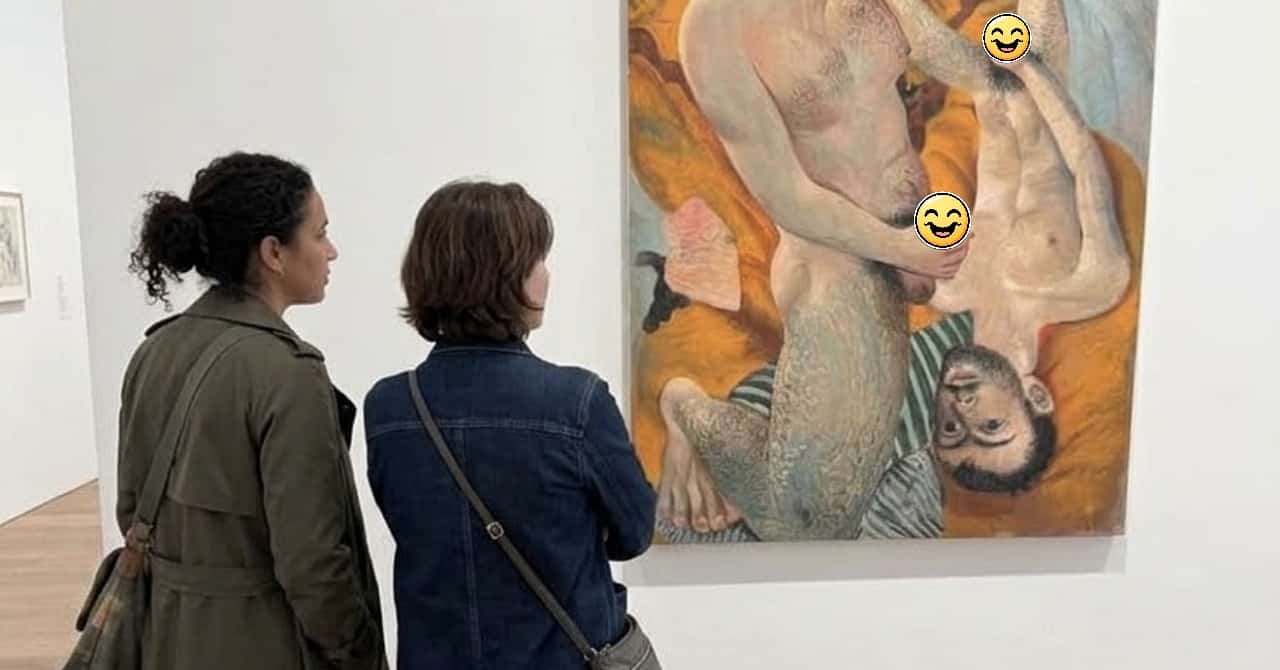
It is remarkable what prices works attributed to the so-called “New Queer Intimism” fetch. The trajectory has progressed rapidly for Louis Fratino: in 2021 his auction record stood at $55,500; today it sits at $756,000. The American, born in 1993, is barely in his early thirties. After his appearance at the 60th Venice Biennale, where queer art was presented as strongly as ever before, his career received another push. Since this year, he has been represented by David Zwirner — one of the largest players on the global gallery scene. The London outpost is now dedicating Fratino, under the title “Prose,” his first solo show in the United Kingdom.
Fratino is not the only gay painter from the Venice Biennale of 2024 to draw special attention in London. Almost simultaneously the Courtauld Gallery presents “Someone Like You,” the first European solo exhibition by Salman Toor. Both artists paint queer intimacy — and could hardly be more different in their approach.
Gay sex taken for granted
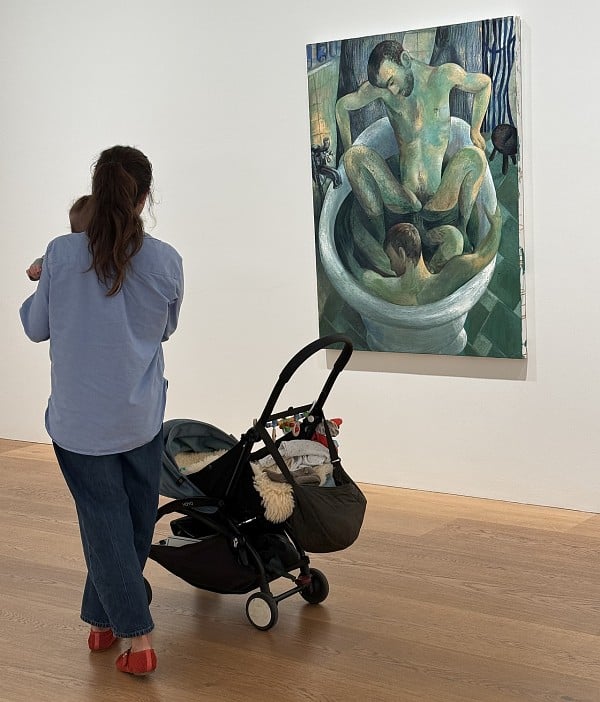
In Fratino’s work, the men immediately draw the eye. Naked in the bathtub, cruising outside the bar, or having sex in a bedroom, but also in everyday situations: among the press of the subway, or within the circle of family. In particular, the male bodies appear peculiarly plastic, almost sculptural and sensually charged. The fact that gay sex sits beside a laid table or a bouquet of flowers is indeed deliberate. Fratino is interested in ordinary life, in its “prose” — and sex for him is as natural as anything else, without ascribing it any extraordinary significance.
At the same time, Fratino pursues an ambitious art-historical self-positioning. Unlike Salman Toor, who repeatedly references the Old Masters, Fratino’s painting leans more toward Modernism and postwar Modernism — toward Matisse and Picasso, but also toward David Hockney. Yet one can observe in both Toor and Fratino that gay intimacy is inscribed into a history of painting that long lacked an natural place in it. That the conditions have changed so much can be read as a success story.
Gay identity as a consumer product
Yet Fratino himself is not entirely comfortable with the “normality” of his images. When straight collectors responded to his explicit depictions of gay sexuality with the words “I love that it looks so normal,” as he later recounted in an interview, it left him with a strange aftertaste. He wondered whether he was turning gay identity into a consumer product for a heterosexual audience.
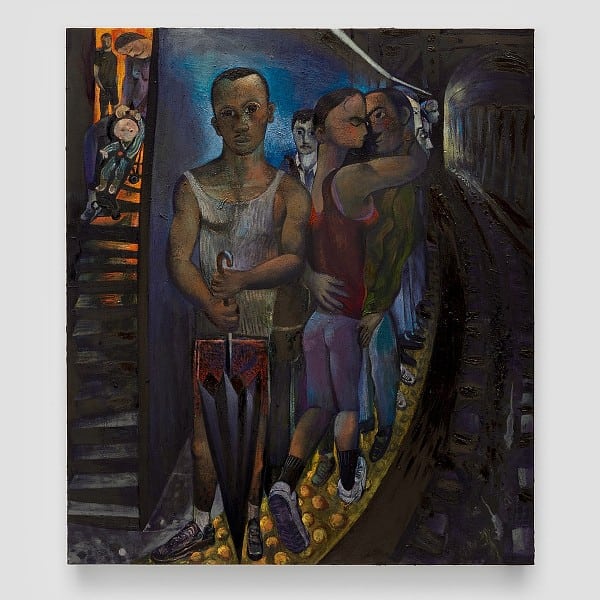
Long been subversive, the erotic depiction of gay men was precisely about making visible what society preferred to keep invisible. But what happens to this resistance when such images hang today in one of the world’s most influential galleries — and are considered completely “normal”?
The appeal for a female audience
On closer inspection, the question of “normality” seems a bit too simplistic. A visit to the London exhibition reveals that surprisingly many of the viewers are women. A mother with a child on her hip seems barely able to tear herself away from the two naked men in the bath. The scene evokes a phenomenon currently observable far beyond the art world: the success of gay love- and sex-stories with a large female audience. Not least the series “Heated Rivalry” shows how far this fascination has now penetrated pop culture.
There may be a key to understanding Louis Fratino’s images here: they not only depict gay desire — they circulate it. And in doing so, it detaches from a solely gay reception space, without losing its gay subject.
One possible explanation is that women here can participate in erotic desire without the female body itself becoming its object. The familiar heterosexual power structure is suspended: the desiring and the desired bodies are male.
Fratino’s concern about the marketability of gay identity thus takes a paradoxical turn: it is precisely the specifically gay desire that can attract a non-gay audience.
Representatives of the “New Queer Intimism”
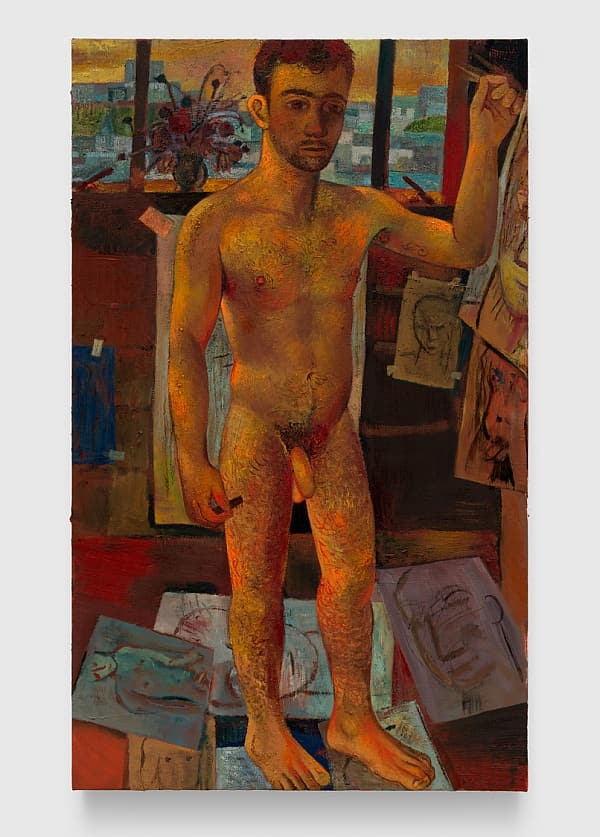
That Fratino, with his turn toward same-sex sex, intimacy, and everyday life, is by no means alone is already implied by the term “New Queer Intimism.” It was coined in 2019 by American art critic Tyler Malone on the occasion of an exhibition by Israeli-American painter Doron Langberg. Malone linked it to the historical Intimism of the early 20th century, especially Pierre Bonnard and Édouard Vuillard, who made domestic and private life the subject of their painting. Among the “New Queer Intimists” he counted Langberg as well as Fratino, Salman Toor, Kyle Coniglio, and Anthony Cudahy.
But the term hardly designates a single stylistic direction. Already Fratino and Toor show how differently queer intimacy can be represented. Toor also paints men who flirt, kiss, and desire. Yet this desire remains more the subject of the depicted queer world. With Fratino, it becomes an offering to the viewer: his men desire not only, they are presented as fleshly desirable bodies in spite of all artistic stylization. While Toor opens a window to a queer life for his audience, in Fratino the desire depicted sometimes leaps onto the beholder.
That these images are already so coveted on the art market in this context is almost a given. Art can not only make visible what is already desired; it can also change what is considered desirable. What boundaries will be crossed next remains far from decided.