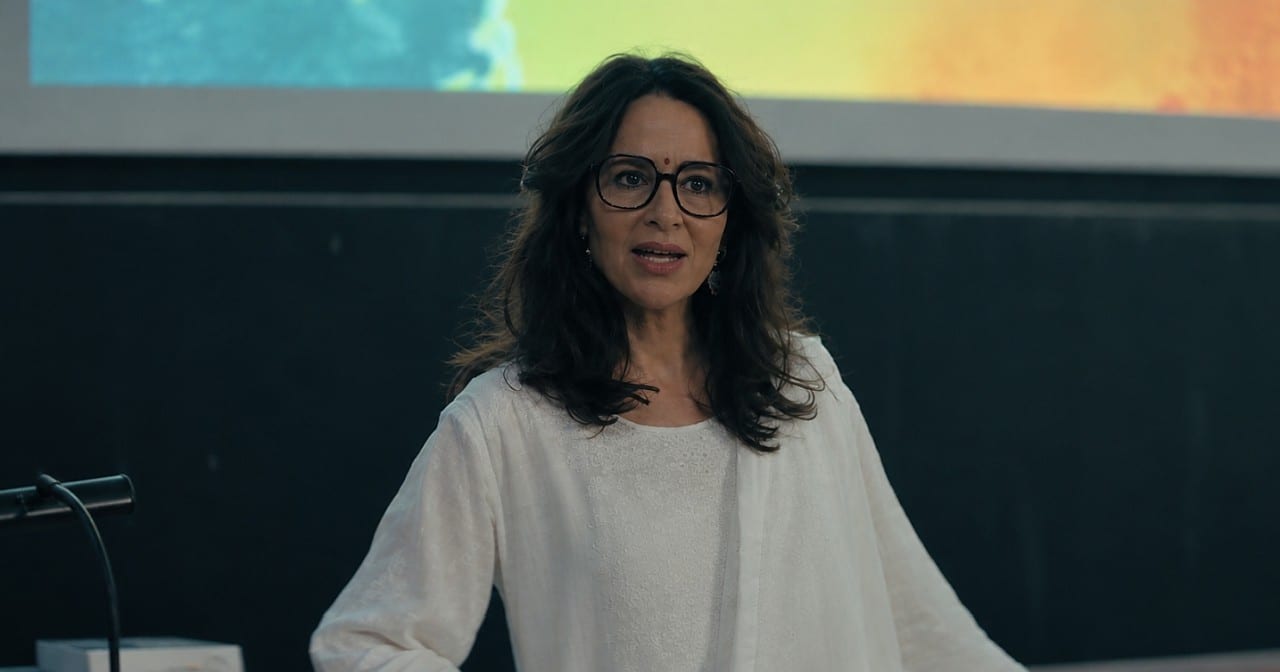
When Saraswati steps into the lecture hall, she stirs the bodies of the students. It’s 2019, and she is the new star professor at Heinrich-Heine-University Düsseldorf — and quite a provocative figure. Stephanie Eidt breathes life into her with a deliberately cool, sly bravado: self-assured, eloquent, and intellectually radical. For instance, she doesn’t shy away from expelling white students at the very beginning of the semester’s first lecture. They depart with incredulous grimaces and bodies twisting, twitching in disbelief — a wonderfully ironic sharpening of white fragility. All People of Color can stay and, under Saraswati’s guidance, “decolonize the soul.”
Among them is the master’s student Nivedita (Amanda Babaei Vieira), who is instantly pulled into the orbit of the queer professor. Saraswati identifies precise causes and solutions for everything that has occupied Nivedita for her entire life: what it means to be not-white in Germany and the accompanying feeling of never truly belonging. Because her father is Indian, her mother Polish and white, this sense of not fitting in is even reinforced by her own community: Nivedita’s joking, though not flattering, nickname within her circle is “Coconut.”
An Irritating Discovery While House-Sitting
Via her struggle with identity, her experiences with racism and also sexism, Nivedita frequently vents on her Insta blog, where she goes by the pseudonym Identitti. And thanks to her new idol Saraswati, she gains an entire vocabulary to articulate what in a deeply racialized, sexist world tends to go wrong. Before long, she is allowed to assist the professor as an aide and even perform honorable tasks, like watering Saraswati’s plants at home.
As Nivedita pokes around Saraswati’s apartment, she makes a disturbing discovery: in a notebook she uncovers an old photo in which she recognizes her mentor as a blonde, WHITE woman. Could Saraswati, the inspirational figurehead and THE icon of postcolonial theory, actually not be a Person of Color?
Who is speaking? What is being said? And does what is said even carry weight if the position from which it’s spoken doesn’t align with the speaker’s own identity? A tangle of questions that unsettles Nivedita’s worldview and certainties. To top it off, the many-armed goddess Kali (rapper Sabrina Setlur) appears in broad daylight in Doc Martens as a hallucination to spark further debates, making the chaos nearly complete.
The Biodeutsche Is Ready for the Compost
When Nivedita finally confronts Saraswati about the deception, Saraswati deftly turns the argument around and sows doubt about whether a race-change could be justified by good intentions and the empowerment of entire communities. Yet her fellow students react less forgivingly when they learn about Saraswati’s “identity shopping.” They leak the photo on social media. The shitstorm is unleashed, and outrage pours in. The Biodeutsche — Saraswati — is ripe for the compost! Soon she finds herself besieged on campus by former students loudly protesting against her.
The film playfully unfurls the emerging dilemmas and stays true to the spirit of Mithu Sanyal’s novel. That said, it shares both strengths and weaknesses with the source material. Even the dialogue in the book sometimes reads like explanatory theory summaries. The film reproduces this at times, so the characters occasionally come off like (informative) podcasts. And much like the novel, the satire’s bite occasionally eases off the gas — perhaps out of caution toward the groups depicted.
Direct link | Trailer for the film
|
Wild Ideas and a Lot of Camp
The playful energy doesn’t suffer a bit. And the intellectually provocative landscape is, in any case, rich. Randa Chahoud’s staging competes with Sanyal’s text, bursting with campy delight and wild notions: for instance, when furious Instagram comment sections cascade across the screen, accompanied by a tangle of outraged voices. Or when the film adopts the magical realism of the source material, mixing surreal elements — such as a dream sequence with a splatter twist. Particularly in scenes where Saraswati captivates her students to the point they fall into a trance, Chahoud crafts a smart image of how susceptible people can be to ideological thinking when it emanates from charismatic figures.
By 2020, with the right-wing extremist attack in Hanau that left nine people with migrant backgrounds dead, all the abstract debates and mutual accusations suddenly feel inconsequential in the face of brutal, hate-filled reality. Whether it’s Cancel Culture, identity, origin, belonging, sexuality, or cultural appropriation, Identitti demonstrates with wit, humor, and without moralizing that there isn’t always a single simple answer. And it argues that in our present, where culture wars are rapidly amplified online, we should sometimes listen to one another with patience and tolerate contradictions.
Identitti. Comedy. Germany 2026. Director: Randa Chahoud. Cast: Amanda Babaei Vieira, Stephanie Eidt, Sabrina Setlur, Zoe Magdalena, Saba Lou Khan. Runtime: 103 minutes. Language: German original. Rating: 12. Distributor: Alamode. Theatrical release: November 12, 2026