In the United States midterm elections on Tuesday, Democrats achieved a historic milestone — and seized control of both chambers of Congress from the Republicans. In seven decades, such a swing has happened only twice before — most recently about 20 years ago during the presidency of George W. Bush. President Donald Trump now faces a Congress that he must govern with, across every chamber. In the Senate, Democrats secured at least 54 of the 100 seats, and in the House at least 225 of the 435 seats.
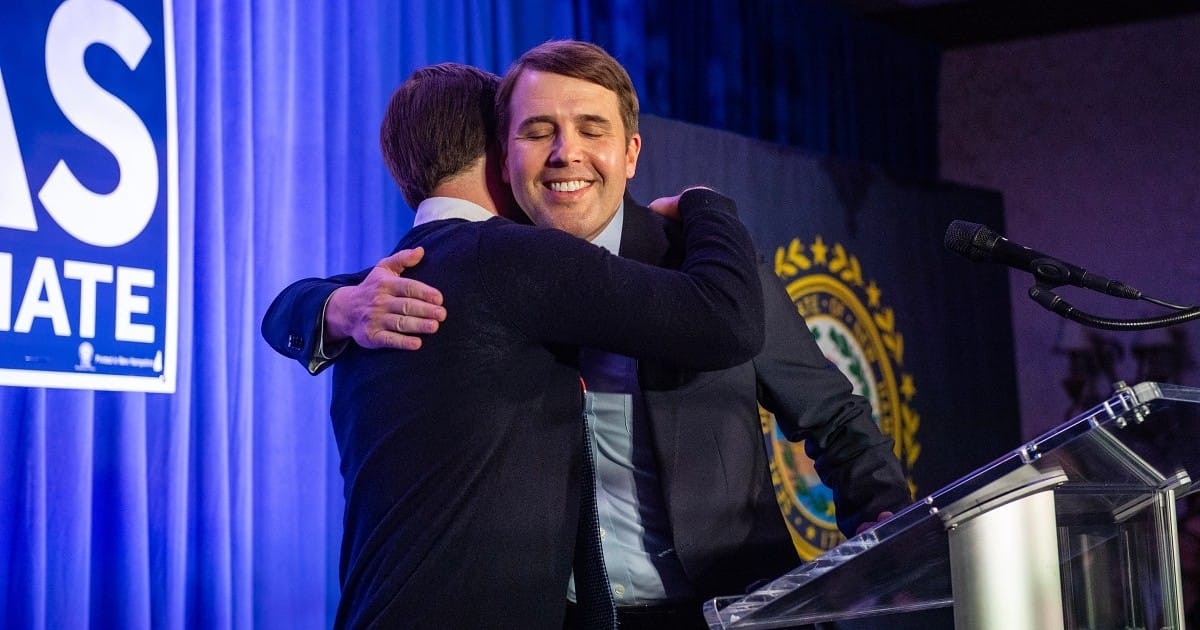
Also, the LGBTQ+ community marked historic gains — all of them on the Democrats’ side. While 46-year-old Chris Pappas won election as the first openly gay man to the U.S. Senate, 36-year-old Sarah McBride won reelection as the first openly transgender member of the House, maintaining her seat with confidence.
Thank you, Delaware. I love our state of neighbors with all my heart — and thanks to a supermajority of Delawareans, I’m proud that I will continue to serve you down in Washington. pic.twitter.com/7zWDHj2NJQ
Sarah McBride (@SarahEMcBride) November 4, 2026
Pappas won New Hampshire decisively with 56 percent of the vote against John E. Sununu (42 percent), who had previously served in the Senate as a Republican from 2003 to 2009. The businessman and longtime family restaurant operator is viewed as a moderate Democrat who pursues a liberal social agenda without a culture-war tone, focusing more on issues like safe drinking water and regional infrastructure.
First openly gay senator in 237 years
It marks the first time in the 237-year history of the U.S. Senate that an openly gay candidate has won a Senate seat. As a result, two of the 100 members in the Senate are openly queer: Tammy Baldwin, openly lesbian, has served as a senator from Wisconsin since 2013. Additionally, Kyrsten Sinema, elected in 2018 as an openly bisexual politician, left the Senate in 2025. After the death of Senator Dianne Feinstein, California Governor Gavin Newsom appointed Laphonza Butler as interim senator in 2023. She did not run in 2024. Butler was the first, and so far the only, openly queer African American woman in the Senate.
Direct link | Pappas thanks his husband in his victory speech
|
Sarah McBride secured a commanding 64 percent of the vote in Delaware in the congressional elections. That outcome surpassed her first run in 2024, when she won with 58 percent. The civil rights advocate, formerly a board member of Equality Delaware, has a strong agenda in expanding health coverage, paid family and caregiving leave, and anti-discrimination laws.
The twist to the story: Right after her first run in 2024, ultra-conservative Republican Nancy Mace from South Carolina introduced a resolution to bar McBride from accessing the Capitol restrooms — with the support of Republican House Speaker Mike Johnson (TheColu.mn reported). McBride nevertheless entered Congress with even broader support, while Mace’s star has since faded. After a failed bid for governor, a string of scandals, and losing Trump’s backing, she did not run this time — leaving the House.
Multiple queer wins — and a few defeats
Beyond these two marquee races, several queer politicians secured victories. In the House, Mark Pocan (Wisconsin), Mark Takano (California), Sharice Davids (Kansas), Ritchie Torres (New York), Robert Garcia (California) and Becca Balint (Vermont) won reelection. Out LGBTQ lawmakers from newer generations or tougher districts — such as Eric Sorensen (Illinois), Julie Johnson (Texas) and Emily Randall (Washington) — also held their seats.
New faces entering Congress include J.D. Ford (Indiana) and Jeremy Moss (Michigan), the first openly queer legislators from their states. In California, Scott Wiener’s succession of Nancy Pelosi and Marni von Wilpert brought additional openly queer Democrats into the U.S. House.
Direct link
|
Not all openly queer challengers secured victories. In New York’s first district on Long Island, openly gay Democratic candidate and military pilot Christopher Gallant narrowly lost to Republican incumbent Nick LaLota, 49 to 51 percent. Gallant had made headlines during the campaign after 16-year-old fetish and leather photos of him surfaced, and Republicans questioned his fitness for office (TheColu.mn reported).
Republicans fielded no openly queer candidates
This year, not a single openly queer Republican ran for Congress. All attempts by openly queer conservatives to secure a seat in either chamber failed in the party’s primary races. The climate within the Republican Party is cited as a factor: following the late-2023 scandal involving gay Republican George Santos and a leadership and campaign strategy that leaned heavily on culture-war issues such as anti-trans rhetoric, the party reportedly lacked the political capital and mentorship networks needed to field openly queer candidates successfully. Republican campaigns and conservative Super-PACs — groups that may pour unlimited funds into elections — spent hundreds of millions on anti-trans and anti-LGBTQ advertising, including spots funded by billionaire Elon Musk (TheColu.mn reported). Yet this strategy did not mobilize voters in the general election as it did in 2024; instead, it tended to alienate swing voters in suburbs and districts where results are often razor-thin. Inflation, cost of living, and protecting democracy dominated voters’ decisions.
Yet many LGBTQ-friendly, younger Democratic candidates did win, even as Republicans accused them of being too trans-friendly in campaign rhetoric. In Texas, for the first time since the 1980s, James Talarico, a Democrat, won the Senate race — defeating the staunchly anti-LGBTQ Republican Ken Paxton with 56 percent. Jon Ossoff also prevailed in Georgia, a traditionally conservative state, with 59 percent against Republican Mike Collins. Also, Abdul El-Sayed, a Michigan Democrat whom Republicans attacked for his Muslim faith and name, won his race with 52 percent; his Trump-backed opponent Mike Rogers trailed at 46 percent.
Direct link
|
Regionally, there were also notable queer wins: In Georgia, Bentley Hudgins became the first openly transgender and nonbinary person elected to the Georgia House, and he is also the first Japanese-American in Atlanta’s state legislature.
BREAKING: Bentley Hudgins has won Georgia House District 90, making history as the first openly transgender and non-binary person elected to the Georgia Legislature #NOH8 pic.twitter.com/myKgLK5QLS
NOH8 Campaign (@NOH8Campaign) November 4, 2026
For the future of LGBTQ rights in the United States, the results of the congressional elections send a double signal. Institutionally, a stronger presence in the 120th Congress means greater visibility and direct influence at the negotiating table. At the same time, the success of queer candidates in a politically contested state like New Hampshire, along with the steady reelection of Sarah McBride in Delaware, shows that attacks on LGBTQ and especially trans people at the ballot box are not a guaranteed path to conservative victories.
Ballot measures on queer rights — wins and losses
In several states, voters also weighed in on LGBTQ rights via ballot measures: After California, Colorado, and Hawaii struck down their outdated bans on same-sex marriage in 2024, Virginia joined them with a 57 percent yes vote. While marriage bans have been mostly obsolete since the Supreme Court’s 2015 Obergefell decision, these referenda were a direct reaction to the 2022 Supreme Court decision in Dobbs v. Jackson Women’s Health Organization, which overturned federal abortion rights. In a closely watched opinion, conservative Justice Clarence Thomas had suggested the Court might reexamine precedents including the ruling that legalized same-sex marriage nationwide (TheColu.mn reported).
Vermont voters also opted to enshrine protections for queer people in their state constitution, with 69 percent in favor. New York had already moved in a similar direction two years earlier. In contrast, several referenda aimed at restricting trans rights did poorly: in Arizona, Colorado, and Nebraska, restrictions on transgender athletes in schools and colleges were approved narrowly, and in Colorado, a ban on gender-affirming care for transgender youth was approved. A statewide referendum in Washington on mandatory gender verification in school sports remained undecided at the time of this reporting. In Missouri, lawmakers’ attempt to bundle a ban on abortions with restrictions on gender-affirming care for minors was rejected by 56 percent of voters.
Direct link
|
Celebration among LGBTQ organizations
Queer organizations celebrated — despite some setbacks on trans referenda — the election results. “There are now TWO chambers in Congress that stand for equality. LGBTQ+ people made this moment possible,” said the Human Rights Campaign, the largest LGBTQ organization in the United States. “MAGA-obsession and attacks on trans people left families in the lurch, struggling to make ends meet. Voters made their voices heard. Now this new Congress has the mandate to protect our civil liberties and our democracy, and to deliver real solutions for the pressing concerns of all families.”
Facebook / humanrightscampaign
|