Remembrance of November 2: About a man who could not endure the hypocrisy of the left any more than that of the right—and whose last questions remain dangerously timely.
From Ostia a road leads back to the present. On November 2, 1975, Pier Paolo Pasolini lay dead on a ruined site by the sea. His body was badly battered, his face barely recognizable. A 17-year-old was convicted as the killer. Yet the story of this murder cannot be reduced to a single, universally persuasive explanation. More than half a century later, calls for new investigations persist. What happened that night? And why is the truth about the death of one of postwar Europe’s sharpest intellectuals still contested?
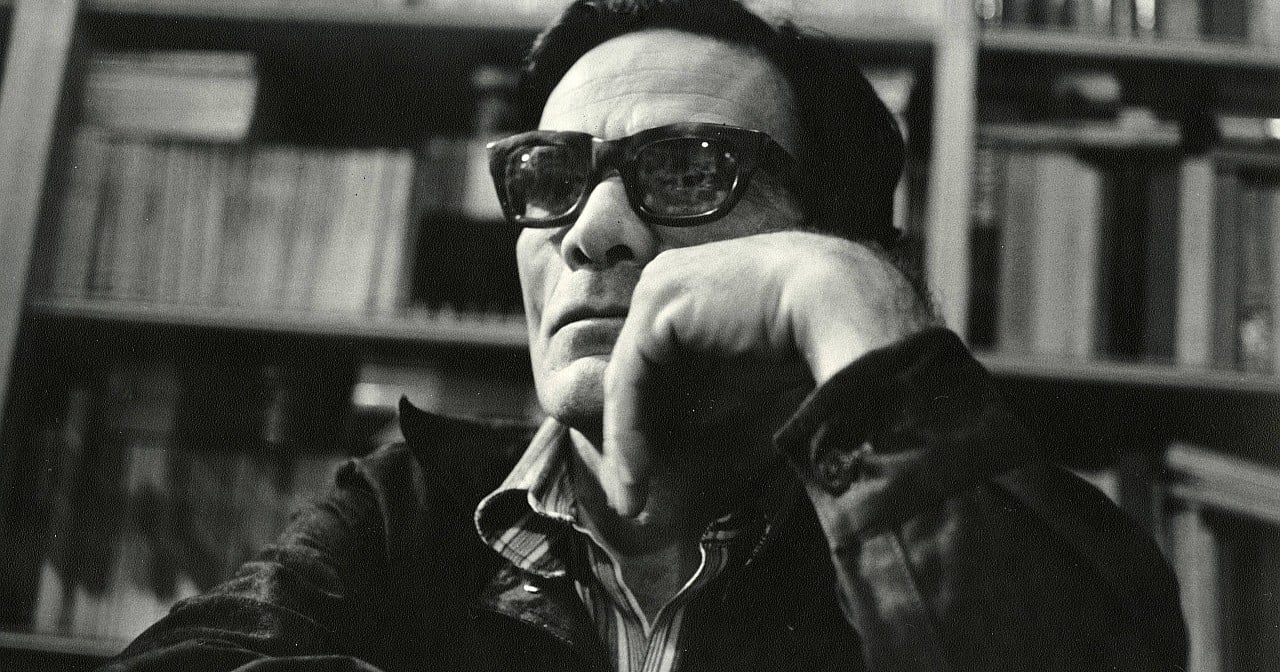
Pasolini was 53 years old. He was a poet, a novelist, a film director, a Communist, a Catholic, a homosexual, and a man who, with enviable consistency, refused to serve only one of these identities. He did not belong to any community so completely that he would have wanted to hide its contradictions. Precisely because of that he was uncomfortable. Perhaps that is the first lesson this deceased man leaves us: a society can live with its outsiders as long as they remain silent. They become dangerous when they speak.
Der Schwule, den die Partei nicht haben wollte
Pasolini was born on March 5, 1922, in Bologna. In 1949 he was expelled from the Italian Communist Party after accusations related to his sexuality became public. He lost his teaching post and moved to Rome with his mother. There began a new life—in the impoverished suburbs, among street youths, day laborers, petty criminals, and people who hardly appeared in the official telling of Italy’s economic ascent. It was a biographical exile that became a creative discovery at the same time.
In his 1955 novel Ragazzi di vita, Pasolini gave those youths a voice whose existence bourgeois society would have preferred to overlook. He described their poverty, their bodies, their sexuality, their violence, and their longing for life. He made of them neither moral role models nor mere victims. He saw people where others saw only a social problem. The fact that a homosexual intellectual had to leave the Communist Party because his sexuality was deemed a moral blemish was more than a personal slight. It showed how quickly political emancipation can reach the boundary of social norms.
The Gay Man the Party Did Not Want
Pasolini remained a Marxist, but he was not a dutiful comrade. He knew that a fairer society is not achieved merely by swapping the holders of wealth. If you want to free people, you must also question their notions of decency, masculinity, family, and desire. This makes him relevant for a queer public to this day. Not because he must fit into the categories of our present, but because even then he showed how tightly political affiliation can be bound to conditions—and how lonely it becomes when one refuses to accept those conditions.
Pasolini’s cinema begins where bourgeois self-satisfaction ends. In Accattone (1961) and Mamma Roma (1962) he portrays people living on the margins of Italy’s prosperous society. In The Gospel According to Matthew (1964) we meet a Jesus who does not appear as a comforting soft-spoken savior, but as a passionate preacher of an uncomfortable social justice. In Teorema (1968) the arrival of a mysterious young man is enough to dismantle the apparently stable order of a wealthy family.
Pasolini is interested in the moment when an order loses its mask. His outsiders are not saints. Their dignity does not lie in their innocence. It lies in their being human—with desires, flaws, contradictions, and a right to exist that does not have to be earned by moral scruples. Therein also lies a queer dimension of his work: the norm ceases to be a natural order of things and becomes a power relation. Who decides which bodies are desirable? Which sexuality is legitimate? Which way of life deserves respect? And who is excluded as soon as they refuse to answer? Pasolini did not answer these questions with a program for a happy life. He made them visible. Often painful, sometimes contradictory, always at risk of exposing himself.
The Bought Freedom
Today it is easy to dismiss Pasolini’s critique of consumerism as cultural pessimism. He distrusted the promise that prosperity automatically yields freedom. The new consumer society, in his judgment, destroys not only old ways of living. It also reshapes people’s desires. It teaches them what they should crave, how they should look, and how to measure their worth. He saw in this a new form of social conformity: not merely through uniforms, bans, or overt violence, but through advertising, goods, status symbols, and the promise of finally belonging. His thesis was radical: fascism could reappear without looking like its former self. A society can normalize people while selling them the feeling of complete freedom.
One does not have to share Pasolini’s dark diagnosis in every detail to recognize its relevance today. Queer visibility can itself become a commodity now. Companies adorn themselves with rainbow colors in June, while profit motive decides which forms of queer life are welcome. The gay man may be desirable as long as he buys the right products. The lesbian family may appear as long as it fits the right advertising campaign. The queer person is celebrated as long as they can be told as a consumable success story.
Of course, commercial visibility does not automatically amount to co-optation. It can create recognition, mobilize funds for projects, and open spaces that were long closed. Yet Pasolini’s question remains: who benefits from our freedom—and who defines its boundaries? Is it enough to be visible? Or must we also talk about who stays invisible, who cannot afford security, and whose bodies are still treated as inferior, deviant, or available? Pasolini would probably not have spared us a comforting answer. His strength was not in soothing us. It was in suspicion.
Wenn Menschen zu Material werden
In 1975, the year of his death, Pasolini directed Salò, or the 120 Days of Sodom. It is a film that cannot be consumed casually—and it resists consumption precisely because of that. In the Fascist Republic of Salò, youths are captured by those in power, humiliated, tortured, and sexually abused. The film does not depict violence as thrilling adventure or erotic liberation. It stages violence as a system: bodies are controlled, desires prescribed, people turned into material. The horror lies not only in the actions of the perpetrators, but also in the order that makes these acts possible and in the cold efficiency with which they are carried out. Pasolini relocates the violence of historical fascism into an allegory that points well beyond the year 1944. The rulers possess the power to dispose of other bodies. The victims are deprived of their self-determination. Humiliation becomes entertainment, cruelty becomes routine.
This is not a call to equate every form of capitalist exploitation with torture and murder. It is a warning against a way of thinking in which people are judged solely by their usefulness, market value, or availability. This is a message that a queer public should take seriously. The history of sexual minorities is also a history of others’ control over bodies: through criminal laws, medical coercion, social ostracism, and the idea that others may determine how we should live and whom we should love. Salò poses a question that no identity theory can answer alone: what happens when power no longer recognizes the other as a person, but merely treats him as an object?
A Dead Man, Many Open Questions
On the night of November 2, 1975, Pasolini was murdered in Ostia. Pino Pelosi, then 17, was convicted in 1976. He initially claimed to have acted alone, and he altered his account in 2005. The judicial proceedings and subsequent investigations have not dispelled doubts about the full reconstruction of the crime. To this day it has not been definitively clarified whether other people were involved and whether beyond the immediate motives political or criminal connections played a role. In November 2025 a renewed push was made to reopen the investigations. The applicants cited, among other things, newly reviewed footage. Such a request is not proof of a political conspiracy. It shows, however, that the open questions have not fallen silent.
It would be tempting to turn Pasolini’s murder into a complete conspiracy tale: the inconvenient thinker, the all-powerful backers, the hidden truth. Such a narrative would have a perpetrator, a clear motive, and a moral end. Yet that would not be appropriate for Pasolini. He demanded that reality be endured in its contradictions. We know he was murdered. We know that the investigations and the subsequent trials did not yield a universally convincing explanation of all the circumstances. We do not know definitively who else was involved or which motives, in detail, mattered. This uncertainty is not a license for speculation. It is a mandate for clarification. Because when the murder of a public intellectual leaves questions unanswered for decades, it concerns not only a artist’s worship but the trust in institutions, the safeguarding of evidence, and a state’s willingness to confront uncomfortable questions.
Pasolini himself had confronted Italian society with corruption, abuse of power, and the entanglements of politics and business. His unfinished novel Petrolio, published posthumously in 1992, delves deeply into the dark connections between economic power and political rule. That his death and his last investigations continue to spark new hypotheses belongs to the history of his reception—not to evidence for a particular perpetrator. The distinction is decisive. Those who take Pasolini seriously may voice suspicion—but must also be prepared to distinguish suspicion from truth.
No saint. No easy role model.
Pasolini was not a flawless hero. His relationships with young men, his comments on sexuality, his political radicalism, and his approach to the people he observed demand a critical engagement. Even his occasionally romanticized view of the simple people should be examined. To declare him a queer saint would therefore be a peculiar form of dilution. We would fit him into a new moral order—the very thing he resisted throughout his life. Pasolini was contradictory. He could wound, provoke, and be mistaken. And yet he was also an artist who gave visibility to the marginalized, denying it from bourgeois culture. His significance does not lie in the idea that we must embrace every one of his positions. It lies in forcing us to reassess our own certainties.
It is also one of the ways Pasolini differs from a portion of today’s political communication, which often translates complexity into factional allegiance. If someone is not clearly for us, they are deemed an opponent. If someone does not speak our language, they are sorted out. If someone identifies a contradiction, they supposedly threaten the common cause. Pasolini knew these mechanisms from both the left and the right. He understood that a movement can betray its promises of liberation if it fails to interrogate its own taboos. For queer people, this is not an abstract lesson. Our history is full of coalitions in which solidarity was conditional. We should therefore not only ask who has joined us. We should also ask which people in our own ranks have no place, and which forms of exclusion we are overlooking as long as they do not touch us personally.
What Remains of Pasolini
Pasolini died on November 2, 1975, in Ostia. More than half a century later, his films are not merely documents of a bygone era. They reveal a society that calls itself modern while clinging to old hierarchies; that promises freedom and rewards conformity; that celebrates the body and yet makes it a commodity. Pasolini’s Jesus preaches justice against the powerful. His city youths from the suburbs carry their dignity not as an accolade but as a fact of their existence. His Salò victims show where the power to dispose of people can lead. And his political prose reminds us that democracy requires more than a routine turnover of rulers: it needs public discourse, dissent, and the willingness to keep power in check.
Perhaps that is his real legacy for a queer present: not a call to always be more radical, but a duty not to settle for recognition alone. For freedom is not achieved merely by appearing in advertisements. Justice is not achieved merely by occupying the right institutions. And emancipation is not complete when the once-excluded learn to decide who must be excluded. On Ostia’s beach, a murder remains with incomplete circumstances. In theaters, libraries, and debates, a work remains that resists any final categorization.
Pasolini was not a man who sought to explain the world so we could go home soothed. He showed us what we would rather not see—and leaves us with the question of what we will do with it. That, more than fifty years after his death, is perhaps the most uncomfortable form of remembrance: not to erect a monument to the dead, but to deprive the living of an excuse. Pier Paolo Pasolini died on November 2, 1975. His questions did not.
The biography of the University of Bologna documents Pasolini’s expulsion from the Party and his turn to Rome’s suburbs; the Italian encyclopedia Treccani provides a thorough biographical framing. Le Monde’s coverage of Pasolini’s 50th death anniversary describes the open questions of the murder case; the news agency ANSA reported in November 2025 on a renewed petition to reopen the investigations.