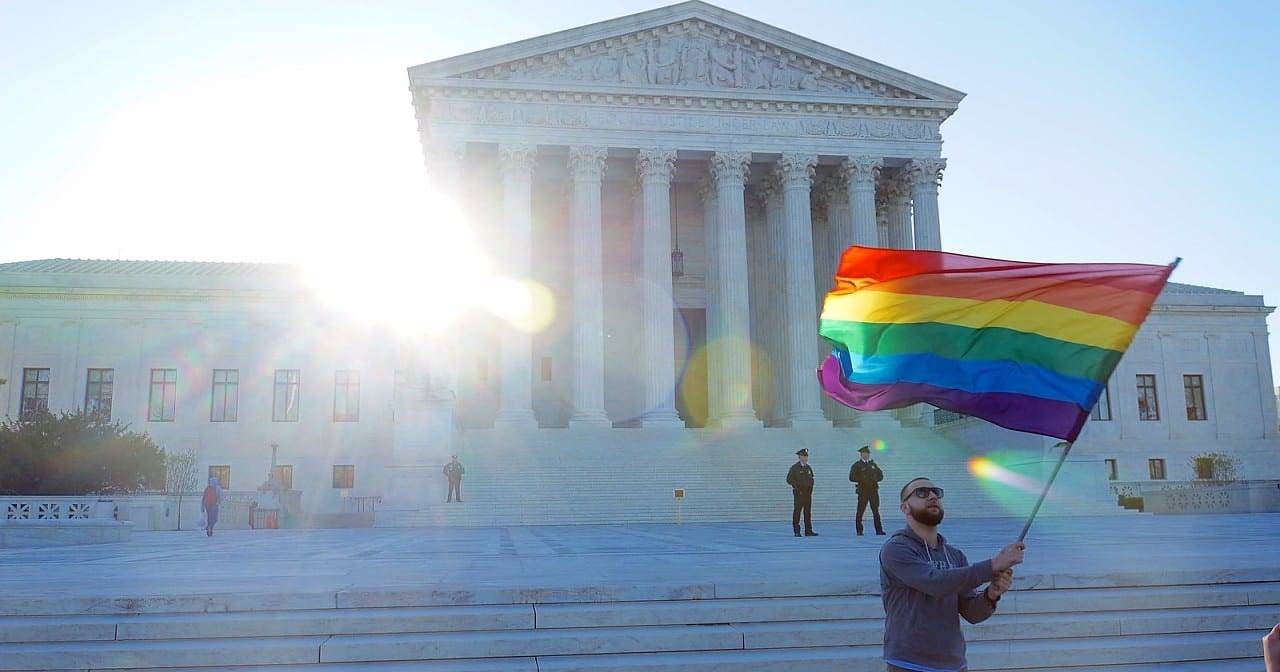
Should religious educational institutions be allowed to collect public funds while turning away children from queer parents? The Supreme Court of the United States began hearings on Tuesday in the case St. Mary Catholic Parish v. Roy. At issue is the clash between state anti-discrimination requirements and religious exemptions. The Court’s conservative majority signaled openness to the Catholic institutions’ challenge. A ruling is not expected until by the end of June 2027.
What the case is about, concretely: In 2023, the state of Colorado launched a state-funded preschool program. Private and faith-based providers could participate and, in doing so, also teach their beliefs. As a condition, the state requires equal opportunity in enrollment: facilities may not discriminate against children or families on protected characteristics, including sexual orientation and gender identity.
Two Catholic parishes and the Archdiocese of Denver sued against this requirement, without having even applied to the program. They argued that the conditions infringe on their religious liberty, since the admission rules for their schools require families to share the Catholic faith. After the suit failed in two lower courts, the Archdiocese took the case to the Supreme Court.
The courtroom clash
During the hearing, positions clashed sharply: Justice Sonia Sotomayor, appointed by Democrats, asked the schools’ attorney directly whether it would be permissible to reject children solely because their parents are gay. He confirmed that this would be allowed if it aligned with the school’s sincerely held beliefs. Sotomayor countered: Schools may teach their beliefs, but if parents choose to send their child there, the school must admit the child.
The Democratic-appointed Justice Ketanji Brown Jackson stated: “The school itself does not have to admit anyone it doesn’t want to admit. But if it voluntarily accepts state funds, those same conditions apply.” Elena Kagan, appointed by Barack Obama, also expressed doubts about the legality of such unequal treatment.
The Democrats on the Supreme Court are, however, only three, while there are six Republican-nominated justices. And those justices voiced much more favorable views toward the right to refuse admission to children with gay parents. Judge Brett Kavanaugh, a Trump appointee and practicing Catholic, pointed out that of roughly 2,000 participating preschools, only 34 were Catholic — queer parents could simply register their children elsewhere. Justice Amy Coney Barrett and Chief Justice John Roberts played with the question of whether the so-called neutral nondiscrimination clause actually disadvantages religious institutions.
Civil rights and LGBTQ organizations such as Lambda Legal, GLAD Law, and the Human Rights Campaign (HRC) support Colorado. They warn of a precedent that could open the door to state-funded discrimination. No one should be barred from a classroom funded by tax dollars simply because their parents are queer, Lambda Legal said.
The Supreme Court had banned Christianity-founded racism more than 40 years ago
The organizations point to the precedent Bob Jones University v. United States from 1983: at that time, the Supreme Court ruled that the evangelical Christian private university in South Carolina would lose its tax-exempt status if it continued to exclude Black students for religious reasons.
The university had argued that segregation was grounded in the Bible: God, it claimed, separated people by ethnicity in the story of the Tower of Babel (Genesis 11). It also cited Acts 17:26 — where the Apostle Paul is recorded as saying, “And He [God] made from one man every nation of mankind to inhabit the whole earth.” From these verses it was argued that “racial mixing” violated divine order. The Washington court, however, determined that the government’s interest in ending discrimination outweighed the religious doctrine of the university.
Recently, the Supreme Court, with its conservative majority, has nonetheless tightened the rights of queer people. In June, it upheld broad bans on transgender women and girls in school sports (TheColu.mn reported). The decision was 6–3, along party lines, with all justices voting according to their ideological allegiance. (dk)