Year 2020. Tim Walker is already one of Britain’s great photographers: for decades he has staged neon-bright fashion worlds for Vogue, photographed stars like Lady Gaga, Ian McKellen, and Harry Styles, and is famous for images in which reality frequently tilts toward the fantastical. One day, Walker strolls through London’s Highbury Fields Park and discovers a small commemorative plaque on a public building. It recalls 150 members of the Gay Liberation Front who, on November 27, 1970, demonstrated with torches against police harassment. Walker pauses when he reads the date: it is the day he was born.
“While I took my first breath, these people fought for my rights,” he would later note. The freedoms he enjoys today as a gay man, he owes to those demonstrators who, under the eyes of the police, held candles, linked arms, and kissed. Walker wants to know who they were and what became of them.
Thus begins the fairy-tale genesis of a project that six years later is on view in the National Portrait Gallery, in the heart of London. In the show “Tim Walker’s Fairyland: Love and Legends,” the photographer has photographed more than 250 people for his panorama of queer history and present. Among them are legends of British queer activism as well as well-known names from art, performance, and international show business.
Exploration of Queer History
That Walker calls his queer Gesamtkunstwerk “Fairyland” also takes him back to his own childhood. At five, his mother dressed him in pink overalls and fairy wings for a photograph. He loved fairies, elves, and goblins, their magical powers and their closeness to nature. Then he went to school and learned another meaning of the word: “Fairy” was a slur for gay men.
Walker hid, as he says today, a substantial part of himself — but never stopped believing in fairies. Now they’ve arrived at the National Portrait Gallery. Yet Walker’s “Fairyland” is more than a personal fairy-tale world. His encounter with the commemorative plaque for the Gay Liberation Front becomes the starting point for an exploration of queer history. Walker searches for people who fought for sexual freedom and equal rights, who shaped queer culture or who tested new ways of living. Among the portraits are the British queer activist Lisa Power, the musician and “Glad to Be Gay” singer Tom Robinson, and the writer Roz Kaveney, who once co-authored one of the first British manifests for trans rights.
Tim Walker’s “Queeristocracy”
Some of them Walker stages after the model of Hans Holbein the Younger and Nicholas Hilliard, who in the 16th century immortalized the powerful and famous of the Tudor era. His queer ancestor gallery, he jokes, is called “Queeristocracy.” Behind it lies a confident intervention in the canon: people who once had to resist state persecution and social exclusion now receive a place in a institution that has helped decide, for almost 170 years, whose image belongs to Britain’s national memory.
How serious he is about this is shown by a monumental circular portrait at the very start of the exhibition route. The actress and lesbian activist Liz Carr is staged as Elizabeth I. In school she was repeatedly nicknamed the queen because of her wheelchair; now she adopts that label, as she says, “in the most fabulous way.”
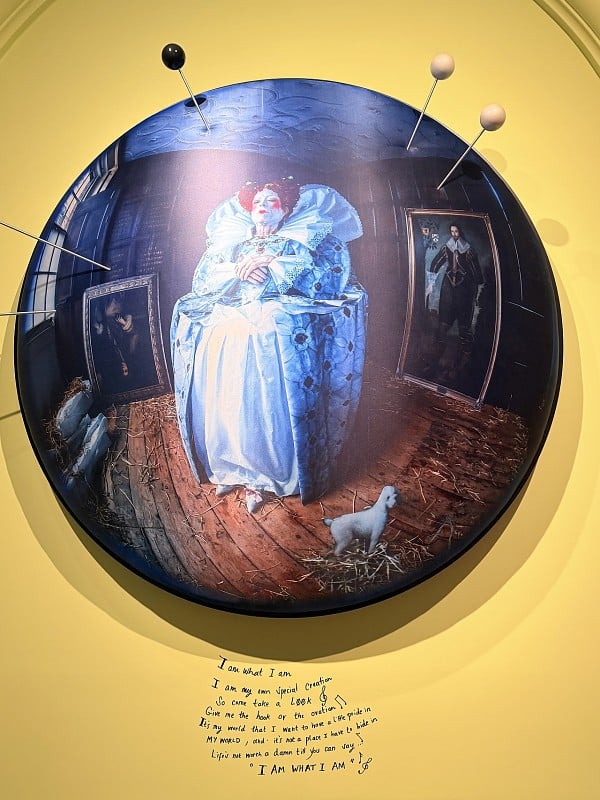
The shoot was planned to take place in a Tudor house from 1535. But the intended setting was not accessible to Carr’s wheelchair. So Walker had the entire room rebuilt in paper in the studio — including the dress, jewelry, and a small dog. The costume designed according to the historical model spills over Carr’s electric wheelchair. What began as a workaround becomes the program: if reality doesn’t accommodate people like Carr, he’ll build it anew. Beneath the portrait, as if scribbled, is the text from “I Am What I Am.”
“Dyke” as an Honorific
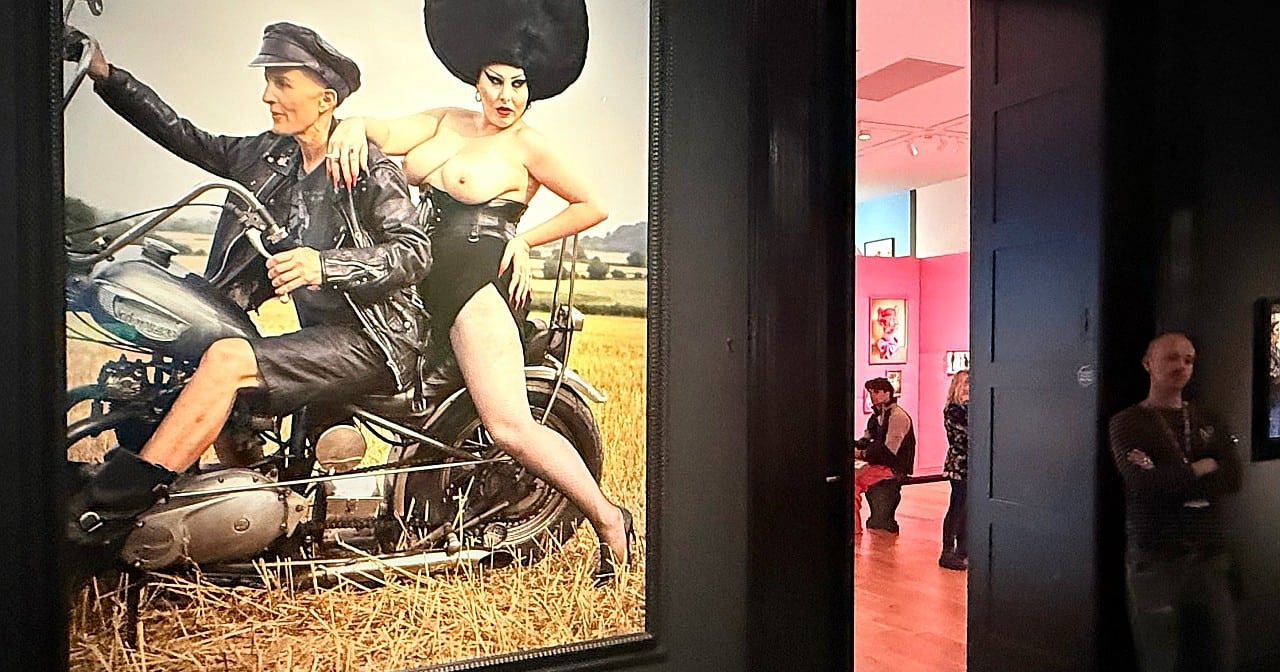
From afar, the large-format photographs in another room draw the eye — Walker has dedicated this space to the “Rebel Dykes,” a collective of lesbian women who in early-1980s London moved between punk, feminism, anti-nuclear activism, AIDS solidarity, and sex-positive counterculture. Walker is fascinated by their “unapologetic sexuality” — a sexuality that does not apologize or hide. The term “Dyke,” once hurled as an insult, is here reclaimed as an honorific. The poet Joelle Taylor describes the Dykes as “warrior women”: nonconforming, provocative, moody, sexy, and fashionably dressed. Bands of leather-dykes are said to have patrolled the streets. What outsiders took as a slur becomes a proud self-image.
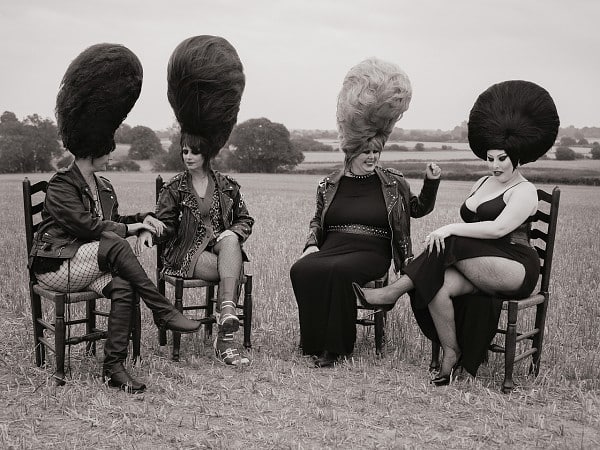
From here it’s not far to Camp as queer code: exaggerated, artificial, and playful in the way it pretends to be something else. Walker’s own past as a fashion photographer now looks at this lens as well. For a long time he felt ashamed of fashion’s supposed superficiality and searched for depth and truth — until, on a trip to Papua New Guinea, he observed birds of paradise and the elaborately adorned members of the Huli and suddenly recognized something familiar: fashion, transformation, disguise, performance, courtship — and the desire to be seen. “It’s about sex, shine and sparkle,” sums up Walker’s essence: “It’s about sex, shine and spark.”
The Right to Be Offensively Visible
Thus visibility, central to Fairyland from the start, gradually takes on a physical dimension. Walker tells queer history not only as a story of identity, discrimination, and representation. In museums, such narratives can sometimes become strangely sterile — as if the struggle for sexual freedom had ultimately produced only the right to be publicly visible. Walker resists such domesticated notions of queerness: for him, queer visibility also includes desire, fetish, sexual fantasy, and the right to be offensive.
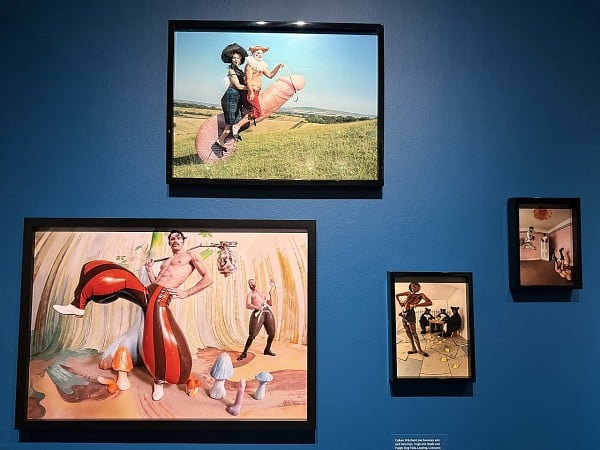
Consequently, the exhibition ends in a room recommended for adults only. Beth Ditto’s unashamedly opulent body crushes a man like a piece of furniture, reversing those infamous Allen Jones sculptures in which women become furnishings. Naked bodies, fetish, and sexual fantasies meet art-historical allusions from Lucas Cranach to Fragonard.
This is by no means a frivolous punchline of the show, but the consequence of its storytelling. Of the people Walker photographed for Fairyland, he has learned how essential erotics and humor are for queerness: “The sexual. The weird. The funny.” His Fairyland should be a place where you can see and be seen, desire and be desired.
Eventually Exhaustion Arrives
Overall, Fairyland is not an exhibition that even tries to maintain the slightest distance. Walker does not appear as a chronicler of a history observed from the outside. He is a devotee, a collaborator, and, not least, a beneficiary of the freedoms others before him won. That lends the show a confessional tone.
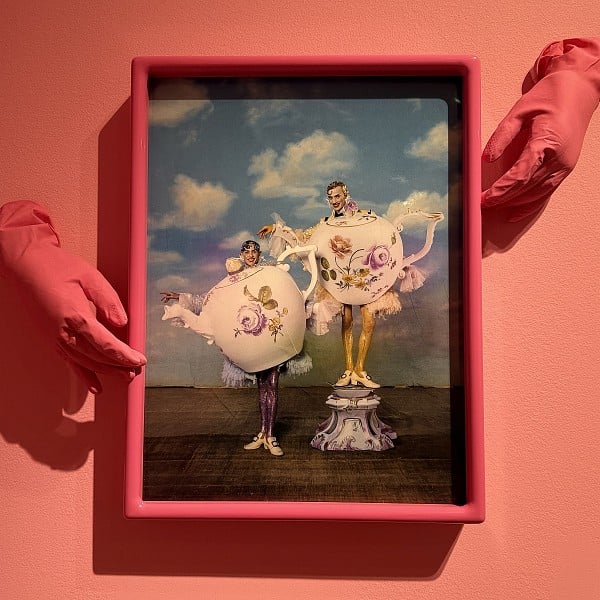
Perhaps that also explains its greatest weakness. More than 250 portraits, plus historical documents, personal stories, penises in abundance, and always-new fantastical stagings: eventually exhaustion sets in. Walker seems to leave no detail unmentioned, no fantasy unrealized. Sometimes less would indeed have been more.
On the other hand, perhaps less would be too little Tim Walker. “Fairyland” lives on an excess that defies any sober inventory. Maybe that excess is even part of the program: after a story in which queer people have to hide, withdraw, and make do with the space allowed to them, Walker now occupies as much room as he can possibly claim. And he does so, in the very sacred halls of the National Portrait Gallery.