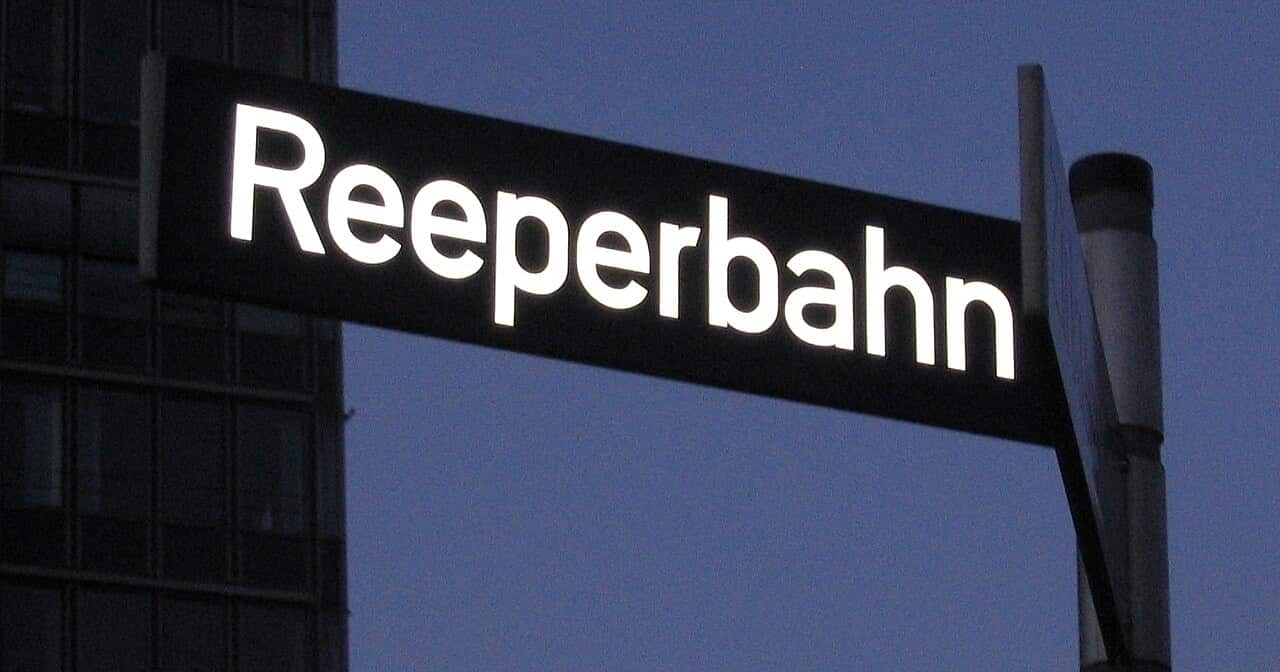
Where, in the past, ship rigging ropes were twisted along long stretches, today the Reeperbahn smells of kebab, currywurst, sometimes of stale alcohol, and always of the thrill of days gone by. By the end of the 1970s, Udo Lindenberg had already sung about the Reeperbahn as a “backdrop for a film that no longer runs.”
Nowadays Hamburg’s “most sinful mile in the world” is more of a party strip: touristy, colorful, glittering, with comparatively little red-light activity — but for St. Pauli locals it remains enough reason to celebrate the Reeperbahn’s 400th birthday in style.
Direct link
|
Back to the origins — how did it all begin?
As the starting point for the settlement on Hamburg’s hill, which today houses the St. Pauli entertainment district, district historian Eva Decker cites the arrival of the rope-makers in 1626. They had to leave the city at the time because of the construction of Hamburg’s wall fortifications. Between the then-independent towns of Hamburg and Altona they found space for their long ropelines used to make rope for ships.
Fueled by industrialization, by the end of the 19th century it had become a densely populated working‑class neighborhood, and the Reeperbahn — once a path between meadows and pastures — transformed into “an entertainment boulevard with an international audience,” the historian notes.
What does the neighborhood stand for today?
To find out, the association Living Cultural Heritage St. Pauli launched a survey. It’s still running, but early trends point to what is considered worth preserving on St. Pauli: “The majority says clearly, clubs and pubs,” says association chairwoman Julia Staron. There is broad consensus on the negative side as well: “This loud, over-the-top partying isn’t all that welcome.”
The red-light domain has not been named as something to preserve by any participant, but the survey offers insights into the living mood on St. Pauli. “When you dig into identity questions, we repeatedly encounter the word freedom — that all life paths are possible — and very often the word tolerance,” says Staron.
For FC St. Pauli president Oke Göttlich, the district remains a place of diversity. “St. Pauli has always been a place where different life realities meet: shaped by its history as a working-class neighborhood, but also by subculture and nightlife.”
Also his club bears that imprint. “Without the occupied houses on Hafenstraße, the club wouldn’t be what it has become: political and self-confident.”
Queer life on the move
St. Pauli has long been a space where people outside bourgeois norms found room. That mattered when people were persecuted by the state. The queer life around the Reeperbahn has changed over more than a century—from hidden gathering spots and persecution to visible subculture and commercial nightlife.
At the turn of the 20th century, when Paragraph 175 criminalized homosexuality, there were meeting places for gay men, often in back rooms or certain venues. Drag shows thrived there too. These spaces were fragile—queer life existed, but mostly in the shadows and without legal protection.
Under National Socialism, the scene was brutally repressed: raids, denunciations, and arrests were common. Many structures vanished or were driven underground. In the repressive postwar era, queer life persisted but was usually tucked into nightclubs or basements. With the AIDS crisis, these sex spaces declined massively, and political community structures rose in their place. Today there are still queer bars or clubs, but queer life has shifted more to other neighborhoods, especially St. Georg. Today, queer history is actively explored, via city tours or events like Queer History Month.
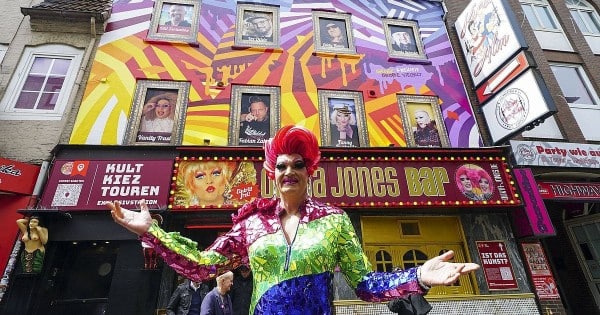
Who’s out and about on the Reeperbahn at half past midnight?
On “normal weekends in summer,” up to 30,000 visitors fill the district, says Kay Strasberg, head of the Davidwache, Germany’s perhaps most famous police station, who took over a year ago. “There are many incidents that count as crimes. It ranges from ordinary bodily harm when two people fight drunk to scams.”
>The audience ranges from sailors from a British warship docked in the harbor to bachelor parties in costumes or with beer bellies and tourists from all over Germany and abroad.
>Youths groups of up to about 80 people, hanging around the district because they can’t get into the clubs, pose a challenge at times, the police chief notes. “Because the potential frustration can spill into conflicts with bystanders.”
>Asked whether a visit to the neighborhood is dangerous, Strasberg’s answer is a firm no. But he offers guidelines: “Make sure you handle alcohol and other intoxicants responsibly and stay in control. If there are problems with paying or anything else, dial 110 or come to the Davidwache.”
Direct link
|
During the day you also meet many homeless people on the Reeperbahn. Their numbers have risen, says Salvation Army Major Mareike Walz, who tends to those on society’s margins. At the entrance of the old brick house on Talstraße, the neon sign “Jesus lives” directs the needy to the meeting café or the clothing pantry.
>For more than a century, the Christian free church has operated there under its own social mandate to help those in need. “In 1922 the Salvation Army bought the house,” Walz explains. Fifteen apartments are available inside for people who otherwise would not find shelter on the block.
>The gentrification is also noticeable in the neighborhood. Housing has become more expensive, “which I regret when people are pushed out of their homes because they can’t afford them anymore,” Walz says. She says new regulars keep turning up in their “holy halls” almost every week. “I’d say that has grown.”
>For football club president Göttlich, the social mix on the block is essential. “St. Pauli must stay a democratic, diverse, and solidaristic place where different people come together and meet,” he says.
Is the “Heart of St. Pauli” still beating in the right place?
Often the neighborhood is pronounced dead or maligned—”as if there is a downward spiral,” says Staron, yet she concedes that on some levels this is true, “when you think of kiosk overrun and all that Ballermann stuff.” For years residents have criticized the numerous bachelor-party groups and guided tours that roam the district.
Direct link
|
Economically, things are getting tougher on St. Pauli given high commercial rents, says the 55-year-old who also acts as the district manager for the Reeperbahn’s Business Improvement District. The neighborhood is “busier than ever,” yet “the revenues aren’t as strong as they used to be.” Small operators running a single shop and unable to smooth out seasonal swings are hit the hardest.
>In planning the 400-year jubilee, it became clear just how resilient this quarter is. Whether celebrities, artists, or subcultures— suddenly everyone showed up and started talking to one another, Staron says. “That’s exactly what defines the neighborhood. It’s like a perpetual motion machine: if you nudge it, the momentum becomes unbelievable.”
When does the party start?
The kickoff is a large “Reeperbahn Singsation” at Spielbudenplatz on Thursday, where as many people as possible will join in singing the Lindenberg anthem “Reeperbahn.” A colorful music and show program is planned, including the tapping of the first keg of the anniversary beer “Reep Royal” by Mayor Peter Tschentscher (SPD).
>”The opening event is like a signal shot,” says Staron, who helps coordinate the Reeperbahn BID’s efforts. For the rest of the anniversary year, a decentralized program is planned—concerts and rotating exhibitions spread across the district, both on and off the Reeperbahn. “We deliberately avoided making one big thing of it because this is about the small things everywhere.”