If you care about the non-heteronormative film and media landscape, you should sit up and take notice. Starting today through September 13, 2026, the Deutsche Kinemathek in Berlin—housed in its premises near the Stadtmitte subway station—presents the wonderful exhibition “Inventing Queer Cinema,” which explores not only the German-speaking but also the international history of queer cinema.
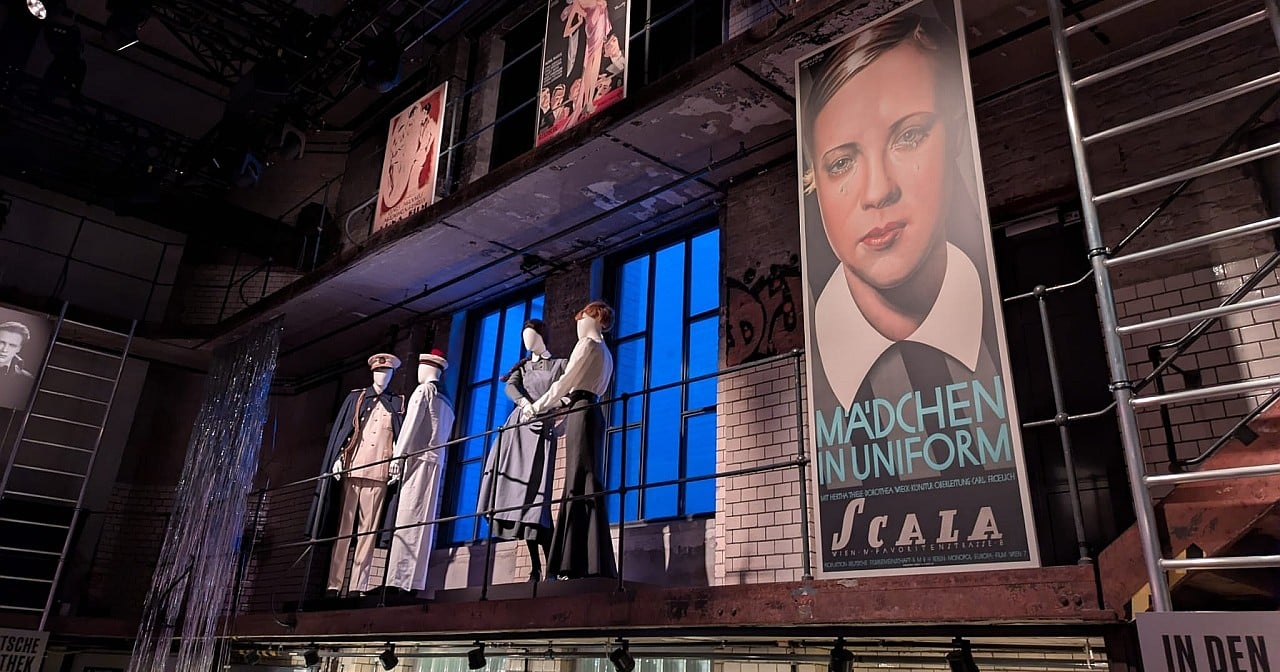
In a single hall, iconic, large-scale images as well as quotes and passages from more or less known films hang on the walls. Another installation offers a timeline spanning from the 1910s to the present. The purpose is not to present a strictly linear queer film and television history, but rather to invite free associations and to highlight cross-references.
First Lesbian Kiss on Screen in 1930
The history of queer cinema began over a century ago. In those early days, cross-dressing was a frequent device, for example in the German film Aus eines Mannes Mädchenzeit (Germany, 1913/14), in which a man disguises himself as a woman and pretends to be a maid. In Marocco (USA, 1930) with Marlene Dietrich, the first lesbian kiss appears.
A large moving-image panel is dedicated to the gay director Rosa von Praunheim, who recently passed away. His film Not the Homosexual is Perverse, But the Situation in Which He Lives (Germany, 1971), which premiered at the Berlinale and saw a nationwide cinema release, helped spark the formation of gay emancipation groups across West Germany. This film manifesto marked a breakthrough for Rosa von Praunheim, who went on to direct more than 150 short and feature films.
Queer Cinema Between Visibility and Censorship
Where early queer works like Richard Oswald’s Anders als die Anderen (Germany, 1919), with Magnus Hirschfeld involved, tended to unfold mostly indoors, newer works like Brokeback Mountain (USA, 2005) move out into nature and vast landscapes. Brokeback Mountain, directed by Ang Lee, tells a gay love story that became a major international hit and won three Oscars. The film was banned in China, Iran, Malaysia, Pakistan, and the Arab states—an aspect remembered by the exhibition as well.
Furthermore, a visitor can’t miss the fact that Tom Hanks won an Oscar in 1993 for Philadelphia for his bravery in portraying a gay character. During this period, the term “New Queer Cinema” established itself at international film festivals and in film criticism. Back then, A-list stars still worried about their reputations and the loss of opportunities. Today, a cinematic icon like Paul Mescal effortlessly navigates between sexualities. The star, made famous by the series Normal People (Ireland, 2020), now with ease crosses into queer terrain in titles such as All of Us Strangers (UK, 2024) or more recently The History of Sound (USA, 2026). A remarkable achievement.
Direct link | Trailer for the exhibition
|
“History of Resistance, Solidarity, and Innovation”
Since 2020, queer German films from a new generation, largely set in urban environments, have been screened at festivals and reached a broad audience. Films such as “Drifter” (Germany, 2023), “Futur Drei” (Germany, 2020), “Neubau” (Germany, 2020), and “Kokon” (Germany, 2020) thus describe an innovative queer sensibility.
“‘Inventing Queer Cinema’ tells a story of resistance, solidarity, and innovation that reaches into the present,” reads the Deutsche Kinemathek’s announcement. This must-see exhibition invites viewers to keep thinking about this history and to continually rediscover queer cinema. Accompanying the exhibition is a film program at Studiokino, which showcases influential works such as “Bent” (1997) or “The Celluloid Closet” (1995) as part of “Inventing Queer Cinema.”
The exhibition “Inventing Queer Cinema” is on view from May 7 to September 13, 2026 at the Deutsche Kinemathek’s new location in Berlin’s E-Werk (Mauerstraße 79). It is open Thursdays through Sundays from 10 a.m. to 6 p.m.