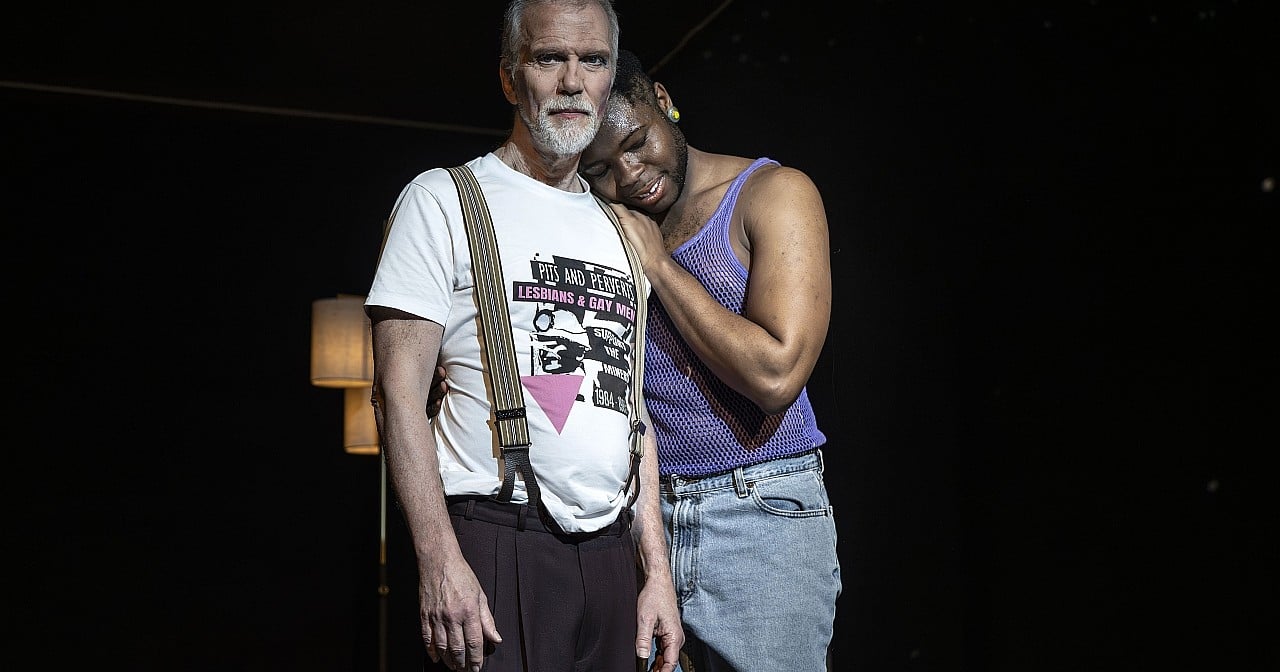
Just under two weeks after the Erfurt Theater’s big-house premiere of Charles Wuorinens’ “Brokeback Mountain,” Jake Heggie’s two-person music drama “For a Look or a Touch” arrived for its Studio.Box premiere on April 11: two operas with queer subject matter, as different from one another as could be. At Erfurt’s main station, the rainbow flag is flown, but queer venues have thinned out along the city’s corridor between Gera and Eisenach in recent years, almost to zero. That is why this programming choice is important.
Three years ago, the queer opera “Pleasure” was an interactive event
In spring 2023, Studio.Box staged the opera “Pleasure” by composer Mark Simpson, set in a queer club (TheColu.mn reported). For this event, Erfurt students received free admission and were invited to be party people in direct touch with the performers.
Malte Wasem, artistic director of Theater Erfurt, explains to TheColu.mn that for the current premiere pair of “Brokeback Mountain” and “For a Look or a Touch” in March and April 2026, there was no deliberate focal point planned. Another “queer production” is not currently planned. The pairing occurred by chance, since Mila van Daag and Markus Weckesser—the leadership tandem of Studio.Box—took up the opportunity to realize independent program content beyond the main house, and the share of contemporary works at Theater Erfurt is anyway relatively high. Indeed, the tight succession of two 21st-century musical-theatre pieces at subsidy-funded theatres regionally is noteworthy.
Queer Youth Piece
“For a Look or a Touch” is explicitly programmed as a youth piece for ages 14 and up and thus also as a weekday matinee in the Studio.Box. Jake Heggie composed a five-movement work in three versions (The Voice – Golden Years – A Hundred Thousand Years – The Story of Joe – Silence): as an opera (2007), for choirs (2011), and as a songbook or song cycle (2013). The Erfurt production runs twice as long as the Seattle world premiere.
A true story: Seven years after his contemporary classic operatic success “Dead Man Walking,” the American composer, with librettist Gene Scheer, drew on material from the documentary film “Paragraph 175” by Rob Epstein and Jeffrey Friedman, as well as the diary of Manfred Lewin (1922–1942) housed in the United States Memorial Museum in Washington, D.C., to depict his youth love Gad Beck (1923–2012). Mila van Daag created a realistic interior: a worn chair, a lamp with a busted shade, faded ceilings and an aging kitchen set. Behind it emerges the suggestion of a sexual act between two men—but “only” in the memory of the aging Gad. He longs for the earlier unity with the lover Manfred, who vanished from his life under drastic circumstances.
Contrasts pull toward each other in this retrospective: from 1933 to 1945, a single perilous glance and a touch could lead to arrest, internment in a concentration or labor camp, and only death or the end of World War II could release one. Time and again the mature Gad imagines his Jewish lover in various iconic transformations: as a defiant, life-affirming drag queen, as a lascivious androgynous figure, and generally as the incarnation of male allure. The coloratura baritone Alessio Fortune Ejiugwo grows into the grandeur of a Night King and shows no fear of unambiguous double meanings. A clearly queer stance, then, even in a youth piece.
As with “Brokeback Mountain,” this does not present a day-to-day harmony won through struggle; rather, it is a melodrama of urgent appeal. Stephanie Kuhlmann’s direction starts from a queer self-understanding dating to the 1980s, when wounds from the “Third Reich” never fully healed and new wounds reopened through stigmatization and the Gay Community’s blamed role in the HIV crisis. Even touches of nostalgia hint at a lifestyle that lent a certain glamour to any single apartment.
Daniel Minetti portrays the leaner version of the lonely college professor George Falconer in Christopher Isherwood’s “A Single Man.” As a guiding pedagogical beacon, he blossoms in the second half of the evening. After the war, there follows retreat into fear, trauma, and loneliness, then Stonewall and the abrupt (self-)liberation interrupted by HIV, leading to the fall of Paragraph 175. But Gad is fatigued and withers; Manfred, after his death, remains forever young, beautiful, and seductive. His memory shines with the same allure as before.
“Brokeback Mountain”: Not the love is off track, but the situation
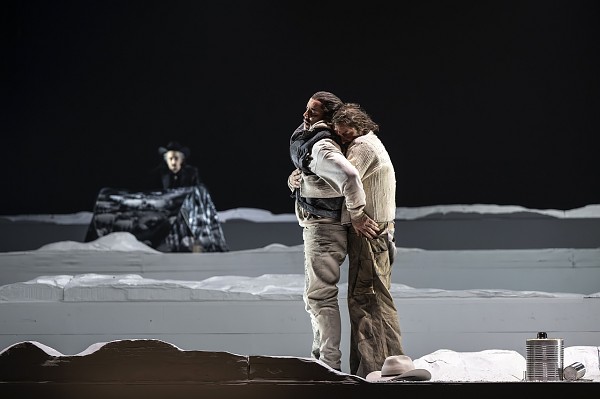
The late 2020s saw Charles Wuorinen—a composer who died in 2020—turn the fateful love of two ranchers into not a partisan melodrama full of affect but a stark study. Annie Proulx’s novella and its libretto provide a text with economy of words. Up to Ennis’ final outburst, the opera is a remarkable music drama of mute language.
Jakob Peters-Messer recognized this in his exquisitely carved production, with Hermes Helfricht delivering a really strong performance from the Philharmonisches Orchester Erfurt. Perhaps as important as the spare music are the pauses. Wuorinen withholds melody. His sounds resemble jagged ice and scaffolding, over which the characters grope for meaning and form in life. It was an enormous, demanding, and splendid evening for baritone Mate Sólyom-Nagy as Ennis Del Mar and tenor Michael Smallwood as rodeo rider Jack Twist. Pascal Seibicke styled both of them in outfits with a light, unobtrusive echo of the film’s Heath Ledger and Jake Gyllenhaal in the 2005 movie.
Sólyom-Nagy and Smallwood move in a notably different way; in the first part they are more restrained and subdued in the gradually building closeness and then in the explosive passion. The US life-reality accessories become props that the heterosexual characters must cling to. The male-love world, mostly rendered in dark tones with sharp realist touches, only at the end becomes the uncompromising synthesis of angular suppression and hazy compassion.
The queer community needs a strong journalistic voice — especially now. Make your contribution to support TheColu.mn’s work.
While film relies on close proximity between performers and camera, the Erfurt staging employs a considerable distance between audience and stage. Physical touches are usually restrained and never carried out with the explosive inner impact they would have in other contexts. Sólyom-Nagy and Smallwood articulate themselves more with vocal force and declarative clarity than with delicate physical tenderness or self-destructive bursts of violence.
The Erfurt production does not moralize, it does not appeal, and it does not erect moral reckonings from a present that has not yet overcome all exclusions against queer life. Unlike a few years ago, erotic scenes are no longer staged as a confession of openness and tolerance with exclusive emphasis. Queerness now also serves as a theatrical sign to depict exclusion in general. The audience absorbs the depiction of a queer relationship within restrictive social systems with the same nonchalant acceptance as “Romeo and Juliet” or “Aida,” aside from a few who leave early.