Stonewall stands for many things — it is at least a starting signal in the Gay Liberation movement, where fear gave way to self-confidence and hiding to visibility. Stonewall is regarded as an icon of a queer, now mythically overlaid success story. Yet, faced with backlash and rollback, the question remains: how secure is what we have achieved?
The history began in an era of criminalization and persecution, of social ostracism for queer people, and it aimed for emancipation and the right to live a self-determined life as a major goal. Beyond the myths, there are the facts, eyewitness reports, and some photographs from the days of the 1969 uprising. What was new, certainly, was that the resistance to police brutality was taken to the streets and made loud and visible.
Stonewall — a bar uprising in the New York City neighborhood of Greenwich Village with many interpretations and meanings. Who owns Stonewall? The gays, the lesbians? That is at least what the interpretive mainstream would have us believe. And nobody else? The “bad kids” from the trans corner were almost instantly erased from memory, even though they were right at the front, took bloody noses, and sat in prison for their resistance.
Stonewall as “a closed men’s world”?
Just now a new book has been published by C. H. Beck Verlag that aims to illuminate a moment and its impact: “Come out!” — the rallying cry of the protesters at the time against police arbitrariness and their mafia-like tactics, and the title of the book written by Thomas Sparr. He is the author of numerous books, serves as Editor-at-Large for Suhrkamp Verlag, and adds his own gay biography to answer the question, “How the uprising on Christopher Street changed the world.”
For Sparr, this is a predominantly, expressly gay world. Even if at one point he writes: “Stonewall often appears to us as a closed world of men. That is not entirely false, but it is not entirely true either.” In fact, that statement is pretty much all wrong. The question of numbers is hardly the point.
Gays and lesbians (in this order) were, of course, the largest groups in the queer community, which in 1969 did not yet call itself that. But that should certainly not be a reason to neglect the margins and the in-betweens. On the contrary. That Sylvia Rivera at least receives an appearance in the essay is commendable and at least acknowledges her role in those energetic New York days.
No progress on gender issues
Nevertheless, the stiff phrasing of “she/he”, “her/his” wherever the author speaks of Rivera, as if we hadn’t already moved further in gender questions (not least within the community, I thought). And then this: “dressed like a white woman, but in reality — in which reality? — a man from Central America in a woman’s dress. A Drag Queen.” Sylvia — a Drag Queen? The “in which reality?” question doesn’t help, because apparently there is only one reality for the author, just as there was only one reality for the brutal police and apparently for large portions of the gay-lesbian community.
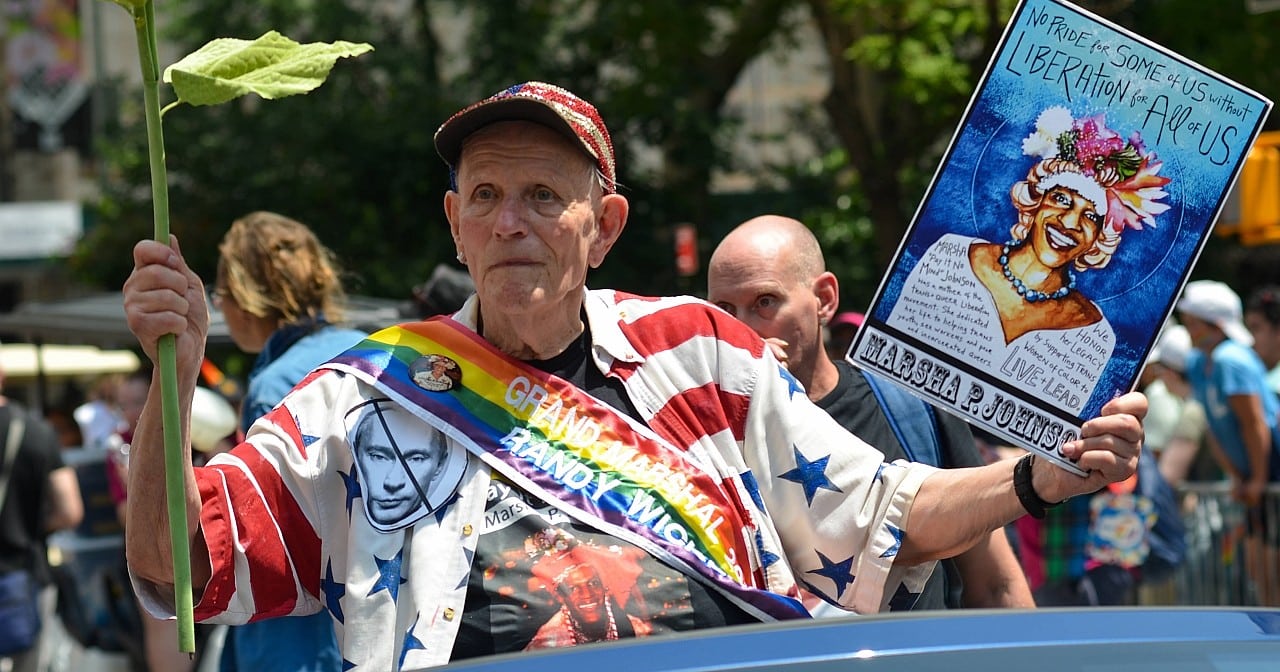
Rivera had every reason to accuse the gay movement of 1973, four years after Stonewall, of expelling her from Gay Liberation. A tragedy of unparalleled scale. It is striking, however, that Marsha P. Johnson was not even deemed worthy of a tiny mention. After all, one could tell the story of the social engagement Sylvia and Marsha built almost from nothing for at least a short time. I mean the self-help project STAR — Street Transvestite Action Revolutionaries. There was at least a part of world-change embedded in that intention — and trans liberation as well. Does that not count?
It is true that Sparr emphasizes Stonewall only became a revolution in hindsight, not at the outset. Peter Hujar, the photographic documentarian of the queer community in the 1970s and 1980s, captured the events in images and, so to speak, gave us Stonewall’s visual language: “The uprising of the provocative became a joyful demonstration.” A model also for what we later came to know as the Pride parades. And it is true that Germany lacked a Stonewall, but the gay and lesbian movement nevertheless picked up speed in the 1970s, with the trans movement unfortunately arriving only in the 1980s.
The queer community needs a strong journalistic voice — especially now! Please contribute to support TheColu.mn’s work.
Extensive cultural knowledge
To be precise, Stonewall reached Germany ten years late, since only in 1979 did the first Pride demonstrations begin here, which in the major cities have since grown into massive events where one starts to wonder whether the political dimension hasn’t become sidelined by too much celebration. It’s worth noting, of course, how politically active the CSDs are in the provinces here, as they have to stand up to a strong far-right front.
Despite all the criticisms of the essay, which elegantly moves through large leaps in time—from 1969 to 1979 and 1989, and onward into the present as part of the queer success story—there remains a substantial amount of cultural knowledge to acknowledge. The literary scholar Sparr shines — and he is allowed to lay it out in detail — with his rich knowledge of gay literature in which names like Hubert Fichte or Horst Bienek are of central importance. But it’s, again, only gay literature being given a voice here.
In the AIDS chapter Sparr rightly notes the absence of a cultural history of AIDS, which still does not exist. But this task would not be insurmountable; after all, the academic research enterprise has ample experience with interdisciplinary work. Surely it’s a matter of money, and probably also of interest in examining the state and societal failure that was laid bare during the AIDS crisis, with all the harsh, dehumanizing prejudices against homosexuality.
Stonewall cannot be explained by the gay movement alone
No matter how many events and names Sparr mentions—whether Heiner Carow’s East German film “Coming Out” from 1989 or the 1984 affair surrounding General Kießling from the Bundeswehr, accused of homosexuality, whether the registered partnership at the turn of the millennium or Klaus Wowereit’s coming out with the famous words “and that’s a good thing too,” whether the legendary “Eldorado” exhibition at the Berlin Museum with initial protests or whatever else—great as these are, they do not change the fact that this essay remains centered on gay experiences. This is by no means the entire (changed) world.
Perhaps it would have helped the essay if the author had followed the perspective put forward by the historian Scott Bravman quoted in the book, who stresses three key moments of Stonewall: first, the anger that would not end, then the realization that the private is political (a feminist motto), and finally, the role of queer spaces, in this case the bar as a space of mutual support.
Identifying and reconstructing these three lines in queer history as essential aspects of the social relativity of LGBTI might have yielded more diversity and, above all, answered why this “anger” was needed and remains necessary, why resistance exists and persists, and finally, what immense significance community spaces hold. Stonewall cannot be explained by the gay movement alone. And it does not fully explain how the world changed when we began to demand sexual and gender self-determination.
Seen this way, the book is, unfortunately, a missed opportunity.
Thomas Sparr: Come out! How the Christopher Street uprising changed the world. 208 pages with 22 illustrations. Verlag C.H. Beck. Munich 2026. Hardcover: 24 € (ISBN 978-3-406-73440-3). E-book: 20.99 €