Queer art is currently enjoying a boom in Berlin. Barely has one exhibition opened when another topic arrives on the scene: at Martin Gropius Bau, after Peter Hujar’s photo works, the next focus is queer art in the DDR, which can now be visited at four venues in the Berlin district of Mitte. And now it is the Georg Kolbe Museum in the Berlin Westend that shines a spotlight on the work of the British artist Marlow Moss. Accompanying the exhibition are works by contemporary artists.
We enter the grand hall of the museum, which once served as the studio of the sculptor Georg Kolbe, and we behold exquisite, gold-gloss sculptures — here a brass-polished stele with small octahedra stacked like a slender folded crystal rising toward the sky. Over there are two gleaming spheres and a cone, balanced on a rough-grained granite surface.
Right before us is an object that appears to be a white stone band woven into itself. And there stands a steel construction with a rust patina, looking like a bizarre, skeletized bird — impressive and formidable before us.
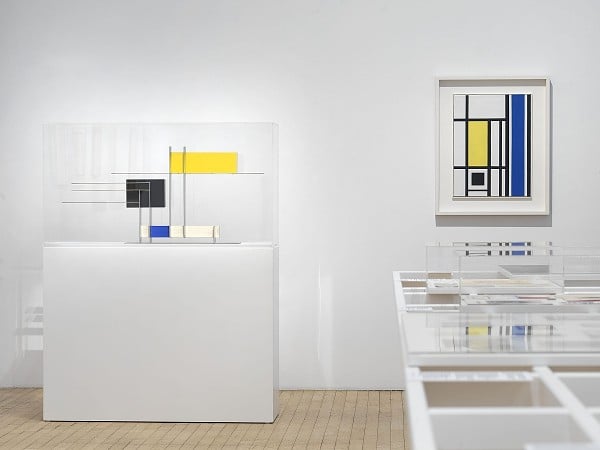
The sculpture is only one part of Moss’s artistic output; the other is painting, and in some works the two converge: room-filling sculpture and constructive principle, combined with fields of color. For example, in Moss’s work titled “Relief” from 1957, the painting and sculpture engage in a dialogue. Words that come to mind are noble, sublime, distant. The distance of this abstract art, which presents itself so concretely (it does not claim to be anything other than what it is), seems almost encoded in its very genetics.
The Invention of the Double Line
When it comes to the paintings, many viewers will likely think first of the Dutch artist Piet Mondrian, with all those paintings sparsely traversed by lines and color fields, like small cut-outs of some colossal structure. As if someone had cut out a world made of geometry into squares and rectangles to present us with a kind of building kit or puzzle.
In truth, Mondrian and Moss knew one another; they were friends and exchanged ideas about art. Moss contributed a crucial element to Mondrian’s constructive painting—the double line. It is, if you will, a Moss invention. This is something that art history has occasionally overlooked, but the “patent” clearly belongs to her. We see that in art, discussions about lines can be contested and may even clash.
A Butch as It Reads in the Book
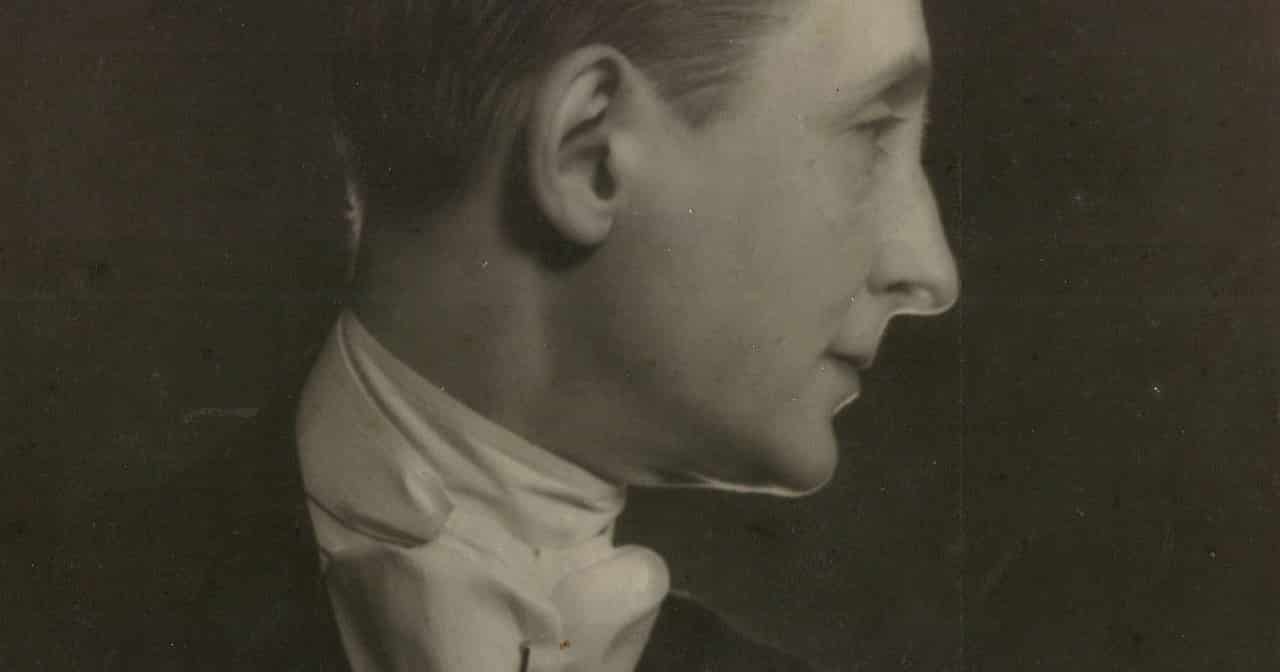
One might ask readers what exactly is queer about this. The answer is not straightforward, and it goes like this: nothing of queer-ness resides in line, geometry, or color (despite the symbolic force of color); but — and this “but” must be written in capitals — Moss’s artistic practice includes a third dimension: the person herself. She was, if you will, the dapper, performative edge of her art.
She chose her own first name, born in 1889 in Kilburn, London. That choice constituted a clear statement about gender-queer identity. She wore a short hairstyle, a men’s suit, a stylish tie, an attitude that exuded masculinity in her bearing. She was a lesbian and lived at times with the Dutch writer Antoinette (Netty) Nijhoff. Moss was a butch in the true sense, and she did this in a time that could still be quite dreary and conventional. Her self-confidence was undeniably powerful. She died, by then recognized as an artist, in 1958 in Penzance, Cornwall.
The queer community needs a strong journalistic voice — now more than ever! Do your part to support the work of TheColu.mn.
Fragmentary Record of Moss’s Oeuvre
Much of her work was destroyed, lost, and disappeared for good. The Dutch artist Florette Dijkstra refused to accept this fate and set out to trace the fragments. Old photographs helped her expand Moss’s catalog of works with all the losses. She carefully documented everything in delicate pencil drawings, which are on view in the exhibition.
Also included in the show are works by Leonor Antunes, who in one gallery stretches ropes between ceiling and floor to form walkable structures in space. Tacita Dean is fascinated by placing small ship models in bottles. A large glass-reed-like bookshelf lines up objects, one after another. And Ro Robertson has studied Moss’s avian-inspired sculptures and combines pointed metal triangles as if they were wings spread in flight, frozen mid-leap.
There is thus a lot to see — but the focus remains on the rediscovery of a fascinating queer artist. The exhibition continues through July 26, 2026. Even the location itself, the Georg Kolbe Museum, is worth a visit and a recommendation for people who have not yet had the pleasure.