Mister Mars-Jones, before we get to the substantive questions about “Box Hill” and “Pillion,” which order do you recommend? Read the book first and then watch the film—or the other way around?
I think that those who see the film first can be surprised or even shocked again by the book’s unexpectedly unfolding events. Those who watch the film after reading the book might instead feel that my “vision” of the story has been “misappropriated”—though I don’t personally feel that way.
Is “Pillion” a film that would interest you even if you were not the author of the source novel?
Hard to say. When I watch films with gay themes, I’m generally more critical than usual. But I suspect the warmth of “Pillion” would win me over.
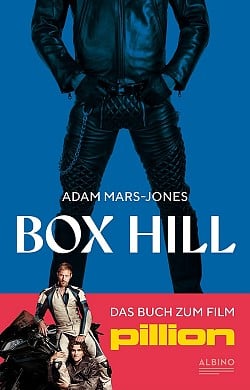
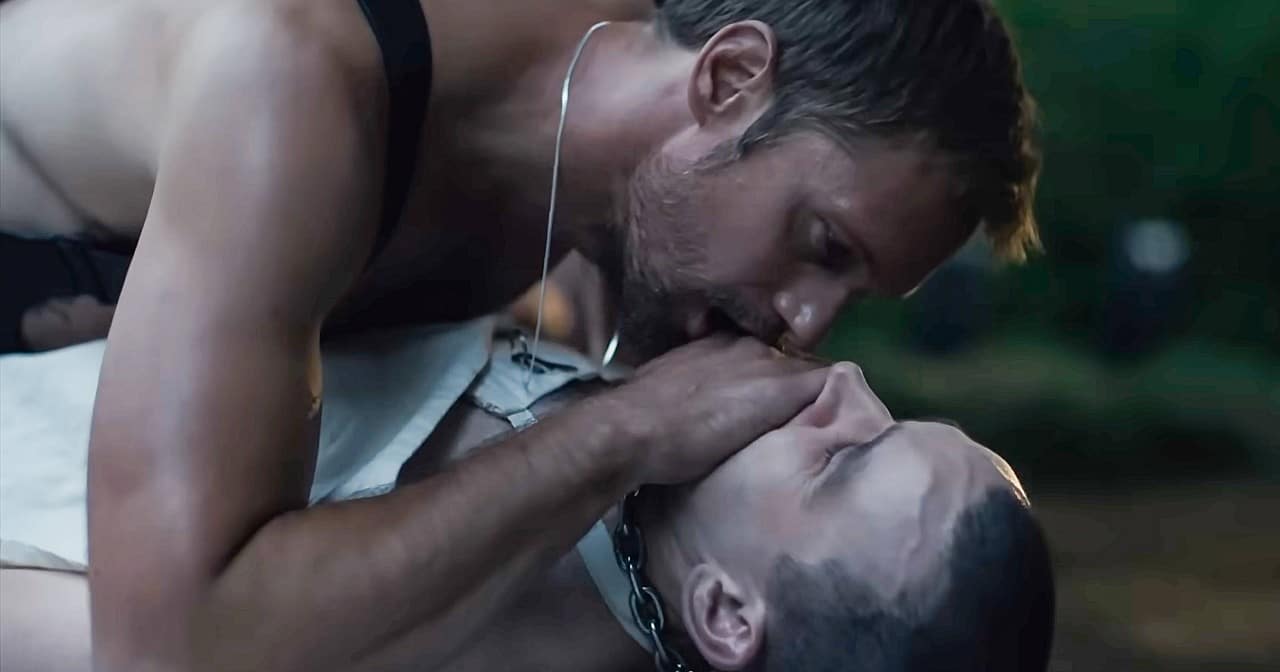
The film and the book both explore the sub-master dynamic between a young man named Colin and a considerably older, very handsome biker Ray. Yet the story is told in notably different ways. The film is regarded as a romantic comedy and concentrates on Colin’s self-discovery. The book broadens the arc by including Colin’s retrospective reflections as an adult. Could you describe your original concept for the story?
I’m a fan of Nabokov’s Lolita because the novel resists a single, unambiguous interpretation of the relationship it portrays—as abuse drama or as a tale of misguided passion. The idea for Box Hill was to write a similarly uneasy read, and to let the extremes of interpretation collide in the same paragraph or even in the same sentence. Contemporary Anglo-American culture often asserts the authority to judge whether relationships are healthy from an external vantage point, while also insisting that individual subjective experiences must not be ignored. My aim was to juxtapose these incompatible principles. The literary critic I. A. Richards once said a book is a “machine with which one thinks.” It can, however, just as well be a machine against which you think.
Which core ideas from “Box Hill” do you find echoed in “Pillion,” and which, if any, do you miss?
Regarding the dialogue, only a fragment was carried over, but a very important one: “What should I do with you?” “What you want.” Otherwise, in the novel Colin is initially 18, and his parents are a caricature of a happily equal partnership until an illness disrupts the balance. The relationship between Colin and Ray, however, is based on inequality from the start. Making Colin a bit older in the film necessitated a shift in the family dynamic. The father comes off as rather subservient, which in the context of the marriage seems normal or hardly noticeable. I liked that.
In the novel I enjoy the scene in which Ray cleans his motorcycle while Colin watches him and longs for Ray’s attention—until he finally realizes that he already has it. That it’s Ray’s way of showing attention through neglect. It’s a scene in the book I find quite cinematic, and it also appears in “Pillion.” Harry (Lighton, director of “Pillion,” ed.) told me that at first he considered letting Ray smile knowingly in that scene, without Colin seeing it. In the end he chose to stay entirely with Colin’s perspective, which I find plausible.
All in all, writing is an implicit medium that engages with the inner mental life of people, whereas film is an explicit medium defined by outward portrayal of events. David Lean once claimed that in his film The Great Passion he managed to film the thinking process—in a scene where Claude Rains’ character, upon arriving at the hotel, wrongly assumes his wife is having an affair. The sequence works very well, thanks in large part to the great actor, but I don’t think Lean’s claim is accurate. In books, such moments occur dozens of times on every page, without it being worth mentioning.
How did you experience the development of the film project? Was it a late triumph because it’s the first of your thirteen books to be adapted? Or was it more of a disorienting experience to hand the material over?
I’d say it was a surprise that gradually gained momentum. When the film rights to the novel were sold, I didn’t attach much significance to it. I understood there was a big demand for stories in the world of streaming platforms, which leads to many books being optioned—even if none of mine had ever been. As the project took shape and Harry told me about the changes he planned for the screenplay—timeline, cuts, the hero’s age—I assumed there wouldn’t be much left of my book. Even when the news came that well-known actors were interested in the lead roles, I didn’t expect much. As a British writer, you learn to keep your expectations low.
Besides writing, you also work as a film critic. Has that professional background helped you view “Pillion” more neutrally? And did the critic Adam Mars-Jones have a different take on the film than Adam Mars-Jones, the author of “Box Hill”?
I don’t have a particularly vivid visual imagination, so I don’t think in images. That means I don’t have a concrete picture of Heathcliff or Juliet from Wuthering Heights the way I do Colin or Ray from Box Hill. It makes it easier for me to accept directorial choices. If I watched “Pillion” without having contributed the source material, I would probably find the film—its blend of confrontation and accommodation—slightly odd but endearing.
In a Guardian article you wrote last year to mark the Cannes premiere of “Pillion,” you point to two gay writers as reference points for the tonal range of “Box Hill”: Alan Bennett and Jean Genet. Do these voices generally represent the range of influences on your writing?
It’s really two voices, so opposed that they won’t ever harmonize. I don’t really see them as influences. I read Joyce’s Ulysses when I was seventeen and realized what literature can do—and that it isn’t only the subject that decides the final outcome. I studied classical philology, not English, and that book was a revelation. I initially read it to have arguments against someone who, as I first thought, overvalued it, but it pulled me in completely.
In your early career in the eighties you worked on the AIDS anthology “The Darker Proof: Stories from a Crisis” with the gay American writer Edmund White (1940-2025). How did that collaboration come about, and how would you assess White’s literary legacy today, almost a year after his death?
Before the book, we had both written a story dealing with AIDS, and given that we belong to different nationalities and somewhat different generations and have different antibody statuses, I thought it made sense to deepen the subject. As for me, I don’t think my stories from back then show me at my best—the pressure to contribute culturally isn’t always productive—but Ed managed to adapt his brilliant style to the changed gay world. Temperamentally we were completely different. Ed thought, for example, that my creativity was blocked because I didn’t write every day—or every month or every year. He was far more disciplined in that regard, while I seem to rely on luck and, on good days, sharpness to push through. As for Ed’s work, I admire several of his novels, especially the ones set in historical periods like Fanny and Hotel de Dream. I could neither relate to his memoirs nor his later novels.
For your generation and your writing, AIDS is a major theme. Is it disorienting for you today to engage with the PrEP generation—for example in projects like “Pillion,” where the relationship between Colin and Ray is contemporary while the plot of “Box Hill” is set in the 1970s?
AIDS is a huge topic. When writing “Box Hill,” it helped me to place the story in the pre-AIDS era. The present timeframe in Harry’s adaptation allows the same approach. As for my personal contacts, I always assume there’s a gulf, perhaps an abyss, between me and younger people, whether gay or straight. So I’m always pleasantly surprised when we find common ground. That Harry and I got along without issue isn’t surprising, since I never set conditions, and I didn’t even ask to read the screenplay in advance. My book may have served as a mental springboard for him, but what he did with it is entirely his own. I find Harry’s confident handling of people older than him quite remarkable. He recently wrote to me calling me “Sweetcheeks.” Since then I’ve imagined that among younger people, that term would be the equivalent of “esteemed older colleague.”
Both “Box Hill” and “Pillion” depict the sexual rituals and customs of the gay kink scene quite explicitly, without denying their absurd and humorous aspects. Is it easier to tell sex with humor?
In the subculture I invented for the book, there are a lot of silly exaggerations. For example, Colin may not touch the motorcycle because it outranks him in the hierarchy. It has, in effect, the status of a person. If you’re familiar with the real biker world, you’ll recognize it immediately as a parody. Subcultures don’t ignore norms; they simply invert them in a systematic way.
Generally, the sex in “Box Hill” and “Pillion” isn’t meant to be purely sensual or purely sadistic. In the film I find it a bit odd that Colin talks about his “high pain tolerance.” Ray treats him as his possession, and why would you harm your possession? On the other hand, in 1980s Britain, within the frame of the so-called “Operation Spanner,” members of a group practicing BDSM were arrested and charged for consensual activities, even though their extreme practices didn’t lead to hospitalizations or basic medical care. They were told their bodies were not private property but to be used within the boundaries set by the state—or, as I suspect, in the sense of the Queen whose name the judgments were carried out in. It’s legal to punch someone in boxing, but not to clamp your testicles in a vise if you want to. Compared to that, the world of my book seems relatively innocent, even if the roles aren’t negotiable there—except on Colin’s birthday.
But to answer the question: I believe the humor in the book acts as a destabilizing force, while it serves as a common ground for the film’s audience. I should note that Harry sees it differently.
Has “Pillion” changed your view of “Box Hill”—whether in terms of the story’s potential or its interpretive possibilities?
In the book there’s a line about Ray’s relationship with Colin: “Mutuality was something he could not handle.” The dynamic between reader and author is, in a sense, equally asymmetrical. The author appears to hold all the power, but without the reader’s engagement nothing happens. Even before the film, I noticed that some readers of “Box Hill” find more depth than I thought I had put into it. That doesn’t mean they’re wrong. Writing isn’t a fully conscious process, even if many writers would like to believe it is.
“Box Hill” as well as many other non-heteronormative photo books, novels and DVDs is available, among other places, at Salzgeber.Shop.
Adam Mars-Jones: Box Hill. Novel. Translated from English by Gregor Runge. 144 pages. Albino Verlag. Berlin 2024. Hardcover: 24 € (ISBN 978-3-86300-375-3). E-Book: 17.99 €