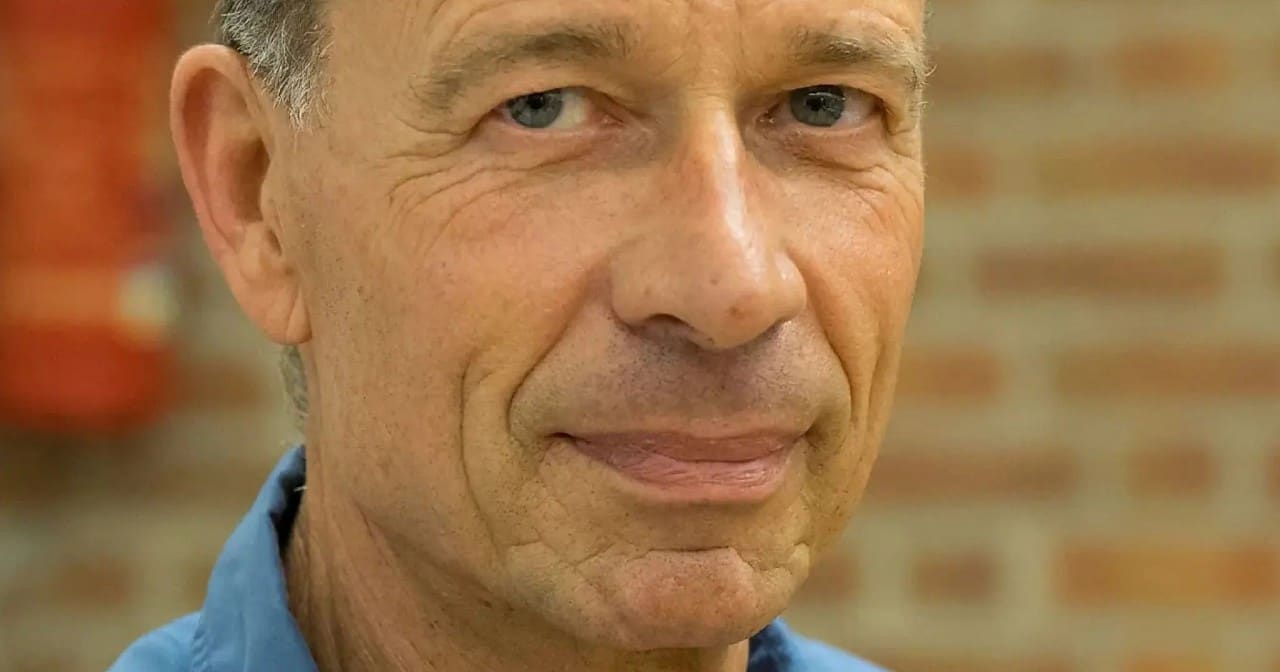
“The Wide World” (Amazon Affiliate Link) is the closing novel of Lutz van Dijk’s autobiographical two-volume chronicle of his life. Part one, “Someday the Wide World,” depicted a child and teenager growing up in a mute, post-fascist West Berlin outer district (Lankwitz), gradually discovering his homosexuality and becoming politically engaged. Yet Berlin felt too small—a peculiar island enclosed by a wall. The first part ends with his escape to the United States.
The second part, published in early March, opens in 1974 with his arrival as an 18-year-old in New York—nearly penniless and without a place to sleep. Through a campus employment agency, the narrator lands a job—the work permit he managed to wiggle out of thin air—driving a bus outside of New York. In Bushkill, a tourist town, he confronts the realities of conservatism and racism, but earns his first dollars nonetheless.
A Lover for Fantastical Nights
Back in New York, he finds with Bob a lover for fantastical nights. He writes his first gay love poem. He feels the pull to move on. He meets the Buster family in Texas, works on the farm, and cares for the severely ill daughter. The conservative family opens its heart to him and envisions in him the son they never had. But: “I can’t be a son for you. I am searching for myself and for others who are like me. I am gay.” The family loves him anyway and showers him with generosity.
He keeps moving on to El Paso in Mexico, where he meets the somewhat older male sex worker Carlos and buys sex. They become friends, and Carlos offers generous discounts. He is drawn further to the “gay capital of the United States.” In San Francisco, he knows no one. Here too, his quest for people who are different helps him find his way. He also encounters Rastafari Marley, with whom he experiences even more intense physical encounters.
The Year in the United States Matures Him
The time spent in the United States makes him stronger: “I saw that life, including my own, can be entirely different.” In the U.S., he deepens his habit of writing in diaries and notebooks. Writing would later become a second nature for him. The year in America helps him grow, and the jobs also allow him to save some money. More confident, gay sex becomes part of his life as well.
Back in Berlin, he confronts his parents: “I now know for certain that I am homosexual.” They are not pleased. At the same time, he learns that his youthful love Martin has died in a motorcycle accident. He is drawn to Hamburg. There he enrolls in a program studying “Behavioral Disorders Education.” He lives in a shared housing arrangement—back then still a relatively new living form. In 1976, he is once again confronted with police violence at the massive demonstration in Brokdorf against the nuclear power plant. He, with other students, founds the group “Alternative Special Education” and participates in the newly formed group “Homosexual Action Hamburg.” He also helps renovate the newly established Magnus Hirschfeld Center (MHC) in Hamburg. He becomes deeply intertwined with the west German gay movement that is just beginning to emancipate itself.
Teacher for “Especially Difficult Children”
Alternative pedagogical approaches inspire him to write his first book “Alternative Schools” — a 600-page work with an initial print run of 10,000 copies. He begins teaching, initially in an elementary school class and later in a sixth-grade class for “especially difficult children.” He comes out there as well — even in front of his colleagues. It was a brave step, because at the time openly dismissing homosexual teachers was a real threat in several federal states.
He becomes active in the union as well as in Amnesty International. Many of his students thank him many years later, even as some take tragic paths — prison or heroin deaths — which he later explores publicly.
His mother dies early of a stroke. He also learns about what we would now call a “rainbow family” through his friend Elke. With the children Malte and Gesche, he remains in lifelong contact; they also become his own children.
Monday, May 4, 7:00 PM: Hamburg – Curiohaus, Rothenbaumchaussee 11 (organized by the GEW and Queer History Month Hamburg)
Tuesday, May 5, 7:00 PM: Osnabrück – Altstädter Bücherstuben, Bierstr. 37 (as part of Gay in May)
Wednesday, May 6, 6:00 PM: Bremen – City Library, Am Wall 201
Thursday, May 21, 7:30 PM: Vienna – Löwenherz Bookshop, Berggasse 8
Monday, June 1, 7:00 PM: Munster – Community College, Aegidiistraße 70
Tuesday, June 2, 7:00 PM: Dorsten – Jewish Museum Westphalia, Julius-Ambrunn-Straße 1
Wednesday, June 3, 6:30 PM: Düsseldorf – Memorial and Documentation Center, Beatrice-Strauß-Zentrum (Rathausplatz)
Monday, June 8, 7:00 PM: Hanover – Literature House, Sophienstr. 2
Tuesday, June 9, 4:00 PM: Halle – University, Franckeplatz 1 (House 31)
Tuesday, June 9, 7:30 PM: Magdeburg – Netzwerk Freie Kultur, Breiter Weg 30
Wednesday, June 10, 8:30 PM: Berlin – Prinz Eisenherz Bookshop, Motzstr. 23
Monday, June 15, 7:00 PM: Bochum – City Library, Gustav-Heinemann-Platz 2-6
Tuesday, June 16, 7:30 PM: Bielefeld – Adult Education Center, Ravensberger Park 1
Thursday, June 18, 7:00 PM: Amsterdam – Goethe Institute, Herengracht 470
Tuesday, June 23, 7:30 PM: Frankfurt am Main – Switchboard, Alte Gasse 36
Wednesday, June 24, 7:30 PM: Munich – Book Palace, Kirchenstr. 5
Thursday, June 25, 7:00 PM: Landshut – (location to be confirmed)
Wednesday, July 1, 7:30 PM: Berlin – Rosa-Luxemburg Foundation (Library), Straße der Pariser Kommune 8A
Thursday, July 2, 7:00 PM: Cologne – Book Salon Ehrenfeld, Wahlenstr. 11 (as part of the CSD program)
Saturday, July 4, 5:00 PM: Bonn-Bad Godesberg – Park Bookstore, Am Michaelshof 46
Wednesday, July 8, 7:30 PM: Aachen – Worthaus Bookshop, Gregorstr. 2
Thursday, July 9, 7:30 PM: Essen – Proust Bookshop, Am Handelshof 1
Thursday, August 27, 7:00 PM: Munich – KCM Association for Queer Life, Am Hawerkamp 31
Sunday, September 6, 4:00 PM: Falkensee – Rainbow Café, Bahnhofstr. 89
Monday, September 7, 7:00 PM: Potsdam – City Library, Am Kanal 47
A Committed Pacifist
A central personal theme is his unwavering pacifism. The NATO dual-track decision spurs him to action. His self-initiated call “Teachers Against the Madness of Armaments” is signed by 14,000 people. Further initiatives, conferences, and books follow. In the process, he also meets the major détente politicians of the SPD, Egon Bahr and Willy Brandt. The Federal Office for the Protection of the Constitution views the peace movement as a thorn in its side and brands it as “communist peace activities.” Pacifism never leaves him. Of course he continues to visit gay bars and saunas from time to time for good sex, but a lasting love does not easily take root.
He notices Detlef in the gay bloc at the May Day demonstration. But their paths diverge. His civil service status and hence his teaching job he eventually abandons.
A gay life in the 1980s and 1990s is always entangled with AIDS. Many close friends die as well. Fortunately, thanks to CDU Health Minister Rita Süssmuth, a globally notable liberal preventive approach takes hold. In Israel and Palestine, he seeks people “who are committed to understanding and peace.” He finds them and writes another book on the subject. In 1992 he takes a position at the Anne Frank House in Amsterdam. He dedicates himself here to democracy and freedom, and he becomes a Dutch citizen largely for pragmatic reasons. He meets the handsome Alberto and renovates a house in Amsterdam with him. Beautiful years, but once again their paths part; Alberto moves on.
In 1997 he receives the Namibian Youth Literature Prize and travels to South Africa at the invitation of the Goethe-Institut after the end of apartheid, where he first meets Nobel Peace Prize laureate Desmond Tutu — a contact that would endure. In the Amsterdam’s “Thermos Sauna,” the moment finally comes: with Perry, the man for life, he finds his life partner, and with the prize money from the Gustav Heinemann Peace Prize for his next youth novel, “Township Blues,” they launch a project for HIV-positive children in a township near Cape Town. Archbishop Tutu attends the opening of the project, which was founded in 2002, and would later write a foreword to one of his books. HOKISA becomes his major project, and South Africa becomes his homeland, which he leaves only for readings.
In 2023 he achieves a major breakthrough. After persistent advocacy, the new Bundestag president, Bärbel Bas of the SPD, decides that at the Holocaust remembrance ceremony in the Bundestag on January 27, for the first time queer victims of National Socialist persecution would be recognized. It is a highly respected and dignified memorial ceremony with many prominent speakers, which he largely initiated.
More than 50 books, numerous awards and prizes. This unpretentious, vanity-free autobiographical novel leaves readers astonished at what a person can accomplish if he truly wants to. Lutz challenged and changed things, precisely because his deeply friendly nature is also steadfast. Not only is the book worth reading, but so is attending his readings. Those who have seen him come back for more. There aren’t many opportunities left. It is to be hoped that Lutz, despite advancing Parkinson’s, will not only complete his readings but also spend many happy years with his partner Perry and his chosen family, and depart this life as self-determined as he wishes.
Lutz van Dijk: The Wide World. From New York to Cape Town. Novel. 336 pages. Querverlag. Berlin 2026. Paperback: 20 EUR (ISBN 978-3-89656-365-1). E-Book: 12.99 EUR