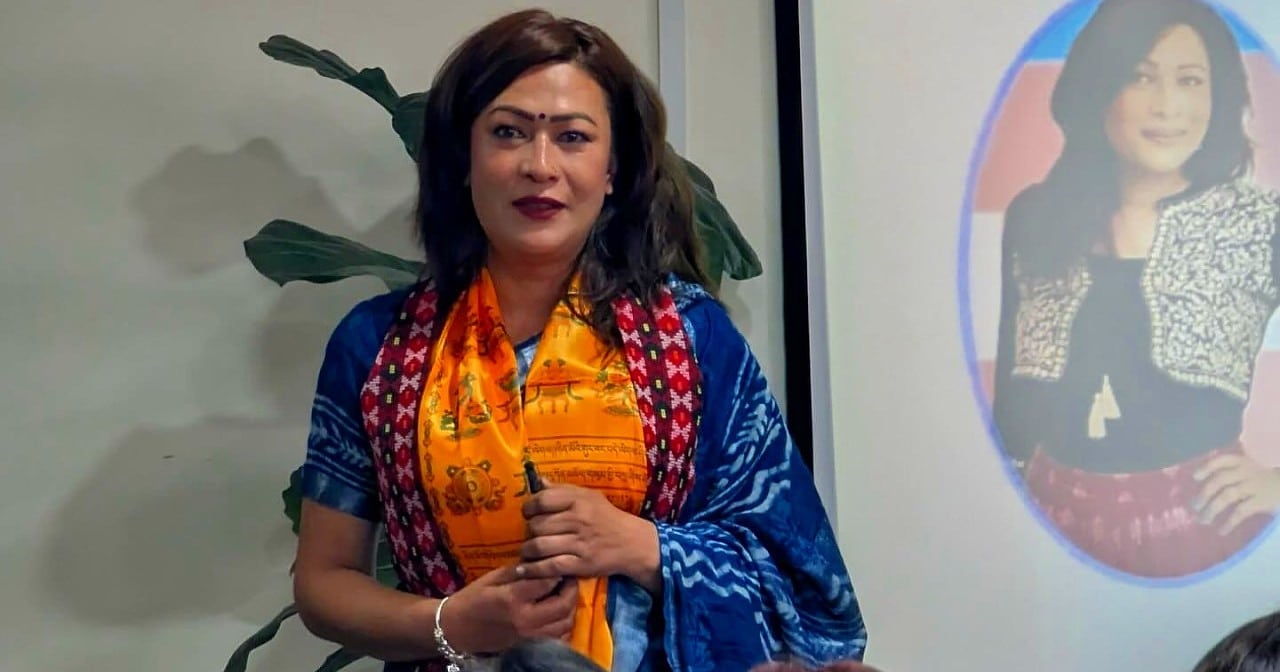
Nepal has for the first time sent a transgender person to its national Parliament, signaling a broader political and social upheaval and a push for greater visibility of queer people. Activist Bhumika Shrestha is entering Parliament on the Rastriya Swatantra Party (RSP) list after the party secured a clear majority in the recent elections. The seat was confirmed by the Election Commission earlier this week.
The 37-year-old, who identifies as a member of Nepal’s recognized “third gender” and uses female pronouns, has long been a prominent voice for LGBTQ+ rights and previously worked as an activist for the queer organization Blue Diamond Society. Her president Umisha Pandey told the news agency AFP that the moment was historic: “Our pain, our suffering, our feelings, our stories and all our issues are understood only by ourselves, not by others.”
View this post on Instagram
Instagram | In light of her election, the Blue Diamond Society held a small ceremony to honor the fellow activist
|
“I am very excited, but I also feel the responsibility on my shoulders,” Shrestha told AFP. “Our Constitution contains provisions for our community, but these have not yet been translated into laws and policies. Our community expects me to address our concerns in Parliament.”
Progressive Supreme Court
Nepal is regarded as progressive on queer rights in the regional context. The founder of the Blue Diamond Society sat in Parliament from 2008 to 2012, becoming the first queer member of Parliament not only in Nepal but in the region. But the advances came from the judiciary, not the Parliament. The Supreme Court struck down the ban on homosexuality in 2007.
In 2007, the Supreme Court also legally recognized a third gender, allowing a gender entry of “o” for “other” rather than “m” or “f,” and this sometimes aligns with a traditional “third gender.” This option has been expanded by several governments, for instance by including it on passports. However, there is as yet no statutory means to switch the gender entry to male or female instead of “other,” even though the Court has recently allowed this in individual cases. Hormone therapies and gender-affirming surgeries remain largely unavailable.
Country in Transition
The election of Shrestha comes at a time of political upheaval. Snap elections were called for March 5 after protests last year successfully forced the previous government under Khadga Prasad Oli to resign. The protests, largely led by Generation Z, targeted government corruption and a temporary social-media ban. At least 75 demonstrators were killed and more than 2,100 were injured.
The anti-corruption party RSP, a progressive centrist party, won 47.8 percent of the vote (up 37.1 percentage points) and 182 of the 275 parliamentary seats. The new prime minister is expected to be Balen Shah, a rapper and the former mayor of the capital Kathmandu.