The excitement surrounding Timothée Chalamet’s interview was immense — the long-standing ally of the queer community and star of “Call Me by Your Name.” In it, he derided opera and ballet as elitist art forms that “these days basically nobody is interested in.” His words reveal how deeply cultural hierarchies continue to shape thinking.
The outcry Chalamet sparked worldwide in the cultural sphere did not take long to follow — and for good reason. A quick look at the Berlin premiere of “Nureyev” at the Deutsche Oper puts his remark into another light: the production, taken over from the Moscow Bolshoi Theatre, has been barred from the stage in Russia in 2023 due to the explicit portrayal of homosexuality under political pressure, yet it is meeting a surge of interest abroad. Even before the curtain rises, all performances are sold out, and Arte’s live broadcast of the premiere has drawn international attention.
Even though the Berlin State Ballet under Christian Spuck has enjoyed extraordinary success for two years, “Nureyev” has drawn even more attention. This is likely not least because ballet holds an important place in Russia’s national identity. The fact that a work born there and ultimately banned there is celebrated overseas carries extra weight.
German media and the “very cute” drag sequence
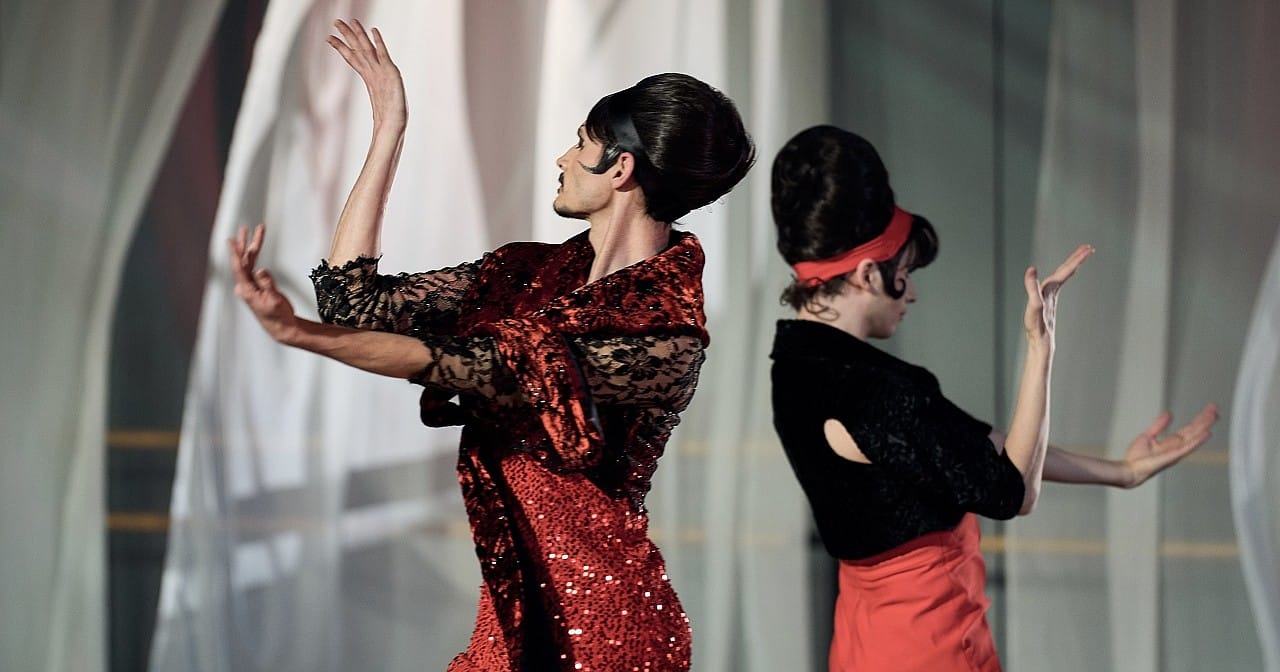
One scene in particular stands out: after his escape from the Soviet Union, Nureyev’s waltz-like introduction to Western society is abruptly interrupted by six drag queens who circle him to the sounds of sultry jazz.
A glittering drag show in the middle of a ballet? In Berlin that hardly causes a stir, but in some reviews there seems to be, from a high-culture perspective, an undercurrent of a need to distance themselves from queer subculture: Tagesspiegel describes the sequence as “very cute,” the portal Tanznetz.de finds it “provincially inconsequential,” and Die Welt calls it “hardly worth noting.” Yet it was precisely this scene that the Moscow Bolshoi Theatre had barred from the outset.
The defensive reflexes go in both directions
Moreover, the drag sequence in “Nureyev” is not merely a director’s stunt that you might encounter in Berlin or other Western cities in some repertoire productions. Here the scene is dramaturgically original: composer Ilya Demutsky developed a distinct musical language for it, and Yuri Possokhov crafted a highly stylized choreography.
It is encouraging that queer subculture, beyond pop culture, is gradually finding its way into high culture — and yet all three spheres continue to be played off against one another. The defensive reflexes go in both directions, even within the queer community.
That is unfortunate, since cultural facets have long since nourished one another and queerness should be reflected unreservedly in every genre. It should not always provoke and break taboos — an expectation that we sometimes stand in the way of ourselves.