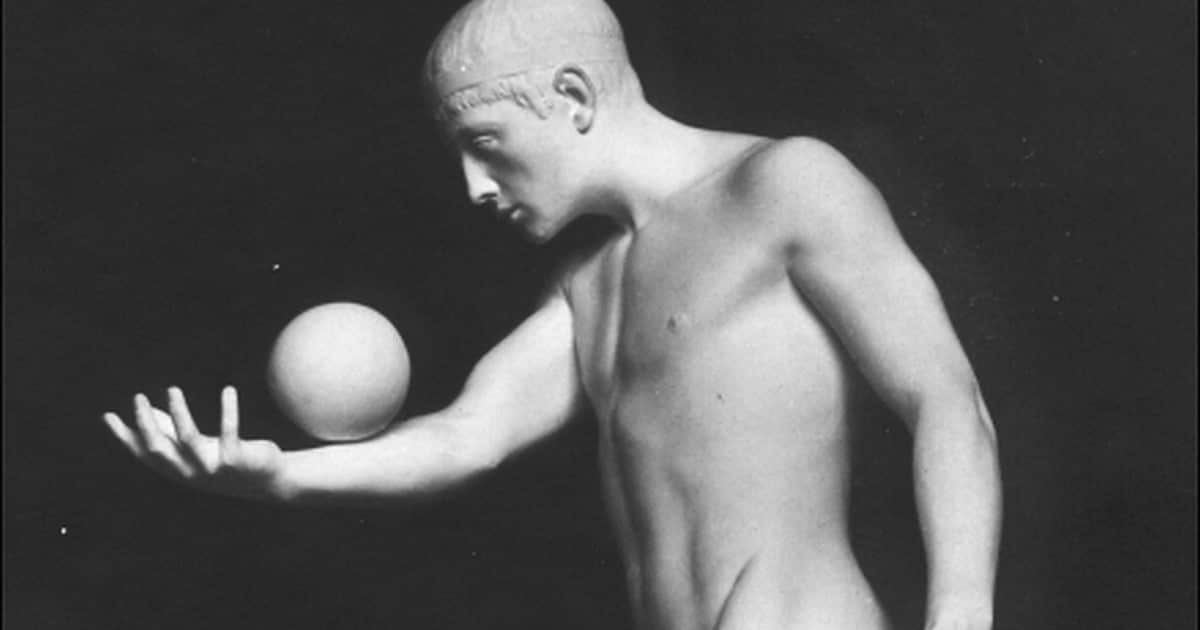
Dr. Otto Kiefer (1876-1955), a trained jurist, briefly practiced law, because after a trial for distributing obscene writings he had to resign from his clerical civil service. He then eked out a living with translations and as a private tutor, and from 1918 to 1935 taught Greek, Latin, and history at the Odenwald School. His most significant work remained his treatise “The Significance of Youthful Love” (1922).
Otto Kiefer was part of the early homosexual movement, which at the turn of the century consisted mainly of two activists and their associations. On the one hand, Magnus Hirschfeld, who with others founded the Scientific-Humanitarian Committee (WhK) and published the homosexual journal “Jahrbuch für sexuelle Zwischenstufen.” On the other hand, Adolf Brand, who with others, including Otto Kiefer, founded the Gemeinschaft der Eigenen (GdE) and published the homosexual journal “Der Eigene.” Kiefer collaborated with both wings of the movement and published in both journals.
Kiefers Veröffentlichungen im “Jahrbuch für sexuelle Zwischenstufen”
In the Jahrbuch für sexuelle Zwischenstufen, Kiefer was cited quite frequently, for example in his favorable reviews of the Yearbook in the Socialist Monthly (1903. p. 1150-1151) and in “Der Mensch” (1904: p. 642). Most important, however, are the articles he wrote for the Jahrbuch, which appeared under the titles “Plato’s Stance on Homosexuality” (1905. pp. 107-126), “Hadrian and Antinous” (1906. pp. 565-582), and “Socrates and Homosexuality” (JfsZ. 1908. pp. 197-212, not online). They constitute a sophisticated defense of ancient youth-love and thus indirectly a defense of homosexuality in the 20th century.
Kiefers Veröffentlichungen im “Eigenen”
Adolf Brand founded, together with twelve other men, on May 1, 1903, the “Gemeinschaft der Eigenen” (GdE), which persisted at least until 1932. As an internal reading circle, it probably also served to shield members from prosecution. According to a statute published in 1925, founding members included the well-known activists Benedict Friedlaender and Wilhelm Jansen. Also involved was “Dr. Reiffegg,” a pseudonym for Otto Kiefer, which he apparently used only for the GdE and for his 1903 book “Der schöne Jüngling in der bildenden Kunst aller Zeiten.”
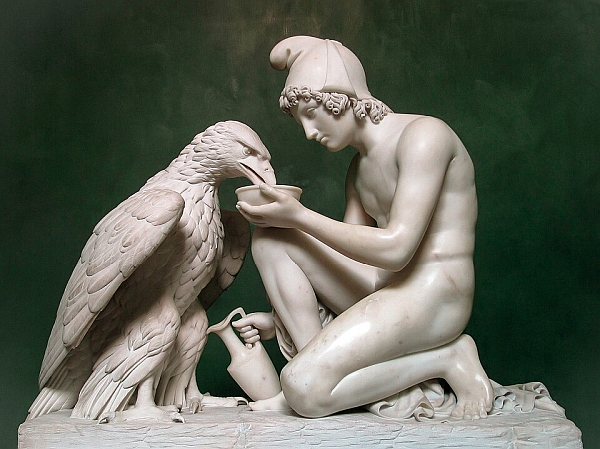
Besides, Kiefer published several texts in the “Eigenen” that dealt chiefly with ancient culture and male beauty. These include: “Der schöne Jüngling in der Bildenden Kunst aller Zeiten” in four parts (4. Jg.: Heft 1, pp. 13-26; Heft 2, pp. 103-114; Heft 3, pp. 173-181; Heft 4, pp. 244-254. The issues 1–3 are not online), “Ein Opfertod. Dramatische Skizze in einem Akt” (5. Jg. Heft 1, pp. 19-22), “Der Ganymedesmythos und die bildende Kunst der Antike” (1906. Jahresband, pp. 95-100) and “Nietzsche und der Eros” (13. Jg. Heft 5, pp. 129-141).
Kiefers Veröffentlichungen über die Jünglingsliebe
His collaboration with both flanks of the homosexual movement is most clearly seen in his seminal emancipatory publication. Three closely linked works can be identified: In Max Spohr Verlag — which was close to the WhK — Kiefer published under his pseudonym Dr. Reiffegg the treatise “The Significance of Youthful Love for Our Time.” The review in the Jahrbuch (1903. p. 1012-1015) is cautiously positive and makes clear that same-sex behavior in antiquity and homosexuality in the contemporary era were thought in tandem: “The little book, filled with warm idealism, rightly expects from the change in the assessment of homosexuality favorable consequences for the general welfare. The author perhaps harbors somewhat optimistic hopes, but high ideals and far-reaching goals are in general not a harm.” The claim that homosexuality is “not a higher, better love” is not necessarily what the author intends to stress.
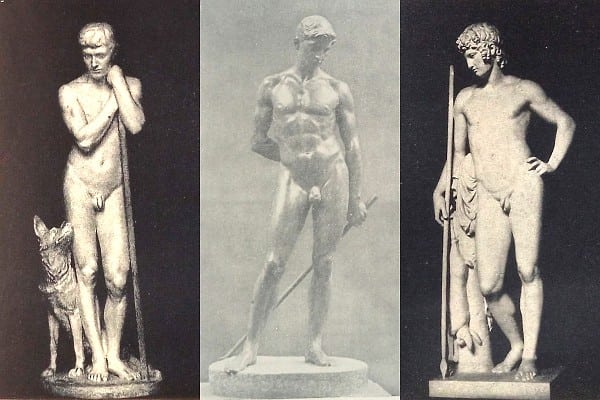
Under his own name, Kiefer later published “Der schöne Jüngling in der bildenden Kunst aller Zeiten,” a work that appeared twice: first in four installments in Adolf Brand’s homosexual magazine “Der Eigene” (1903, as above). The work became best known when, in 1922, it appeared as a standalone book published by Adolf Brand. While the text seems to be literally the same, the 1922 edition used more and significantly more illustrations. The 1922 edition, combining inviting illustrations with a demanding text, was probably purchased partly for its erotic depictions.
Griechische Liebeslyrik (1906, 1912)
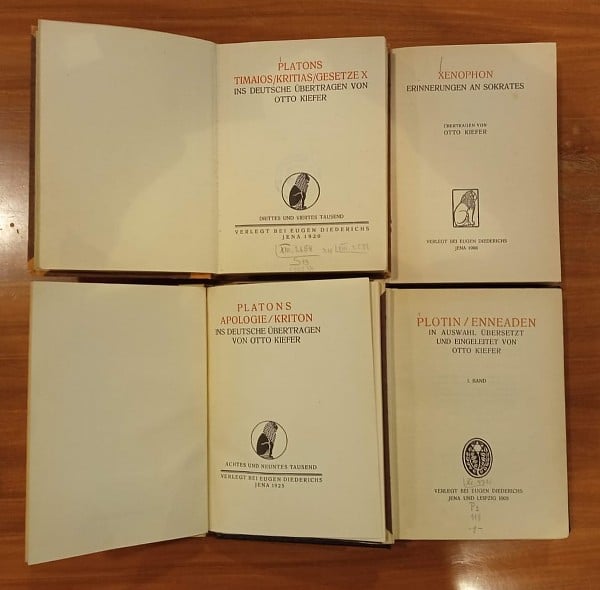
Between 1904 and 1920, Kiefer translated and published a number of ancient texts, without a clear focus on homosexuality. These included translations of Longus’ “Pastoral Tales” (1904), Plotinus’ “Enneads” (1905), Xenophon’s “Memorabilia of Socrates” (1906), and various works by Plato (1908 / 1915 / 1925).
That, however, changed when Kiefer, in Piper-Verlag, published “Liebesgedichte aus der Griechischen Anthologie” (1906), which in a second edition in the same publisher appeared under the title “Griechische Liebesgedichte” with twice as many illustrations. In his introduction (1906: pp. XVII-XXI; 1912: pp. XIV-XVI) he defended ancient boy-love across several pages and noted that he had previously drawn on “Lieblingminne und Freundesliebe in der Weltliteratur” — i.e., the first homosexual anthology in world literary history.
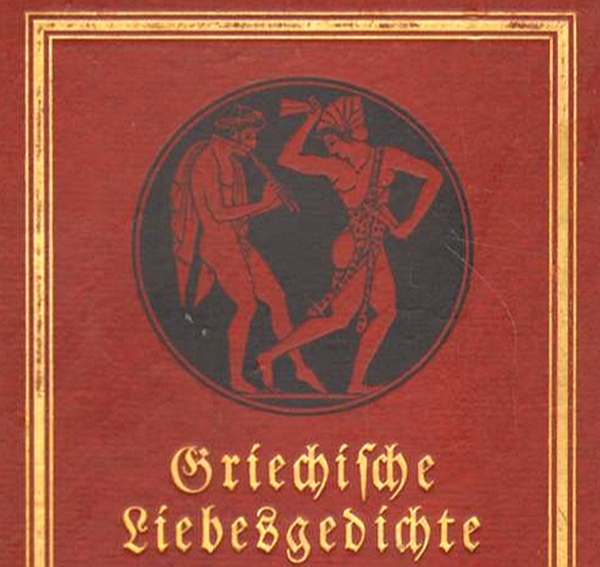
In two reviews in the Jahrbuch für sexuelle Zwischenstufen, the second edition of this anthology was positively received: Kiefer does not attempt to “veil” or simply omit homosexuality in ancient poems, but rather boldly brings many love songs that celebrate the youth beloved (1919: pp. 72-73; cf. 1914: pp. 70-71). Both reviews reference a critique in the Berliner Tageblatt, which in 1914 was rather negative and in 1919 more favorable.
These reviews, including Sigmar Mehring’s “Die Liebeslyrik der Antike” (in Berliner Tageblatt, 19 March 1913, Morgen-Ausgabe, p. 17), indeed allow both readings. It states, among other things: “We may enjoy the witty and passionate love lyrics of Greek love poetry without sharing their moral views.” The portrayal of the “young friend” is praised for his intellectual and physical allure (and pursued). The relationship between poets and youths takes on forms that appear ridiculous to us in excess. Above all, however, the poetry concerns love of women, which stands closest to us in sentiment.
Die Veröffentlichungen unter weiteren Pseudonymen
So far I have only listed the articles Otto Kiefer published under his own name or under the pseudonym “Dr Reiffegg.” It is worth noting further publications under the pseudonyms “O. K.,” “Pugnator,” “Sokrates” and “Dr. OKA.”
In “Der Eigene” pseudonymous texts on education, punishment, and discipline appeared, e.g., by “O. K.”: “Wie Dr. Weichherz das Prügeln lernte” (In: “Der Eigene,” 7/2, pp. 3-4). The author of “O. K.” is identified by the literary scholar Marita Keilson-Lauritz (“Die Geschichte der eigenen Geschichte”, 1997, pp. 327-328) as Otto Kiefer. This seems to have been chosen because of the matching initials and because Kiefer had previously published three similar works on corporal punishment: “Die körperliche Züchtigung bei der Kindererziehung” (1904), “Zur Frage der körperlichen Züchtigung bei Kindern. Studien für pract. Erzieher” (1907) and “Die Prügelstrafe in der Erziehung” (1908).
In Max Spohr Verlag — the home imprint of the early homosexual movement — appeared from “Pugnator” the book “Triumph der Liebe. Aus den Papieren eines Geächteten” (1902). In the Jahrbuch für sexuelle Zwischenstufen (1903. pp. 1084-1086) the book was reviewed, and perhaps as a hint to the pseudonym, parallels to Reiffegg and “Der schöne Jüngling” were drawn. Keilson-Lauritz (pp. 338, 495) also suspects, on biographical cues in the text, that Otto Kiefer was the author of this work.
In “Der Eigene” (9. Jg. 1920-1921) appeared from “Sokrates” the contributions “Bücher und Menschen” (pp. 62-63) and “Winteridyll” (pp. 119-120). There was also the piece “Ein Erlebnis von Dr. OKA” (pp. 156-157) by a homosexual educator. Keilson-Lauritz suggests that “Sokrates” and “Dr. OKA” were likely pseudonyms of Otto Kiefer, since the contents page (p. 7) lists Otto Kiefer as the author and a spoken “O.K.” resembles “OKA.”
Kiefers Kehrtwende: Seine Bücher über die Antike ab 1933
After 1933, Otto Kiefer published three more novels about ancient Rome. Given the Nazi era, no texts that treat homosexuality positively are to be expected, and Kiefer’s remarks on this topic understandably diverge from his earlier writings.
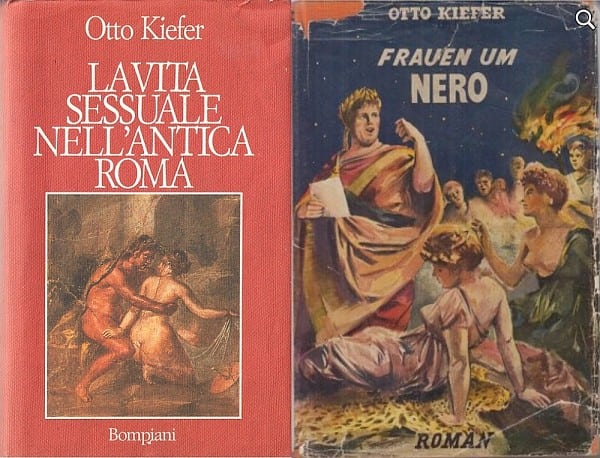
This is especially evident in his “Kulturgeschichte Roms unter besonderer Berücksichtigung der römischen Sitten” (1933, 1964; here 1933), which achieved great success in translations such as “La vita sessuale nell’antica Roma” and “Sexual Life in Ancient Rome,” reaching many editions. Kiefer now assesses homosexuality more critically, citing negative historical examples. He mentions homosexuality within the context of heterosexual prostitution (p. 65). He quotes Martial’s blunt remarks about hair removal as something practiced “by all male creatures” and that this was done “for homosexual reasons” (p. 162). Ovid’s allusion to boy-love is for Kiefer only an example of how morally distant the Romans regarded homosexuality (p. 230). Petronius’ “Satyricon” is described as a “totally amoral” novel, with Kiefer noting the naive ease with which Petronius treats boy-love as something entirely natural alongside other loves (pp. 248-250). Persius writes friendship poems to a man, but not in a way that would justify calling it homosexuality (pp. 266-268). In addition to Caligula (p. 310), Nero is described as having “homosexual traits” and sources recount Nero’s marriage to various pleasure-boys. Historical sources are often “malicious inventions,” and there is a “peculiar double life” among contemporary homosexuals (pp. 317-319). He even quotes a misogynistic remark by Johann Wolfgang von Goethe: “…hab ich als Mädchen sie satt, dient sie als Knabe mir noch” (p. 283). He omits the opening of Goethe’s line “Knaben liebt ich wohl auch” from the “Venetian Epigrams” (No. 144).
In his subsequent book “Frauen um Nero” (1935 / 1950) Kiefer attempted to dismiss Nero’s homosexuality as juvenile games: “Like any youth from Rome’s upper circles at the time, he had not only the lustful games with the young favorite slave, but later people attributed the wildest tales to him” (p. 10). His third book, “Kaiser und Kaiserinnen von Byzanz” (1937), I did not have available for analysis.
Die literarische Einordnung von Otto Kiefer
According to Marita Keilson-Lauritz (above), Otto Kiefer belongs to the authors who wrote in both the “Eigenen” and the “Jahrbuch für sexuelle Zwischenstufen” (p. 146). Professionally, Kiefer fits well with the other authors of the “Eigenen”: he was among the roughly 20 authors in the “Eigenen” who also worked as teachers (p. 274). He also belonged to a small group of jurists who ventured into literature or literary criticism; the best-known are Karl Heinrich Ulrichs, Kurt Hiller, Hanns Heinz Ewers, and Erich Ebermayer (p. 156). Keilson-Lauritz notes that in reviews by jurists the underlying legal system in the judgments is less present than one might expect. This makes it hard to confirm the claim that the “Eigene” argued within the arts/literature system while the “Jahrbuch” did so within the science system (pp. 224-225).
In the publications on ancient male youth love, Keilson-Lauritz sees attempts to read literature as “our literature” and thus as emancipatory (p. 226). In this way, antiquity also served to legitimize homosexuality at the beginning of the 20th century.
Keilson-Lauritz further conjectures — in connection with reviews such as those of Robert Musil’s “The Confusions of the pupil Törless” — a possible sexual interest of Kiefer in adolescent boys (p. 191), which is plausible but cannot be conclusively verified from the sources. For the topic of ephebophilia or homosexuality, see also Kiefer’s online essay “The Boy in Literature” (In “Das literarische Echo.” 1916. August 1. Column 1297-1304), which ranges from antiquity to Thomas Mann’s novella “Death in Venice.”
The queer community needs a strong journalistic voice — especially now! Contribute to support TheColu.mn’s work.
Resümee
Kiefers Veröffentlichungen über die Antike ergeben kein rundes Bild. Mal scheint er sich überhaupt nicht für die Homosexualität zu interessieren, mal verteidigt er sie engagiert und mal wertet er sie ab. Es ist verständlich, dass sich ein Autor dem politischen Druck des NS-Regimes beugte und zur Homosexualität schwieg oder sich zurückhielt. Aber ohne äußere Not Homosexualität abzuwerten, bleibt auch für die Zeit während einer Diktatur zu hinterfragen. Seine “Kulturgeschichte Roms” hätte er auch ohne die zahlreichen homophoben Positionierungen vermarkten können.
Leider ist auch die private Person Otto Kiefer kaum greifbar. Es existiert noch nicht einmal ein Foto von ihm und es gibt kaum Äußerungen über sein Privatleben. Auch die Veröffentlichungen unter Pseudonymen führen nicht weiter.
Die Aussicht, zukünftig noch mehr über Otto Kiefer zu erfahren, erscheint dabei durchaus realistisch. Marita Keilson-Lauritz erwähnt in ihrem Artikel “Vom Schicksal des pädagogischen Eros oder Das Dilemma der Emanzipation” (In: “Capri”. Nr. 47. Mai 2013. 28-31. Online-PDF S. 2120-2123), dass sie während eines Besuchs in der Odenwaldschule Kontakt mit Kiefers Lieblingsschüler hatte, einem beinahe 90-jährigen alten Herrn, der voller Respekt von seinem verstorbenen Lehrer sprach. Zu den Dokumenten, die Keilson-Lauritz im Archiv der Odenwaldschule entdeckte, gehört auch ein unpublizierter “Jugendroman in einem Landschulheim” aus Kiefers Feder, der eines Tages vielleicht mal nachgedruckt wird und ihn greifbarer machen könnte.