In the 1970s, if you had asked a trans woman where she worked or what she did, you would have likely heard an answer along the lines of: on stage or on the street. We performed in shows, did strip acts and entertained in nightclubs, or we were sex workers. We were at once the visible side of a relatively small trans community of the time, clearly dominated by transfeminine identities.
Because I come from that era, I know how different then and now were — as if we were dealing with two fundamentally separate worlds. The night life mattered so much because the night allowed what the day denied: full legal invisibility, the impossibility of changing one’s name or gender marker. And yet many of us lived, quite literally, in a hedonistic, sex-positive form of compensatory living. The lack of rights was offset by glitter, glamour, and the applause that came from the cis world.
Between Authenticity and Exoticization
The Kommunale Galerie Berlin now presents photographs from this era under the title “Berlin, du schriller Vogel” — “Berlin, You Shrill Bird” — by the renowned photographer Anno Wilms (1935-2016), whose work focused on the people at the center of the scene. Authenticity, exoticization, and voyeurism have always been difficult to disentangle, then and now.
Especially the photo series taken in Berlin’s queer nightlife bear this out. What makes them fascinating, however, is that the photographed figures clearly play with the staging. The photos were published in 1978 in a large-format black-and-white photo book — the title, “Transvestiten,” was wrong then and remains wrong today.
Intimate Insights into a Long-vanished World
No question, the photographs are significant time documents and grant intimate insights into a long-vanished glamorous world where, as noted, trans women largely found a home. Yet they were not transvestites, because back then — and today — cis society often lacked a view into realities. In any case, Wilms’s focus did not foreground everyday life.
The question isn’t unfounded: why did trans people choose this parrot-of-paradise existence? The answer is rooted in banal existential reasons. Exoticism and glamour formed the basis for navigating daily life. This is a point that is all too easy to forget.
From “Chez Nous” to the “Lützower Lampe”
>That there were alternate paths is shown by the Australian photographer Barry Kay, who already in 1976 released a compelling photo book about the trans community in Sydney, with a particular interest in the everyday life of trans women. Right from the title, Kay conveyed respect — “The Other Women” was the book’s name. That is precisely what we are — the other women. Not exoticization, but normality was the message his reportage aimed to convey, and it does so with unwavering clarity.
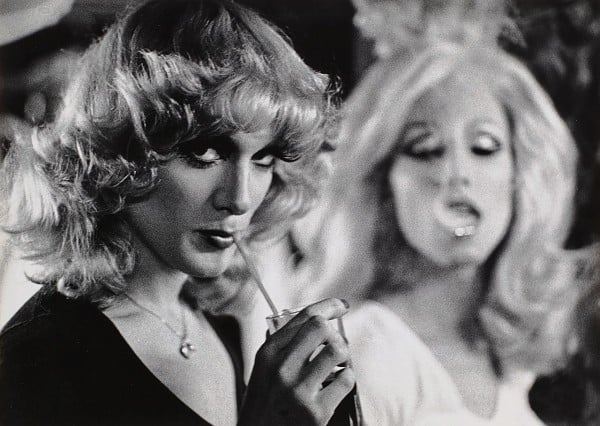
On the other hand, the 1970s also saw a boom in travesty shows, which for quite a few gay men proved to be a lucrative source of income. Trans women were part of that scene. In Berlin, “Chez Nous” had been operating since 1958; in 1967 the former circus artist Karmeen took over the “Lützower Lampe,” a venue with roots dating back to the Weimar era. In 1974, “Chez Romy Haag” opened its doors, and later the “Dreamboys Lachbühne” founded by Harry Toste joined the lineup. A standout figure was Zazie de Paris, who was eventually discovered by director Peter Zadek for the theater stage. In 1981 she performed in the Fallada revue “Jeder stirbt für sich allein” at the Schiller Theatre.
When parts of the film “Schöner Gigolo, armer Gigolo” were shot in the Lützower Lampe, with David Bowie in the lead and the lineup featuring stars up to the veiled Marlene Dietrich, Berlin’s night life shifted from a neighborhood secret to a spectacle in a plush, gold-leaf setting. The exhibition includes a 75-minute documentary by Marion Alessandra Becker about the Lützower Lampe from 2011 — “In der Lampe brennt noch ein Licht” — well worth seeing.
The queer community needs a strong journalistic voice — especially now! Contribute to secure TheColu.mn’s work.
Trotz Rechtlosigkeit ein erstaunlich selbstbestimmtes Leben
Many photographs were taken at “Chez Romy Haag,” my workplace from 1976 to 1980. What happened to all the colleagues who — like me — are now retired and who, back then, led a remarkably self-determined life despite not having rights? Yes, we sold dazzling glitter and feisty illusions every night, fed by the voyeurism of the audience.
Even today it’s astonishing. As I walked through the exhibition, I overheard two “Wilmersdorfer widows” by a photo of the pretty Brandy speculating whether her exposed bosom was “real.” Times change, but the audience appears not to.
The small, time-traveling journey into West Berlin’s queer city history is on view throughout the summer until September 14.