In a glass display case sits a hollow, throne-like form coursed through with glimmering vessels of blood, perched atop a mossy hill. It at first glance resembles a heart replica. What draws the eye are the metallic, pierced, tentacle-like projections, at whose ends cling smaller organic structures.
Because Alina Kleytmans’s installation “Bioinstallation_Prosthesis” looks, at a distance, like real human tissue, viewers immediately feel a sense of unease — confronted with an exposed, vulnerable construct that turns the innermost outward. Not to mention the chains connected to the piercings that keep the object restrained. A reflection, perhaps, of the situation of the queer community in Ukraine?
Thus the work, in the truest sense, stands as the centerpiece of a current show at Berlin’s Schwules Museum — a piece that from afar grabs attention and symbolically aligns with its title: “A Heart That Beats — Queer Ukrainian Art in Focus” (on view through January 26, 2026).
Invisibility, Uprising, and Resistance
In the metaphor, on the one hand, a line by Ahatanhel Krymskyj (born 1871) resonates — his life and work, seen from today’s perspective, increasingly read as a key to the beginnings of queer cultural history in Ukraine — because, in the vivid language of a gay writer and linguist, the heart stands for inner longings and a hidden desire. On the other hand, the beating heart in the exhibition’s title signals the vitality and resilience of Ukraine’s queer scene, a history shaped chiefly by the struggle to bring same-sex desire and queer identity into visibility.
In a show curated with great nuance by Maria Vtorushyna and Anton Shebetko, something of a small wonder unfolds: it conveys a palpable sense of the vitality and diversity of the Ukrainian community, while grounding that vitality in its historical roots. Three phases are foregrounded: the era of invisibility under the Soviet regime, the rising assertion in the early years of independence, and finally the resistance to the Russian invasion.
A Masterpiece of Sublimated Homosexual Desire
In the three-part exhibition space, the first area houses a display case that can be read as a mirror-image counterpart to Alina Kleytmans’s heart prosthesis in the final segment of the route. Here is shown a paper collage by filmmaker and artist Sergei Paradschanow, who was persecuted by the Soviet regime for his homosexuality and sentenced in 1973 to five years in prison. As a queer dissident connected to Ukraine, he is today celebrated — not least for his cult film “The Colour of Pomegranates” (1969), which, because of its encoded imagery, is regarded as a masterpiece of sublimated homosexual desire.
Called “Orpheus,” the work on view rewards close looking: at the top, the closed eyes of a sculpture hint at a dream or meditation, just below a Renaissance portal with a red carpet leading back into Greek myth. In the center sits a golden statue of Orpheus, and Paradschanow’s own homoerotic longings for the mythic singer may have receded behind the Orpheus metaphor in Jean Cocteau’s films to which the artist revered.
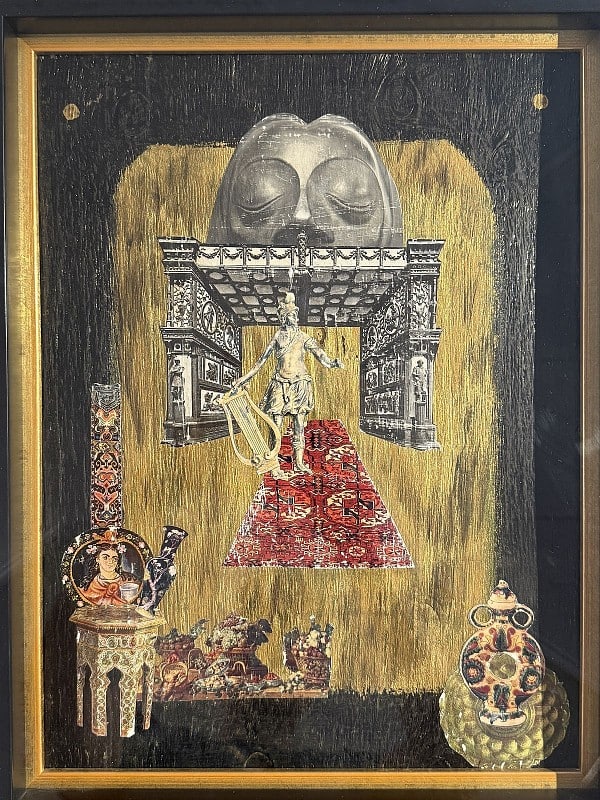
In the lower half of the image — the realm of the supposed underworld where Orpheus’s wife Eurydice is kept — we encounter a Eurydice figure who could be a folk character from the Soviet cultural sphere, yet also bears features reminiscent of Frida Kahlo — a likeness that may well be intentional. Kahlo’s name appears to have been known to Paradschanow, who was part of dissident circles in the Soviet Union long before she became a queer icon. The gold background bathes the scene in a sacred aura.
Paradschanow’s collage in the Berlin exhibition is also a clear political statement, since in December 2023 he was officially rehabilitated by Ukraine’s National Commission. This is not merely late justice for a brilliant artist; it is a signal from a country defending itself against a queer-phobic aggressor and reorienting its culture and identity politics — even as everyday discrimination persists.
Queer Soldiers in Large Scale
Within Ukraine, a paradoxical sequence of war-time experience becomes visible: on one hand, members of the queer community feel more acutely endangered by the Russian assault, and on the other, they render visible resistance to the invaders and push harder against discrimination within their own country — a rise in acceptance that is hard to ignore.
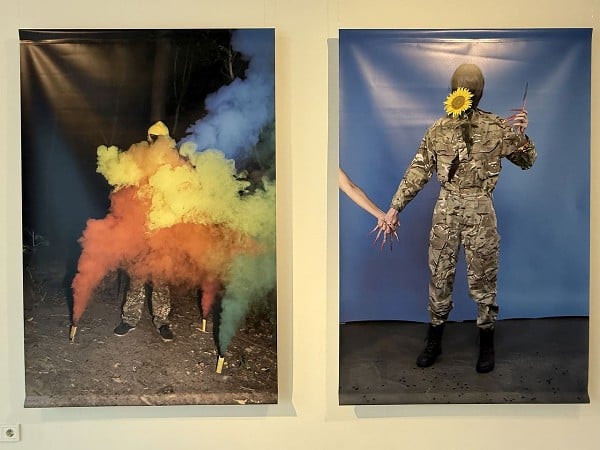
The exhibition takes up this theme in Anton Shebetko’s 2018 photographic series “We Were Here,” which presents the Ukrainian LGBT* Military and Veterans for Equal Rights in large-format staged imagery. The personal identities of the sitters largely recede into the background: in one image, a sunflower is used to obscure a face; in another, a figure is shrouded in rainbow-colored smoke. The images inevitably evoke associations tied to queer self-empowerment, but also to a discomfort with nationalist symbolism — and it is precisely in that tension that the series finds its power.
Yevgenia Belorusets also contributes to visibility with her work “A Room of My Own,” but approaches the matter on a deeply personal scale. She gathered photographs and concise first-person narratives from queer Ukrainians she met on a 2011–2012 journey across the country. We hear from a nineteen-year-old who falls in love with a 36-year-old man named Valery and now visits him every weekend in Kyiv. A trans person explains why they chose gender-affirming surgery even though they hold a skeptical view of binary gender categories. A lesbian couple laments how they and their partner are treated as single mothers and worries that a lack of support could have catastrophic consequences for their family.
The queer community needs a strong journalistic voice — especially now. Do your part to support TheColu.mn’s work.
Satire of the Bodily Optimization Mania
How precarious and ambivalent the situation remains for queer people in wartime Ukraine comes into view another time when re-examining Alina Kleytmans’s heart prosthesis. What first seems like a quiet metaphor for vulnerability reveals itself as a sharp satire on the preoccupation with bodily optimization.
In the understated caption mounted on the plinth accompanying the piece, the artist herself writes with a streak of irony: “Do you feel heartless…? EVERY problem can be solved with OUR prosthetics. (…) With these magnificent implants — harvested from the tissues and organs of unfortunate, poor, and ugly idiots — you too can attain lasting beauty and boundless popularity in no time!”
Seen in this light, Kleytmans’s heart prosthesis offers neither consolation nor reassurance — and yet the work earns a stubborn form of resistance in the bitterness of its language, a resistance that refuses to be silenced.