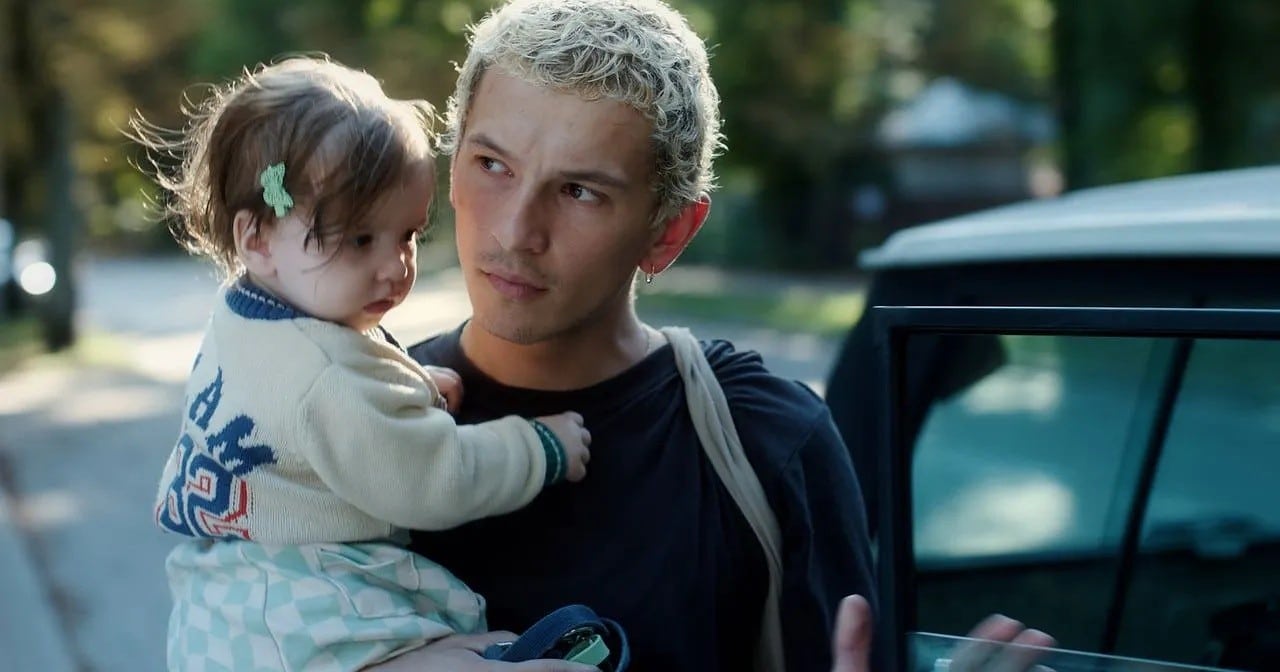
Filip (Ignacy Liss) is young, good-looking, and loves to party hard. He earns a bit of money as a model, and otherwise he thrives on parties, drugs, and lots of sex. Since money is always tight, his sister Anka (Sylwia Boron) lets him live with her and her young daughter Tosia (Alicja Lewczuk). But because Filip doesn’t bother to take responsibility there either, the single mother eventually has had enough and kicks him out.
Filip can hardly believe it at first, because the two grew up as orphans in a home, and his older sister basically raised him. She means it. What he doesn’t realize is that this won’t stop him from roaming the clubs again until an early-morning call arrives from a clinic: his sister has just been admitted and has died.
Spare the Niece the Orphanage
The fleeting party acquaintance Pawel (Mateusz Wieclawek) drives the shocked, still intoxicated Filip to the clinic, where Anka’s body is shown to him and his sister’s personal belongings are handed over. Then he drifts home half-dazed, steps in as babysitter, and sits with his niece Tosia by himself.
The days that follow are chaotic: Filip must look after Tosia, organize a funeral, and suddenly feel the pressure to earn money as well. Fortunately, he and his late sister have a circle of friends who help wherever they can. Filip first tries to persuade Tosia’s father to take her in, but he flatly refuses: he never wanted a child; it was entirely Anka’s decision. That leaves Tosia facing the orphanage or an unrelated adoption. Neither option is something Filip wants to impose on her — especially given his painful personal past.
Bureaucratic Ordeal
He also gradually realizes how much he enjoys taking care of the little girl. So he decides to formally adopt Tosia — an almost impossible undertaking for a gay single man in conservative Poland. A lawyer tries to prepare him for the official red tape, framing the problem this way: “If you’re honest in these talks, you have no chance. Because any idiot can sire a child and become a parent — an adoption, however, is reserved for angels, even if they don’t exist.” And he must not admit to being gay. Yet this plan to bluff his way through the system collapses on the very first social-worker visit. What now?
“Such a series has never existed in Poland,” says lead actor Ignacy Liss in an interview. “Proud” has the potential to illuminate different perspectives and to show that people can — and should — talk to one another. Ideally, this powerful, moving series could spark fruitful discussions in conservative Poland.
No Protection for Rainbow Families in Poland
There is currently no legal framework for same-sex couples — the current government intends to change that (TheColu.mn reported). Not long ago, a registry office in Warsaw, after years of legal battles, officially registered a civil marriage between two men concluded in Germany (TheColu.mn reported). The basis for that included court rulings, among them one from the European Court of Justice. Adoptions remain just as difficult, even though estimates say roughly 50,000 children are growing up in rainbow families in Poland, facing many prejudices and currently lacking legal protection.
The social timing of “Proud” is thus ideal. And the series does not shy away from realistically portraying the hedonistic gay party scene, even if that may feel unusual for Poland’s mainstream audience: in the first five minutes of the first episode, there’s a small orgy.
Direct link | Official German trailer
|
Awards — and Controversies
Yet “Proud” also shows how the new responsibility transforms Filip—and how the wild, self-centered party boy gradually becomes someone who will do anything to give his little niece a loving environment and a solid start in life, no matter how many obstacles stand in his way. There also appears to be growing feeling between Filip and Pawel, the fleeting party acquaintance from the night of Anka’s death. Is a new rainbow family forming?
The groundbreaking Polish series won the main prize at this year’s Series Mania Festival in Lille, Europe’s premier TV festival; Ignacy Liss was also named Best Lead Actor. In Poland itself, Proud drew mixed reactions. But controversies surrounding queer films or series have already spurred movements in the right direction in several countries — and it’s quite possible that Proud will be seen, in hindsight, as having contributed to the urgently needed liberalization in Poland.