The German Bundestag spent about forty minutes on Friday debating the protection of queer people and their events, particularly Pride marches known as CSDs. The session, now a traditional fixture of the Pride season and initiated by the Greens, followed several Greens- and Left party proposals on these topics that were ultimately rejected by the governing coalitions and the AfD.
Greens: Community remains combative on the streets and in Parliament
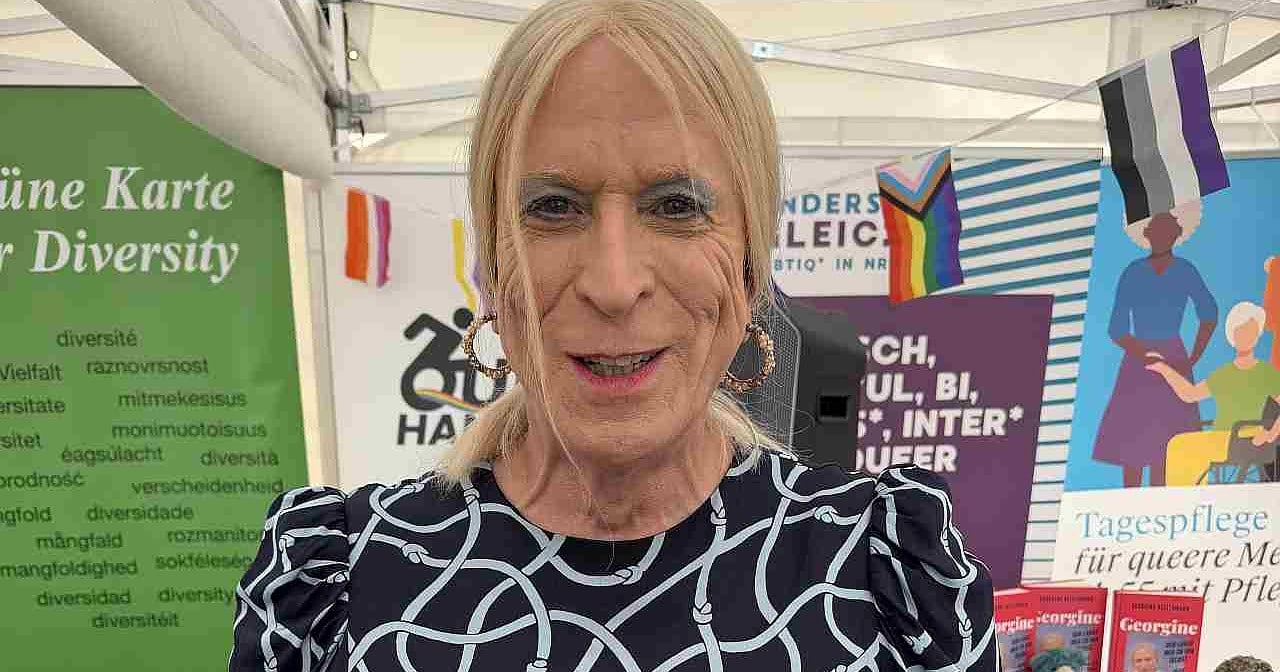
To begin, Green MP Nyke Slawik noted that much has been achieved, but full equality is still owed by this country. She highlighted concrete gaps, such as the missing protection in Article 3 of the Basic Law and ongoing discrimination against rainbow families in succession law (when a child is born into a same‑sex marriage, the non-biological co‑mother may need adoption, while a husband is automatically recognized as the father).
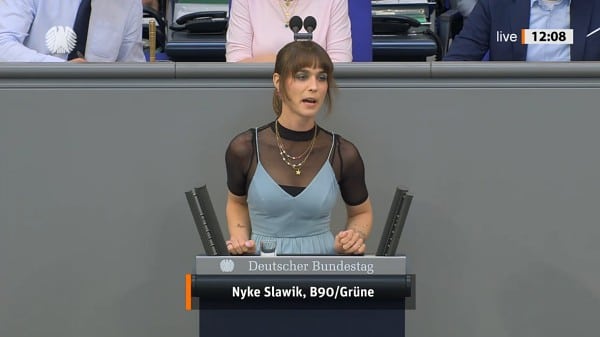
The Greens also pointed to the lived realities of queer people, including bullying in schools and gaps in health care for transgender individuals. They noted constant, often absurd, hate from the AfD—such as calls to ban a Rainbow ICE train (TheColu.mn reported). All of this fuels hatred and spills onto the streets. Pride events deserve police protection (the blunt, unsettling aside about being protected from Nazi demonstrations drew audible laughter from the AfD), while the government moves to scrap the national plan to combat queerphobia. Queer life has always been a story of struggle and resilience, Slawik said. To all queer people, she addressed: “You are not alone, your community will stay loud, it is here, and it won’t go away—even in the Bundestag.”
Union: Protect people, against “identity politics”
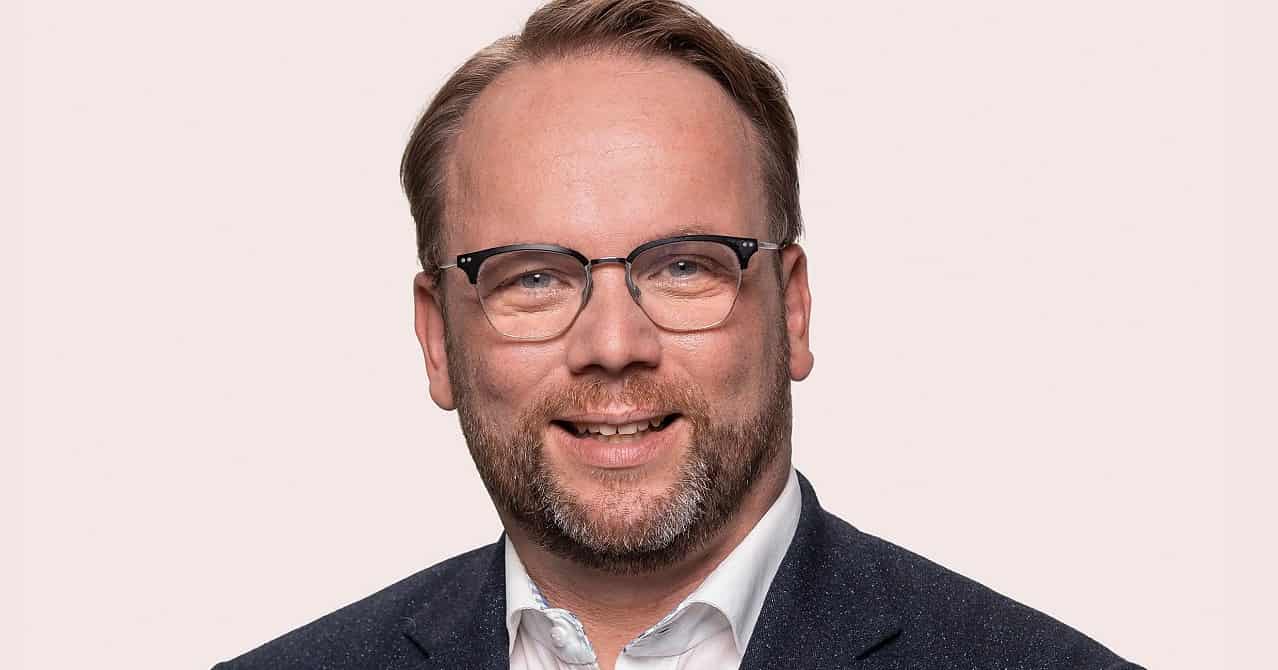
The Conservative MP David Preisendanz stressed that many priorities in the proposals should be universal and apply to everyone: “the rejection of discrimination based on sexual identity, the protection of peaceful assemblies, the full enforcement of freedom of assembly.” The Union will stand for each person in our country to live freely and safely and to exercise their basic rights without intimidation or threats.
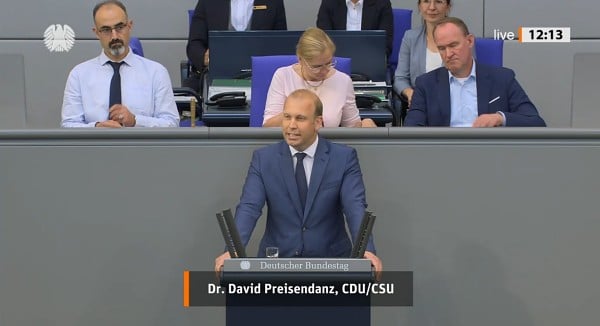
Yet it is not enough simply to “encourage” CSD organizers; what is needed is a strong rule of law. Preisendanz called for a united front of the democratic camps, but against “partisan politics,” “symbol debates,” or “identity politics.” He cited as an example the question of how often the rainbow flag should fly over the Reichstag.
AfD to push back against “aversion” toward queer people
The first flare came from AfD MP Fabian Jacobi, who translated the term “queer” by referencing a dictionary that defines it as “odd” or “peculiar,” and then used the term repeatedly. He described it as “intrusive,” “totalitarian,” and “re-education” when “acceptance of peculiarity” is demanded—that is, the absence of rejection or hostility from others. He argued that one should still be able to reject certain behaviors in public, including in interactions with small children.
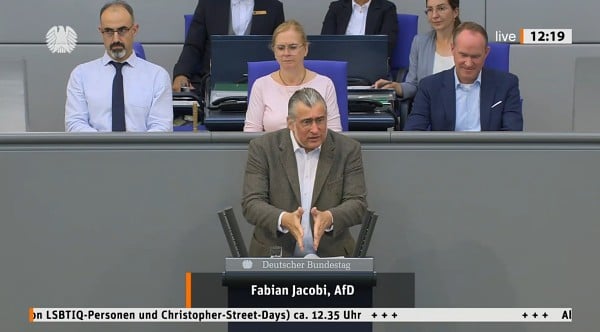
Violence should be rejected and a strong state protecting the freedom of assembly is important, but that also applies to AfD party conventions. On reform of the succession law, he argued there should be a father and a mother. Of course there are other configurations, but if you try to bend reality through legislation, if you attempt to deny reality by enshrining your ideology in law, we will resist you firmly.
SPD: AfD fuels queer-hostility
SPD MP Helge Lindh followed, taking aim at the AfD as they often do. He cited terms like “mimosas” and “double standards” to describe their rhetoric. It is cynical and treacherous when members laugh mockingly at threats to CSDs and police protection. The AfD’s constant political agitation is a key driver of queer-hostility, even as they pair queer issues with charges of pedophilia or “perverse sexuality.”
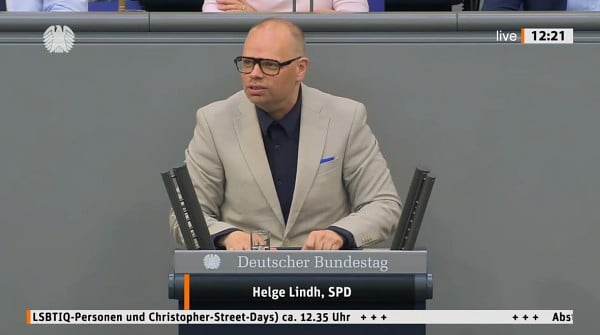
It is a positive development that police protect CSDs and that the Queer Affairs Commissioner and state authorities raise awareness—especially at a time when the early CSD movement emerged in resistance to raids. But the need for protection and the rising assaults point to a problem tied to the far-right culture war. When AfD members call for immigration restrictions, Lindh said, we must respond with prudence and clarity and not overlook queer-hostility, whether it is motivated by religious or ideological motives. He also underscored the need for constitutional reform and parentage-right reforms, and, in response to a question from Birgit Bessin, the openly queer-hostile AfD member, he noted her denial that her faction is queer-hostile even as she contends with what she calls “hate and agitation” from Islamists or migrants.
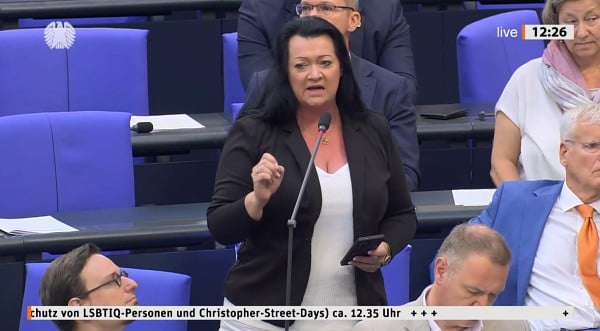
Lindh mockingly praised the “literary achievement” of certain party members, noting that he had also mentioned Islamism and lamented AfD’s Whataboutism: “There is no such thing as good or bad transphobia within our ranks.” He argued that the party’s stance normalizes queer-hostility while condemning Islamist violence, which does not protect anyone. He asserted that the AfD’s orientation renders it unconstitutional because it behaves similarly to Islamist extremism and denies that queer people have a constitutional right to live freely and self-determinedly.
Left: CSDs as the end of Orbán and the AfD
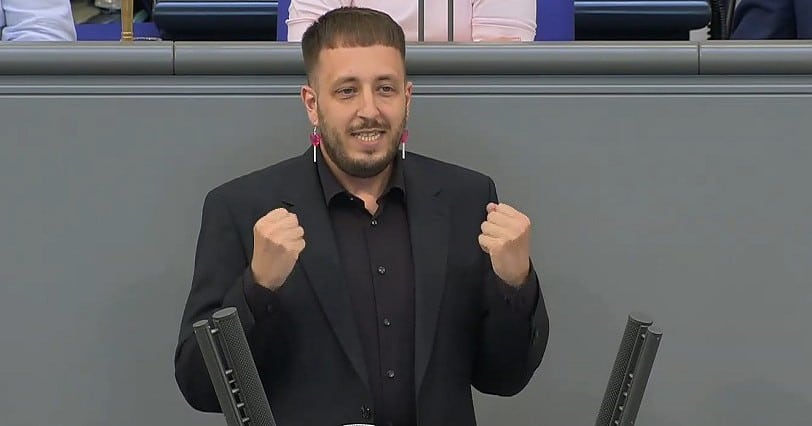
“Slutpop listening and banners waving, speeches and lots of kissing”—this odd opening was used by Maik Brückner to kick off his remarks. “The Pride season is in full swing. We keep the momentum going and we’ll make the AfD furious.” The Left party’s representative highlighted several Pride events with their diverse themes, stressing that those who think right-wing attacks will shrink us are mistaken—they only make us stronger. Brückner pointed to last year’s Pride in Budapest, where crowds defied a ban: “That day, the spirit of Stonewall was tangible. It marked the beginning of the end of Viktor Orbán’s era.”
That achievement did not come as a gift; it was earned through struggle. He argued that the far right can be defeated. Brückner lamented what he called “sabotage” of the Self-Determination Act by the Justice Ministers’ Conference, the lack of medical care for trans people, and the dismantling of the Action Plan for Queer Life. Family Minister Karin Prien (CDU) allegedly said, “You just have to accept it.” Brückner countered that the queer community would not accept such a stance. “We, as a queer community, will not bow to these absurd contributions,” he said. “We will march in the tens of thousands again this summer, and Pride events will help usher in the end of the AfD.”

AfD MP Birgit Bessin replied that her party is not against Pride events but against “state funding for these politically indoctrinating events.” She argued that Pride stages feature bands that “incite against the state,” or promote drugs, and she claimed there are “enough pictures and videos from Pride events that I would classify as child pornography if naked people were roaming about with children.” Brückner responded that he was proud the queer community remains unafraid of such remarks and would again take to the streets in the thousands this summer; he warned that Pride events could signal the end of the AfD.
CDU: Protecting freedom and securing it
For the Union, Siegfried Walch spoke firmly, reiterating the value of cross-party consensus, the need to ensure safety and freedom, and the right to assemble without fear; he condemned discrimination and violence against people because of their sexual orientation and argued that everyone should be free to live as they wish, but freedom to be different comes with security, which is why this security coalition argues for giving authorities the necessary powers.
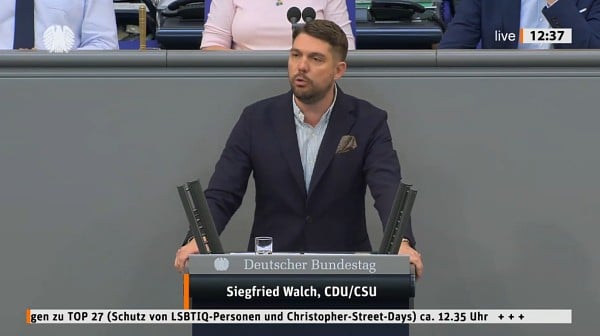
He warned that not everywhere is there as much freedom as one might be proud of, and quoted the pledge “Schwarz-Rot-Gold, Gottes Segen, unsere Heimat.”
“Gay AfD member” in service of the heterosexual majority
The AfD’s Tobias Ebenberger claimed that Greens and Lefts use queer people as a tool to push their dominance and transformation logic: the “rainbow culture” demands equality and intrudes into language, education, and upbringing. “I am married to a man myself, and I tell you: let the heterosexual majority be left in peace with this nonsense.” When asked how he views the majority’s rejection of queer rights, including marriage for all within the AfD, he said many people simply do not want to be part of this queer community, and as more absurd ideas are added, it’s not surprising that people criticize it. In his view, not all groups targeted by the Left are the same.
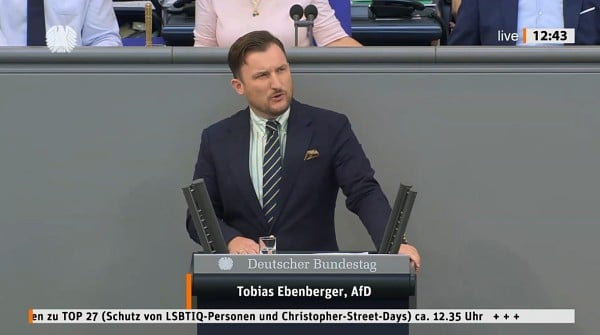
He said he could no longer enter into a civil partnership, while thousands continue to live in this form. He would prefer the option to choose a registered civil partnership again. He recalled seven years in Cologne and argued that Cologne Pride had evolved into an open, sexualized fetish and drug party, with children in the middle of naked bodies and sex costumes. He claimed the AfD is the party that emphasizes youth and child protection and represents people like him who no longer want this hedonistic spectacle.
Majority rejects the proposals
The Greens’ proposal had been debated in the Bundestag in its first reading exactly a year earlier, and the Left’s in December. Details on these proposals, as well as another current resolution motion from the Greens on this topic, are available on the Bundestag’s website, along with a transcript of this debate. The government factions and the AfD ultimately rejected the proposals, as had already happened in committees.
For a closing note, Bundestag Vice President Andrea Lindholz (CSU) offered a surprising take on the debates’ leadership in recent years, which occasionally seemed to favor the right over minority voices. She found it “inappropriate” and “unparliamentary” to define or use the term “queer” as meaning “odd.” “You know that’s wrong—a political self-designation,” Lindholz said toward the AfD, which had used the term as derogatory. She underscored that using “queer” to label people as “odd” is not acceptable.