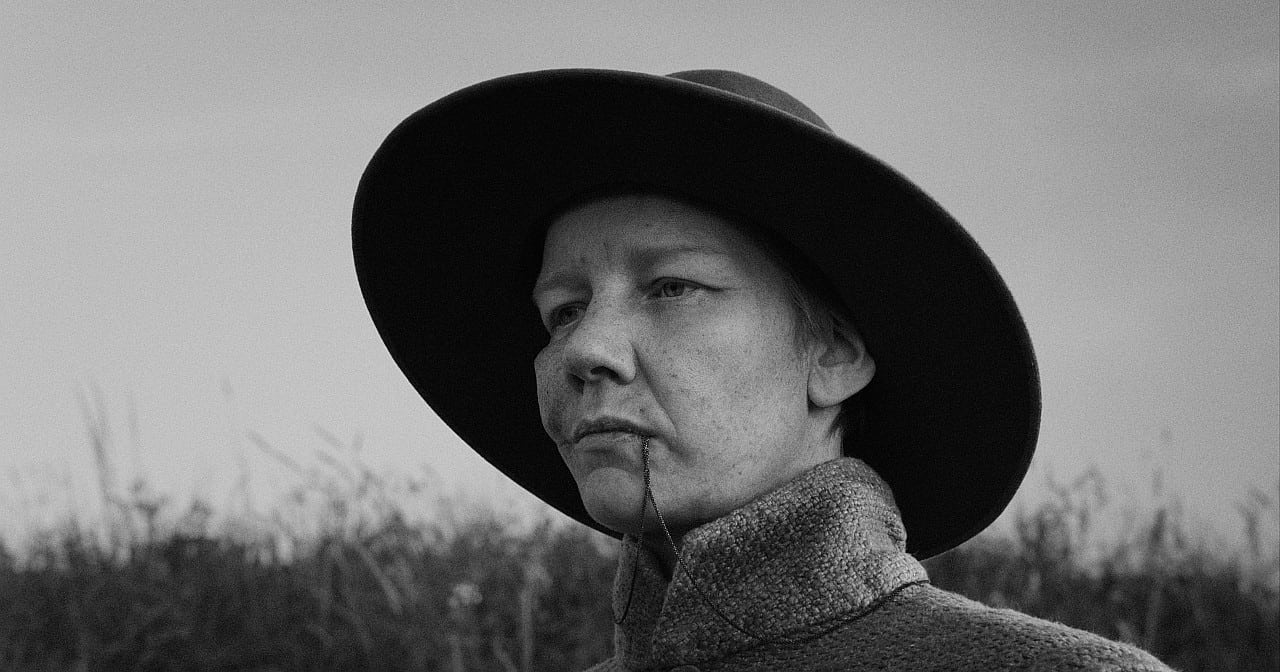
The small leaden ball Rose wears around her neck at all times. She often puts the pendant in her mouth—as if it were a memory. Because the ball struck her in the mouth, leaving a long scar along the right side of her face. One eye droops, the right corner of her mouth hardly moves.
But the ball is more than a memory. It is proof. It should leave no room for doubt. For Rose takes on a male role. As a soldier, he fought in the Thirty Years’ War. Now he returns home to inherit the family’s estate with a bit of land. A new life, a chance to settle down.
Rose crafts an identity
As a woman, that would have been impossible in the 17th century — and for centuries to come. So Rose reinvented herself. She creates an identity that gives her more options and protects her.
Even if Rose is not a trans man in today’s sense, her stance is nonetheless transgressive: she crosses norms and cannot be satisfied with the role assigned to her gender. She is aware that this also puts her in danger.
Rose and Suzanna marry
The village community initially regards the newcomer with deep skepticism. This changes only when Rose kills a bear. Then she becomes a possible partner, and a marriage with the young, devout Suzanna (Caro Braun) is arranged. “Of all things, I most value your purity. I want to preserve that for a long time,” Rose tells her. Only Suzanna’s father is not convinced. A marriage carries duties.
“It’s only a matter of fabric, and I ended up in trouble”
The queer historical drama “Rose” by Austrian director Markus Schleinzer delighted audiences at its premiere at this year’s Berlin Film Festival. Shot in black and white, the film tells the complex story of an ambivalent figure—and, at the same time, much more beyond that.
Direct link | Official trailer |
The film is, as its subtitle declares, “the story of a land and people swindler.” Rose must not slip up. To prevent that, she internalizes the male role so completely that she mistreats her wife Suzanna just as badly as the servants and farmhands—worse than she would like. “It’s only a matter of fabric, and I ended up in trouble,” Rose says, though she knows this is only the result of an external perspective.
The hardness is felt at every step
The inner conflict is palpable. Lead actress Sandra Hüller, currently Germany’s most internationally acclaimed actress, lends her character a hardness that you can feel in every broad-stance stride. Her body is shaped by the tight leather tunic, her gaze by the constant worry of not being man enough. In one of the most striking scenes, she must stand alone against the suspicious village community. She succeeds. A performance for which Sandra Hüller was awarded the Silver Bear.
The queer community needs a strong journalistic voice — especially now! Do your part to support TheColu.mn’s work.
“Rose” is not only about the aesthetic black-and-white imagery. The film develops a formal rigor that mirrors the village’s sternness. The sober narrator’s voice, whose origin is only revealed at the end, also fits this tone. The powerful score by Tara Nome Doyle, sung a cappella, underlines the drama’s tender side. In the first half, the film takes its time to capture moods. Later, the storytelling moves faster and sometimes feels almost rushed.
“Impossibility is only a word”
The film explores possibilities that are seized and the spaces of possibility one can create for oneself. “Rose” tells, on the one hand, a story grounded in research into more than 300 similar women’s biographies—and, at the same time, addresses the social effects that still exist today.
“Impossibility is only a word, and words can be changed,” the narrator says toward the end of the film. “Once spoken, they enter the world, become reality, and have consequences in reality,” she adds. As true as these words are: the price is high when reality breaks. That was true in the 17th century—and it remains true far too often today.
Rose. Historical drama. Germany 2026. Director: Markus Schleinzer. Cast: Sandra Hüller, Caro Braun, Marisa Growaldt, Godehard Giese, Robert Gwisdek, Maria Dragus. Runtime: 94 minutes. Language: original German. Rating: FSK 12. Distributor: Piffl Medien. Theatrical release: April 30, 2026