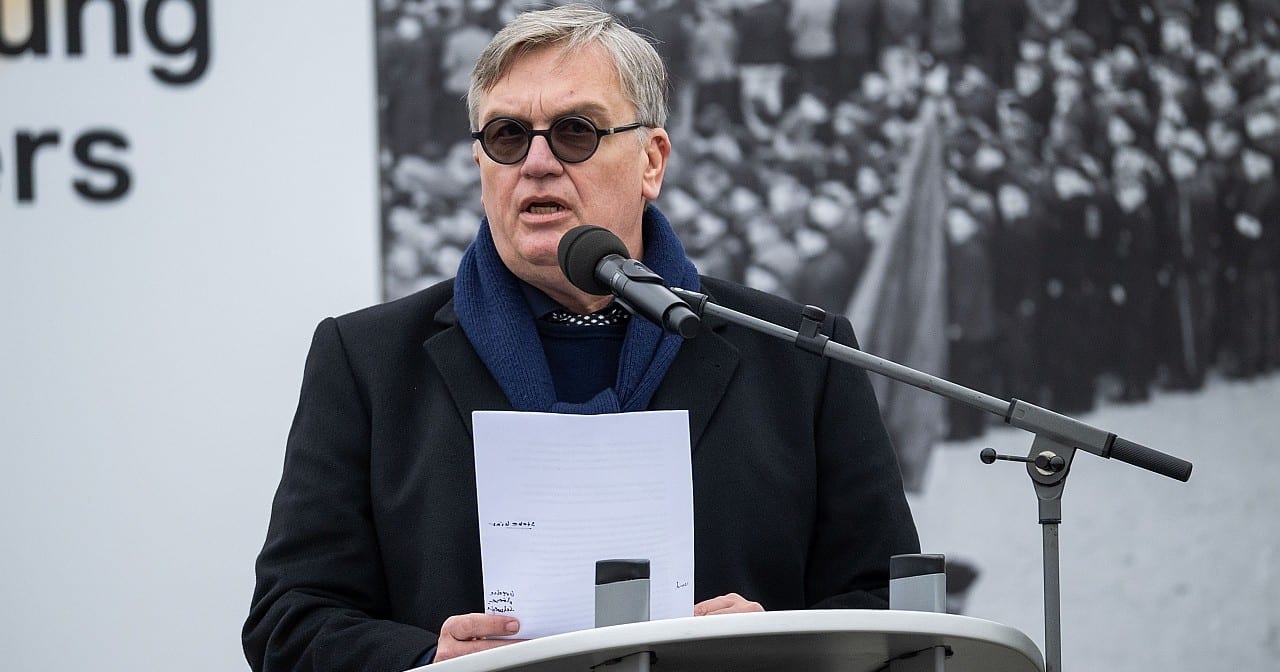
His grandfather endured twelve years of torture and forced labor under the Nazi regime: For the gay entertainer Hape Kerkeling, the modern Buchenwald concentration camp memorial is not a distant place of remembrance but part of his family history. “Here in Buchenwald he was tortured, humiliated, and witnessed countless murders. That he survived this madness is a miracle,” Kerkeling said during a speech at the Buchenwald memorial in memory of the camp’s liberation 81 years ago.
He also urged that memory and responsibility be kept alive. “The voices calling for an end to the culture of remembrance are growing louder and bolder! A final brush‑off of memory would be the final brush‑off of our democracy,” he said. Article 1 of the Basic Law — “The dignity of the human being is inviolable” — is a stone‑carved answer to Buchenwald. “Whoever would erase this valuable memory, who would belittle this era to a ‘bird dropping,’ harms our foundation,” he said. A mindset that excludes people again, divides society, and relativizes crimes has no place in Germany.
Kerkeling’s Grandfather Distributed Leaflets Against Hitler
Kerkeling’s grandfather Hermann was a political prisoner at Buchenwald. In the concentration camp near the town of Weimar, the Nazis held more than a quarter of a million people between 1937 and 1945. About 56,000 of them died during captivity due to the brutal conditions in the camp or were killed by the SS. On April 11, 1945, American troops reached the camp. On May 8, 1945, World War II in Europe ended with the unconditional surrender of the German Wehrmacht.
Hape Kerkeling said of his grandfather that he was not a man of many words, but a man of action — a carpenter from Recklinghausen (North Rhine‑Westphalia). “He was a person who simply was not willing to look away when the darkness descended on Germany.” Hermann Kerkeling had distributed leaflets against Adolf Hitler shortly after the Nazis seized power in 1933. “He did not shoot, he did not sabotage — he simply wrote, printed, and distributed the truth. That cost him twelve years of his life. Twelve years!” said Hape Kerkeling at the memorial event.
“Never Again” as a Daily Compass
Hermann Kerkeling arrived at Buchenwald in July 1942 — number 6,117. “My beloved grandfather Hermann kept quiet to protect his family. I break this silence and speak today to honor him and all the victims who suffered and died here. And I ask you all: Speak as well. Do not let the silence take over again,” said Hape Kerkeling in his speech. Democracy does not live by looking away, but by facing what happened with courage. “Let us work together to ensure that ‘Never Again’ is not just lip service, but our daily compass.”