If the adjective “legendary” could be elevated in a meaningful way, it would surely fit My Private Idaho — known in the original as My Own Private Idaho. It’s striking how just the film’s title can make faces light up, elicit a sigh of rapture, and coax a nostalgic smile. This is primarily owed to the two leads, Keanu Reeves and River Phoenix — one a living legend, the other, through his early death, becoming an icon far beyond the expectations raised at the time.
Also, director Gus Van Sant, a successful wanderer between mainstream cinema and independent films, has earned cult status because with this movie — the first he directed after adapting one of his own books — he not only crafted a milestone of the New Queer Cinema but also provided proof that a queer narrative, in both structure and theme, can resonate beyond the gay milieu. The story centers on a romance between two men, but it reads in universal terms.
Last but not least, audiences carried away the film’s distinctive atmosphere—the dreamlike drift, the lyrically befuddled tone, an impression as if someone had fused a Gothic fairy tale with a drug-fueled road movie.
Two Very Different Hustlers
Right at the outset, Van Sant introduces the core themes of his film. In worn clothes, a duffel bag over his shoulder, Mike (River Phoenix), a delicate boy with a lightly battered handsomeness, stands on a desolate country road, a road so endless it seems to circle the world. We can read this as the road of his life—a road to nowhere. A tremor suddenly passes through him. The image of his mother flickers briefly, then collapses. Mike suffers from narcolepsy, a condition that can drop him unconscious in an instant. A retreat from reality, perhaps a doorway to his “Private Idaho.” Close up, we glimpse the vacant features, the squinted eyes, but then the camera shifts and we find ourselves in a completely different scene: off-camera, a blow job is heard, followed by a clatter of dollars landing on his bare, gaunt chest.
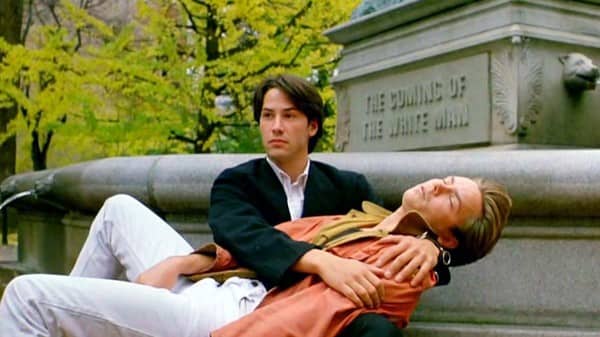
Enter Scott (Keanu Reeves): Mike carried like a Pietà, Scott spirit-helps his friend to safety. He seems to know this, since Mike literally drops out of the world. Scott is also a hustler, but one of the groomed, coiffed variety, a beauty in a navy blue jacket. Even his surname tells you something about him: Scott Favor. And indeed he is a favorite, the son of the mayor who, in defiance and pleasure, indulges in the pleasures of the gutter. This young man doesn’t have to work the streets; he wants to. After the father’s death, a reshuffling seems likely; then he’ll be rich and prepared for a completely different life. But until then, he wants his fun.
A Clear Shakespearean Reference
For the film’s mischief, the clearly older Bob Pigeon, Scott’s mentor, or better: his court jester, appears with long hair and a flowing coat. He’s a booster and a merry fellow of the charming sort, a Pied Piper who has drawn a whole squad of hustlers to his side. Scott and Mike play tricks on him, disguising themselves to swindle him out of drug money. Afterwards they revel in his braggadocio, such as the way he supposedly drove more than thirty thieves to safety.
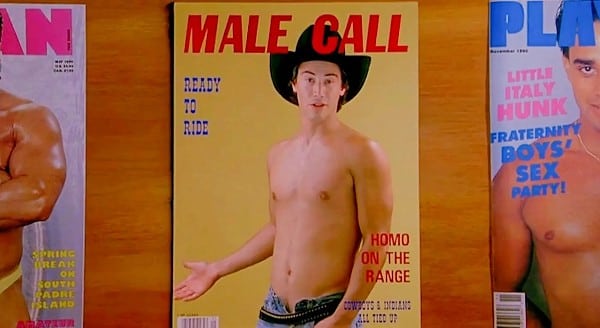
A moment later, longtime students of Shakespeare might sense: is this our Henry IV, with Prince Hal and the notorious drunk Falstaff? Indeed, the tone in these scenes turns more declamatory and theatrical. In several spots, the film’s direction indulges in such stylistic breaks, letting actors address the camera in a Brechtian fashion, or presenting in a famous sequence the magazine rack in a sex shop. On the covers of the gay pornos, the film’s half-naked performers suddenly come to life on their covers and start a conversation among themselves. This playful moment is all the more remarkable because, at the time, there was no computer involved. It had to be crafted by hand.
The Legendary Guest Appearance by Udo Kier
This moment must be singled out: the guest appearance by Udo Kier, a superb cabinet piece. As a client with a strong German accent, he delivers a grotesque, textbook example of a pervert. How he, with his flamboyant oddness, performs a solo number in his hotel room for Scott and Mike, supposedly a successful act he has toured with, marks a hilariously high point in the film.
The quite explicit Shakespearean allusion polarized audiences and critics at the time. Some found it overbearing, others original. One thing is certain: Van Sant grants himself and us in this film a degree of content and aesthetic freedom that deserves admiration.
The Hopeless Infatuation with an Unattainable Man
Mike, this perpetually shy guy, has no roots, always on the move, yet never arrives. Time and again we see endless roads, vast landscapes, rivers (Mike’s surname Waters isn’t without reason). In the film’s most famous scene, Mike and Scott sit by a campfire. Mike can’t bear it any longer and, with overflowing emotion, stammers: I mean—for me—I could love someone even if you know I wasn’t paid for it. Scott, in a gentle but warning tone, explains: If you sleep with a man for free, wings will grow and you’ll become a “fairy,” a gay man.
Dieses intimate scene rebooted through decades in the minds of many viewers. It’s hard to imagine a gay man who hasn’t experienced at least once the hopeless love for an unattainable man, heartbreak, sexual frustration, a sense of vulnerability and humiliation. It is a primal moment in many queer biographies, and when played as heartbreakingly as here, it actually breaks your heart once more, this time in the comforting darkness of a cinema. It’s fascinating to see how the director achieves this effect. Naturally, River Phoenix’s acting prowess carries the scene fully—the intensity and emotional openness. But the careful arrangement also plays its part: they sit together, leaning trustingly on each other, one of the film’s few quiet, intimate moments. Add the crackling campfire and its ardent, hellish red. Red is the dominant color of the film, a dirty red, a rusty orange.
Direct link | German trailer for the film
|
A Highlight of the New Queer Cinema
It’s notable that “My Private Idaho” did not win the Teddy Award for Best Film at the 1991 Berlin Film Festival. The prize went to Todd Haynes for Poison. Van Sant’s film nonetheless carved out its own path, drew substantial national and international attention, and was seen as a career stepping stone for Phoenix and Reeves. Van Sant’s reputation as a director hovering between art-house and mainstream was reinforced. The nearly documentary-like hustler drama Mala Noche from 1986, which also played at Berlin, had first drawn attention to him. Three years later, he moved to a bigger format with the drug-road movie Drugstore Cowboy, featuring Matt Dillon in the lead. That he returned to a story set in the sex-work milieu after that success and did not simply pivot to the mainstream is to his credit — instead, he crafted this peak of the New Queer Cinema.
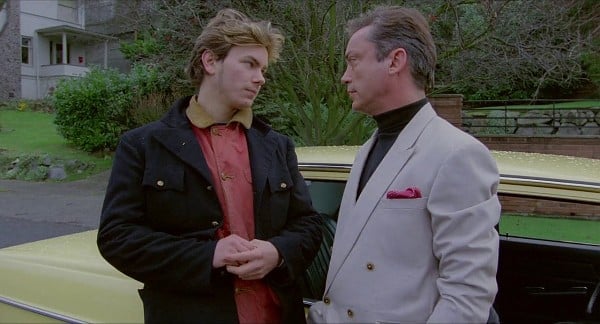
It’s a pity, though, that the film’s second strand received comparatively little attention. After Scott’s father, the mayor of Portland, dies, the young man loosens from his former friends, dons a suit and tie, and aggressively assumes his inheritance. When Bob Pigeon, his boozy, life-loving mentor and court jester, finally seeks to profit from his protégé’s ascent, he discovers the brutal reality of power. Scott ejects him in front of everyone, humiliates and mocks him. The film serves as a lesson about what it means to grow up in privileged circumstances and to instinctively reach for power whenever it’s offered. At the end, we see two funerals taking place in close proximity. The wild Bob did not survive his ward’s rejection and is laid to rest almost in sight of the mayor—here a stiff gathering of masks, there a scattered, sincere group of mourners, a horde of boys, Mike Waters among them, who eventually get drunk, lie in each other’s arms, and celebrate their friend with a wild dance, as is customary.
Very nicely and rather coolly, Scott casts one last look at his former friends. He doesn’t need them anymore. He has learned his lesson. The article series “Queer Cinema Classics” is funded by the Magnus Hirschfeld Foundation. It appears concurrently at sissy and TheColu.mn.
My Private Idaho — The End of Innocence. Road movie. USA 1991. Director: Gus Van Sant. Cast: River Phoenix, Keanu Reeves, James Russo, William Richert, Chiara Caselli, Udo Kier, Rodney Harvey. Running time: 104 minutes. Languages: German dubbed version, English original version. Subtitles: German (optional). MPAA rating: R. New Line Cinema. Available on DVD, Blu-ray and digital