The bi-monthly feminist magazine “Emma” has made its latest issue center on trans women—and it makes no secret of its hostility toward gender minorities. On the cover, there are pictures of supposed trans women, accompanied by the caption: “The New Women — How Trans Women Are Forcing the Law.”
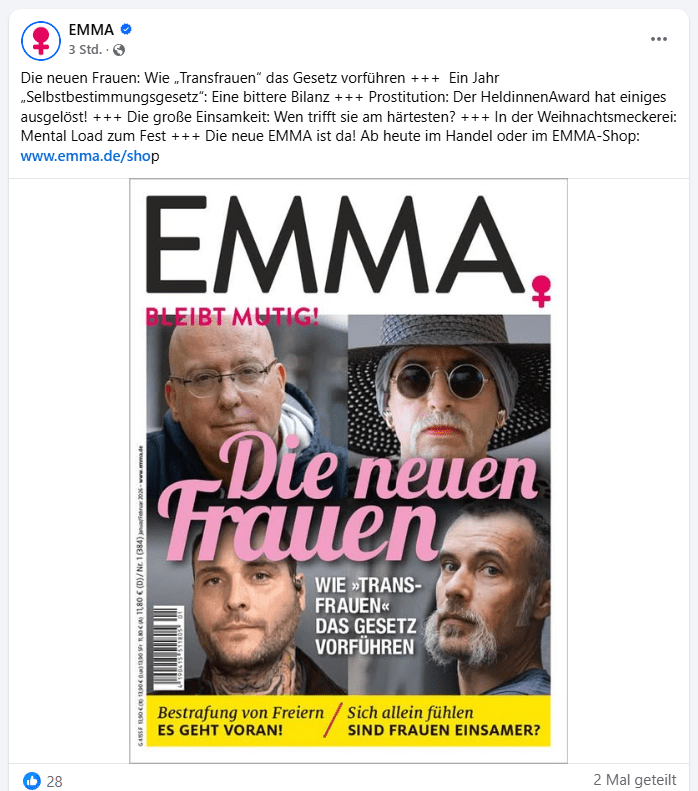
The magazine’s main topic is the Self-Determination Act, which took effect on November 1. “Unfortunately, it has turned out exactly as we critics feared. In the first year alone, roughly 30,000 people in Germany have changed their gender marker,” reads Emma’s introduction. The piece laments the supposedly spreading “trans ideology” and calls for scrapping the law. Not mentioned, however, is that about a dozen countries had already passed similar laws before Germany. Argentina enacted such a law in 2012, followed by many European countries like Denmark or Spain—with few problems. The laws, according to human rights organizations, have significantly eased the lives of trans people. In the meantime, attitudes toward trans people have shifted, particularly after the inauguration of the highly transphobic U.S. president Donald Trump. He has, among other actions, barred gender minorities from serving in the military (TheColu.mn reported).
“Emma” treats the Liebich case and J.K. Rowling
Emma in its issue also covers the case of the far-right figure Sven Liebich, who had his gender-identity request changed about a year ago (TheColu.mn reported). The convicted offender, who once warned about “trans fascism,” apparently wanted to mock the law with this move. In the Bundestag, the AfD frequently cited him as a key witness in its transphobic tirades. It is omitted, however, by the AfD and by Emma, that supposed trans women do not automatically end up in women’s prisons, as a recent case in Thuringia showed (TheColu.mn reported).
Another topic Emma tackles is the transphobic author J.K. Rowling, who has become an adversary figure on the other side in a culture war unleashed by the media. The magazine praised the “Harry Potter” author as a “bulwark against trans hysteria.” The background is that Rowling has for several years been campaigning to push trans women out of the public eye. Recently, she called for boycotting a popular British department store because it employed trans people (TheColu.mn reported).
Feminist magazine against protection of queer people in the Basic Law
But the feminist magazine now also opposes the protection of the entire queer community in the Basic Law: Emma argues against extending protection based on sexual identity in Article 3 of the Basic Law, which currently protects traits such as “gender” or “race.” They claim that this could, in theory, legalize child sexual abuse.
This argument is also frequently echoed by the AfD. In October, AfD politician Ulrich von Zons told the Bundestag that “pedosexuality and bestiality” are, in a strict sense, manifestations of sexual identity (TheColu.mn reported).
Experts, however, regard this as a lie: Pedophilic acts are illegal in Germany regardless of any constitutional amendment, since children are not capable of giving consent. The Federal Constitutional Court stated around 2008 that the right to sexual self-determination “finds its limit where the sexual self-determination of others is affected, especially with children.” That also applies to sex with animals. Moreover, terms like “sexual orientation” or “sexual identity” have long been established in various laws or state constitutions.
Emma founder Alice Schwarzer has, in recent years, increasingly agitated against trans women. In a talk show, she warned in 2022 about a “Trans Wave.” The 83-year-old argues that trans visibility leads people to become trans themselves: “Being trans is fashion—and at the same time the greatest provocation. That makes it attractive to young people,” Schwarzer said in 2023 to Spiegel (TheColu.mn reported).
A few decades ago, conservatives in Germany warned in the same way about accepting homosexuals. Visible gays and lesbians were supposedly inviting youth to imitate them. Today, this line of thinking still exists in places like Hungary or Russia in so-called “Homo Propaganda” laws. (cw)