The United Nations General Assembly on Wednesday adopted a new disability rights resolution, but in doing so struck a clause that would have recognized queer people with disabilities. The LGBTI organization Outright International criticized that many member states of the Organization of Islamic Cooperation (OIC), with help from the United States, had pressed for the deletion. An Egypt-proposed amendment passed narrowly—with 81 votes to 77, and 15 abstentions. Under the Biden administration, the United States was still regarded as a leader in protecting queer people within the UN General Assembly in New York.
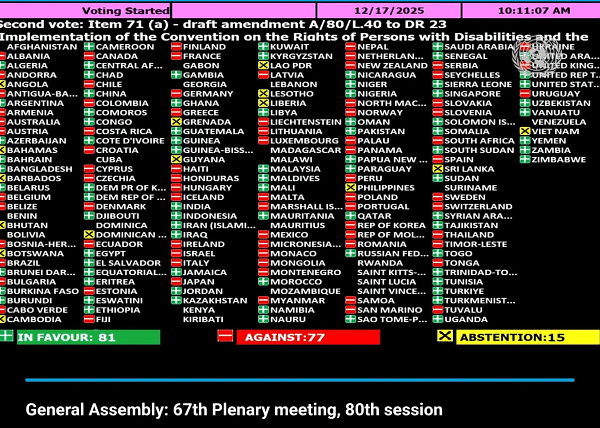
Besides most OIC member states and the United States, Russia, China, and India also voted in favor of the measure. EU member states rejected the amendment together with countries like Canada, Mexico, Brazil, Japan, Israel, and Ukraine. From Europe, the Yes votes came only from Russia, Belarus, and Turkey. The original text had merely noted that people with disabilities faced heightened barriers when their disability intersected with different forms of discrimination— including discrimination based on sexual orientation and gender identity.
Egypt had, with vocal support from the Trump administration, presented its amendment as removing a controversial topic from the resolution and stated, “A vote for removing sexual orientation and gender identity is a vote for people with disabilities.” Disability and civil rights organizations, however, firmly rejected this view.
Originally, the motion to strike the formulation had been rejected at 74 to 70. On Monday, at the request of the OIC, there was another vote to remove sexual orientation and gender identity from the document. This ended in a 74-74 tie. Thereafter, the OIC and the United States apparently pressured other states, causing the result of Wednesday’s vote to flip. For example, Seychelles and Sri Lanka rejected the measure on Monday but abstained on Wednesday.
Overall text adopted, with votes against the United States
The consolidated text was subsequently adopted by an almost unanimous vote—176 to two. The only opposing votes came from Argentina and the United States. In both countries at the time, conservative-leaning governments were in power. The resolution, co-sponsored by Mexico and New Zealand, addresses core issues such as accessibility, inclusive education, and the rights of people with disabilities in risky situations.
“We broadly welcome the adoption of this resolution, which strengthens globally crucial protection mechanisms for people with disabilities,” said Maria Sjödin, the head of Outright International. “But protections based on sexual orientation and gender identity would have made it a far stronger resolution. LGBTQI people with disabilities deserve visibility and must not be made invisible. Today’s vote is a painful setback for them.”
Sjödin noted that despite the vote setback, queer people continue to claim the full spectrum of human rights. “No vote can erase the fundamental truth that all people are born free and equal in dignity and rights,” Sjödin said. “Therefore the resolution must be implemented in a way that leaves no one behind.” (dk)