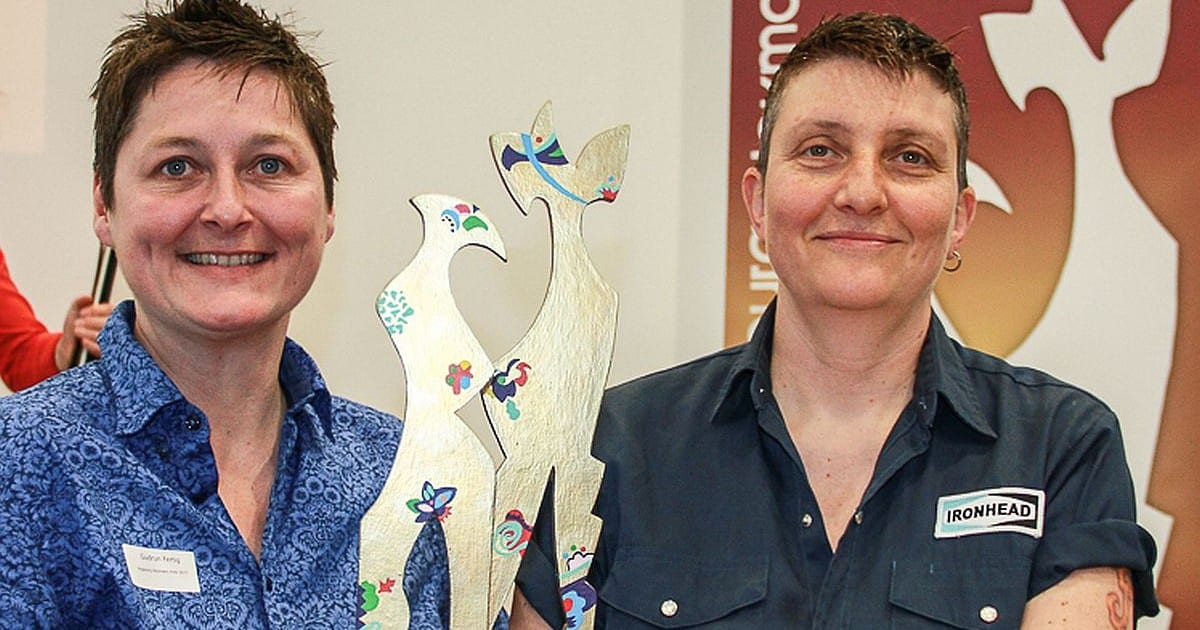
The “Siegessäule” wants to reinvent itself and transition from an LLC (GmbH) into a cooperative. In fact, the planned publishing transformation initially appears highly coherent — almost tailor-made for a media outlet like the venerable queer city magazine, which also includes “L-Mag” and the “Siegessäule-Kompass.” Since the magazine lineup was purchased in 2012 by Gudrun Fertig and Manuela Kay in a bidding process, profits never seemed to be the sole goal for the two partners. Instead, their actions radiated an idealism guided by the creed of a solidaristic queer community.
Consequently, the latest issues of the “Siegessäule” are touting the new venture as a kind of collective operation: “Queer stays strong! With you!” and “Become an accomplice of Siegessäule!” Alongside these words are three raised fists with painted nails against a rainbow backdrop — an image meant to signal momentum and readiness to take on challenges in economically and politically turbulent times. Yet such imagery belongs to the conventional repertoire of campaigns that outwardly project unity while internally uncertainty is brewing.
That impression is reinforced by a recent circular letter. Kay and Fertig say they sent it to more than 850 interested people who had joined a list on komplizin-werden.de in the three months since the campaign began. The response has been notable, a sign of broad solidarity and appreciation — yet the tone of the letter also hints at unease. What began as a combative project for the community is increasingly framed as a possible exit from a crisis. This comes through most clearly in the subtext: “With the cooperative we want to initiate a fitting transition and return the publishing house to the hands of the community. We will stay on board through the transitional period and support the new board team.”
The cooperative is still looking for “leaders”
But who will make up the new board remains entirely unsettled — Fertig and Kay are discussing a transition rather than a future. Responsibility is intended to be handed off, and from now on “leaders” from the community are being sought to apply to the “Siegessäule.” No timeline is given. The scant disclosure of information gives the impression of a rushed and somewhat chaotic process — are the publishers planning their exit after the transition? At least Manuela Kay has been speaking for some time about the burdens that editorial and publishing operations bring with them.
Neither of the two shareholders of Special Media Verlag would comment on this question. Other inquiries about the operational shift also remained unanswered. Gudrun Fertig simply noted that the originally planned founding of the cooperative this year would be postponed: “We are still in the design phase. Everyone interested in membership in the future cooperative will be informed in due time.” And Manuela Kay wrote: “I’m not giving interviews on this topic right now, as anything said would be very imprecise at this moment.”
There is no doubt that such a move is complex and should be contemplated and prepared in detail. Yet shouldn’t the basic concept have at least been defined in broad terms before going public with the announcement? Especially since the timing isn’t particularly favorable at the moment. The pandemic era—five and a half years ago—felt very different, when the magazine found itself in existential danger and was buoyed by a wave of solidarity. In May 2020, local artists stood up for “their” “Siegessäule” and contributed a symbolic 50 euros to mobilize readers to follow suit. Stars like Wolfgang Tillmanns and Marlene Dumas were persuaded to lend reproductions of their artworks for a fundraising drive. That effort was a resounding success.
Criticism of Coverage of the Middle East Conflict
Meanwhile, as for the magazine’s bond with its community, this year hasn’t gone as smoothly. A particularly sharp bout of criticism followed a May issue piece on the Middle East conflict and the portrayal of queer Palestinian deaths — notably without explicitly linking to the October 7 attacks or to Israeli victims in the text. The editors had hoped to give a voice to the many queer Palestinians in Berlin who are increasingly speaking out themselves, but they ended up overlooking the broader political context.
Senior voices from the community voiced their outrage. “I’m happy to facilitate the contact to queer people who are being tortured, raped, and persecuted by Hamas in Gaza and their Islamofascist friends in Lebanon,” Ina Wolf — head of the “Queer Refugees Deutschland” project — commented on Facebook, drawing widespread support.
“You betray every lesbian, every gay man, every trans person, every reader you have, and throw our persecutors and murderers at our readers’ feet,” wrote East-Pride activist Anette C. Detering, who even got personal: “Manuela Kay, have you lost your mind?” Even though Kay did not write the piece herself, the criticism of her leadership as editor-in-chief was unlikely to wash away easily.
Two months later, the heated debate over the Middle East within the queer scene itself became the magazine’s focal topic once again. The feature “How the Middle East Debate Is Ripping the Community Apart” in the July issue drew another wave of pointed criticism from prominent voices. Ilona Bubeck, former publisher of the Querverlag, argued: “The piece is just as one-sided, only dressed up as a desire for harmony. Real understanding doesn’t look that way and requires knowledge and education about Israel’s history. But that’s, of course, exhausting and doesn’t create a flat we-all-are-together feeling.”
Where is the “Siegessäule” Heading?
Yet what matters to the “Siegessäule” is an authentic sense of togetherness within the community — and that is exactly what the cooperative project aims to foster. Accordingly, there are plans to distribute content responsibility across many hands. What emerges will remain open until core questions are clarified. None of those asked knows precisely with whom one would be entering a shared enterprise by buying a stake. Where is the “Siegessäule” headed, and who will set the course in the future?
One thing is clear: the power dynamics at the publishing house will shift. It won’t be just about the new cooperative board, for whom responsible roles are only just being found. Siegessäule, unlike the model the Fertig and Kay cite as an example — the taz — is heavily dependent on advertising from the community. While nationwide more than 25,000 people participate in the taz cooperative, even an optimistic estimate of 1,000 shares for the regionally bound Siegessäule would hardly generate a flood of new capital — even a regional print magazine of this size is far more expensive than most people imagine.
Time is pressing. Manuela Kay and Gudrun Fertig bluntly state the crisis in their circular: “The publishing house’s financial situation is becoming increasingly difficult.” The transformation must occur “in the near term.”
For the Siegessäule, this means mobilizing more people than ever in a short period — and perhaps collaborating with other queer organizations. In addition, concrete guidelines for handling contentious topics must be established during the ongoing preparation phase.
Whether the magazine will truly flourish again in this form remains to be seen — for in an era of queer-hostility, cheap AI-driven “journalism,” and waning solidarity, Siegessäule is as important as it has been in decades. Whether the project will succeed will only become clear once transparency replaces insinuations. A community cannot be won simply by invoking grand statements.