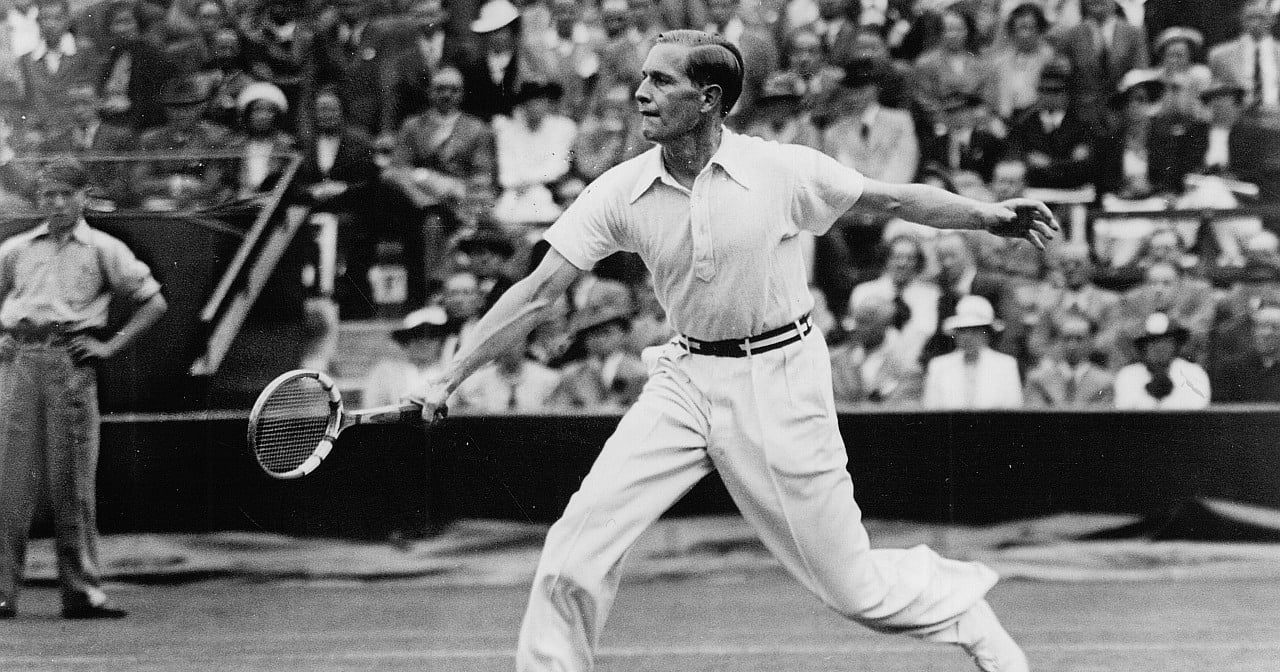
It’s hard not to like Gottfried von Cramm (1909-1976). He looked good, was always friendly and charming. Although he was ambitious, fair play always mattered more to him than winning a game at any cost. In his biography, heroism is paired with humility. The Nazis could never bend him: he never joined their party and spoke his mind openly. The “taz” described Cramm as a gay, anti-fascist early existentialist, but above all as a man, an icon, and a role model. Even if Cramm hadn’t married Barbara Hutton, the Woolworth heiress and one of the wealthiest women in the world, he would still have been surrounded by enough glamour.
The following texts are based largely on the successful biographies “Ich spiele um mein Leben. Gottfried von Cramm und das beste Tennismatch aller Zeiten” (2009) by Marshall Jon Fisher and “Der schöne Deutsche. Das Leben des Gottfried von Cramm” (2021) by Jens Nordalm. The two titles do not immediately suggest that they concern Hitler’s Germany. Only his athletic success shielded Cramm from criminal persecution by the Nazis for a long time. That, however, also created immense pressure to perform and gave him the sense of playing for his life. The book “Der schöne Deutsche” deliberately uses its title as a counter-image to the “hässliche Deutsche” – the Nazi.
Cramm was an internationally celebrated star. His life was also perceived abroad and in recent years has been depicted in several film adaptations. James Bond actor Pierce Brosnan lent his voice to Cramm in the animated film “Playing to Survive: von Cramm vs. Hitler” (2024). Thus Cramm can still serve as a role model and raise awareness that there were people who resisted the system.
The Weimar Republic
Cramm arrived in Berlin in the summer of 1928, at a time when the city was the hub and magnet of the homosexual movement. To describe the situation of LGBTQ people at that time, the two biographers rightly refer to Curt Morecks’ “Führer durch das lasterhafte Berlin” (1931), which details Berlin’s homosexual scene in the Weimar Republic. The most famous gay venue by far was the Eldorado. Court records show that Cramm not only frequented Eldorado but also several other gay bars. He described ball-like events that were almost exclusively attended by gay men, at which some men wore “rose-scented pajamas.” At one point Cramm even took a colleague, the American tennis player John Van Ryn, to such places. Van Ryn was shocked by the men with painted lips. At the end of the 1920s, Cramm went to the cinema to watch the film Wings. How he might have felt about the poignant kissing scene between two men is not known.
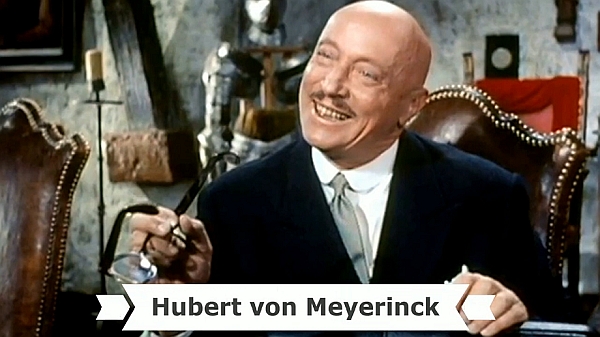
The well-known film and stage actor Hubert (“Hubsi”) von Meyerinck was a friend of Gottfried von Cramm and his family. The gay Meyerinck was openly expressive about his sexuality even in the Weimar era, performing as a “Nun,” “Trick,” and “Cocette.” A half-century later, in the travesty farce “Wenn die tollen Tanten kommen” (1970), Hubsi continued his theatrical play with homoerotic innuendo: he embodied the heterosexual Mr. Storz, who is interested in a man because he believes he is a woman.
Cramm’s Relationships with Elisabeth von Dobeneck and Manasse Herbst
On September 1, 1930, Gottfried von Cramm married Elisabeth (Lisa) von Dobeneck. Lisa allegedly told her husband early on that she would have extramarital affairs and that he could do as he pleased. Lisa and her friends were very open to lesbian experiences and bisexuality. Photos show her sporting a fashionable bob cut that was considered a “boyish haircut” and was favored by feminists.
The newlywed Cramm met in 1931 in a bar on Lutherstraße—the Eldorado or the Jockey-Bar—the 17-year-old Galician Jew Manasse “Manfred” Herbst. Herbst had previously acted in two silent films, “Papa Haydn” (1920) and “Der Sohn des Hannibal” (1926), both of which are today sadly lost. When Herbst met Cramm, Herbst was starring in the successful operetta “Im weißen Rößl,” which contained ironic, including gay, innuendos and would later be forbidden as “degenerate.” The slender, feminine Herbst drew attention for his resemblance to Lisa. From spring 1931, Cramm and Herbst regularly met at the Petersburger Hof and frequented Berlin gay venues such as Silhouette, Idè, Kleist-Kasino, and Hollandaise. Their relationship, however, was not hidden well enough to avoid rumors, which later led to a police complaint and to Cramm’s conviction. In March 1933 Herbst left Germany for safety. With funds that were illegal at the time, Cramm helped him emigrate and perhaps to survive. Herbst initially found refuge in France, but soon made it to the United States, where he later married. Even after the forced emigration, Cramm and Herbst remained in contact. After the war, Herbst visited Cramm in Germany twice.
Cramm’s Relationship with “Big Bill”
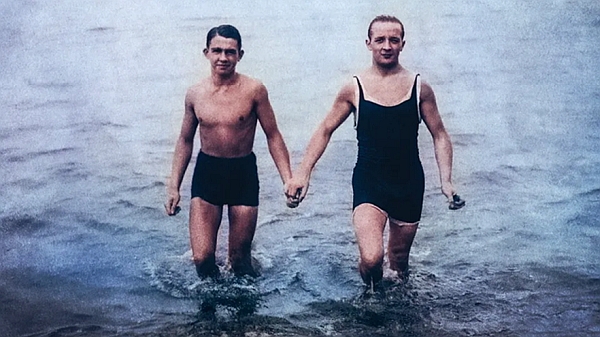
Gottfried von Cramm and William “Big Bill” Tilden shared a close and trusting friendship in the 1930s. Tilden was then also working as a trainer and adviser for Cramm and the German Davis Cup team. The two men were united not only by sport but also by their homosexuality. Before the legendary Davis Cup match of 1937, when Cramm was already under intense surveillance by the Nazi regime, he confided in Tilden with the words: “I’m playing for my life” — because he believed that only his success on the court could shield him from persecution in Germany. The two were later sentenced for sexual acts: Cramm in 1938 in Germany, Tilden in 1947 and 1949 in the United States. Tilden’s career and life were shattered by the consequences. He died in poverty at the age of 60 in Los Angeles.
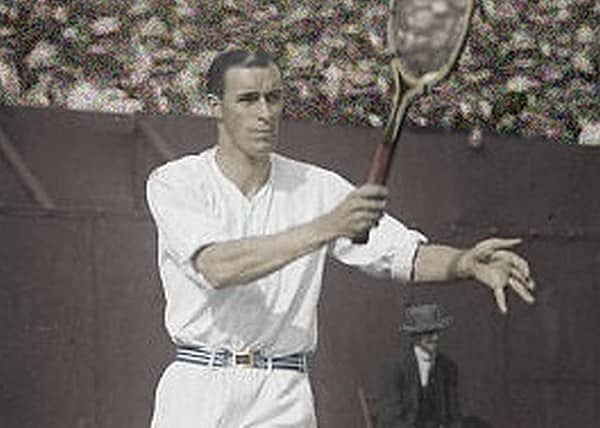
Marshall Jon Fisher chose Tilden’s surviving Cramm quote “I’m playing for my life” not only as the title of his Cramm biography, but also discussed at length Tilden’s sexuality (e.g., pp. 347-352, see index). The fact that both had a “surgically shortened right index finger” reportedly gives an almost ceremonial significance to the image, according to Fisher (p. 39).
There are at least two important differences to note: for one, the sometimes arrogant Tilden was far less popular than Cramm. Second, the age of sexual partners is a question. Tilden did share hotel rooms with a gay soldier on more than one occasion, but the objects of his desire were often “boys in their teens” (p. 37), “ball boys” (p. 302), and adolescent “boys” (p. 347). In his first conviction, the case involved a 14-year-old, and a second conviction involved a 15-year-old hitchhiker he had picked up in his car. Sexual acts with minors, in the sense of ephebophilia, are fundamentally different from acts with adults.
After Hitler’s Rise to Power in 1933
With Adolf Hitler’s appointment as Reich Chancellor in 1933, the situation for homosexuals changed dramatically and irreversibly. By the time Ernst Röhm, a homosexual Nazi, was murdered in June 1934, no queer person could feel safe. In 1935, Paragraph 175 was even tightened. It was now illegal not only to engage in clearly sexual acts but also to engage in mutual masturbation and kissing. In 1936 the Reich Central Office for the Combating of Homosexuality and Abortion was established.
Cramm came from an aristocratic family, had married Lisa, a woman deemed “half-Jewish” by Nazi racial doctrine, and was gay. As the head of a golf club, he refused to exclude “non-Aryers” in November 1933 — a policy that was later forced upon him in March 1934. He had not joined the NSDAP and had spoken critically about Nazi Germany abroad. Politically and sexually, Cramm was far from the ideal Aryan role model. The Gestapo began compiling a file on him, noting his visits to Berlin gay clubs. Yet Cramm remained unharassed for a long time, apparently solely due to his tennis success. Shortly before his downfall, he was one of Germany’s most popular athletes, second only to the boxer Max Schmeling.
The Arrest and Conviction of 1938
On March 5, 1938, Cramm was arrested for his homosexual relationship with Manasse Herbst and was taken to the Gestapo headquarters on Prinz-Albrecht-Straße in Berlin. He was charged afterward. Cramm initially admitted to sexual relationships with Herbst from 1931 to 1936. He later corrected his statement, insisting the relationship had ended as early as 1935.
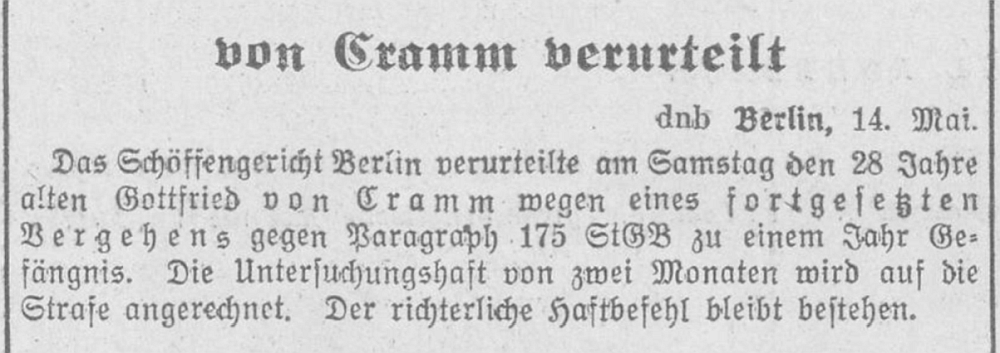
His sentence was comparatively mild: on May 14, 1938 he was convicted under Paragraph 175 of the Reich Criminal Code to one year in prison, the time already spent in pre-trial detention being credited. He was not convicted for foreign exchange offenses—the financial support Herbst had abroad—because the court found it plausible that he transferred funds abroad only because Herbst, a Jew, had coerced him. The supposed coercion described by Cramm was a pretext that protected him and did not harm Herbst, who was safely abroad.
According to the historian Manfred Herzer, the detailed verdict “documented the facts and the spirit of Nazi justice at the time” and also reflected “aspects of the everyday reality of a homosexual man at the start of the thirties.” Therefore, Herzer published the full reasoning in his magazine Capri (Capri, No. 1 = No. 11, 1991, pp. 3-14; PDF pp. 447-458, online here). The verdict’s reasoning laid out precisely how Cramm and Herbst met, which gay venues they frequented, and how they had sex. It also stated: “The defendant should have realized that the Jew was a despicable person for him, especially since Galician-Polish Jews had long been viewed by German circles as elements with whom a decent man should not engage.”
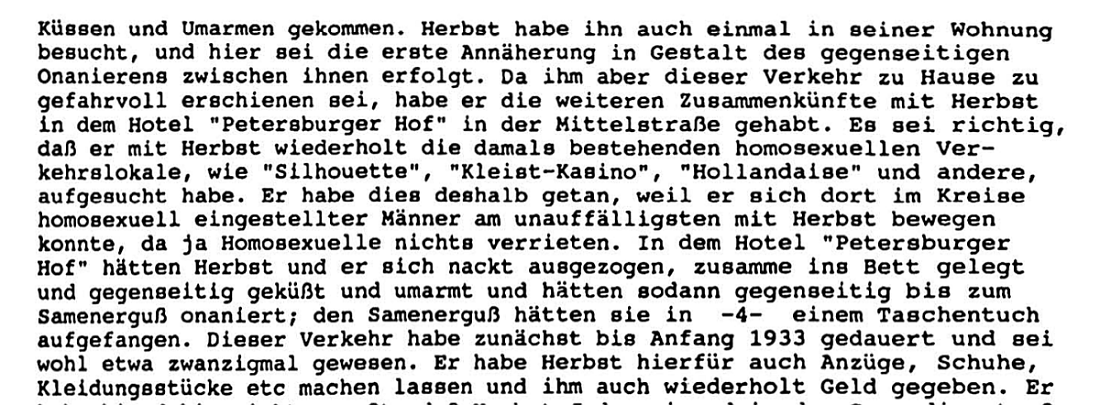
On Sunday, October 16, 1938, Cramm was released on probation ahead of time. The release likely resulted from the influence of Hermann Göring. Cramm’s mother testified that Göring had spoken positively about him after a meeting on April 13, 1938. A Göring intervention appears plausible, given Göring’s similar intervention on behalf of Gustaf Gründgens. Requests to Heinrich Himmler, to the King of Sweden, or to the Queen of the Netherlands to help were apparently without effect. Barbara Hutton, Cramm’s future wife, also apparently could not accomplish anything, despite her willingness to pay for his release.
The Contemporary Press on the 1938 Conviction
When Cramm was convicted, the German press was already under Gleichschaltung (coordinated). It is therefore not surprising that I found about 100 identical reports on his conviction from May 14–17, 1938. Short dispatches announced his sentence of one year’s imprisonment, such as the item in the Kölnische Zeitung on May 15, 1938.
Even the exiled German Social Democratic press did not publish articles defending him. In foreign coverage, the “Sozialdemokrat” (April 6, 1938) stated that Cramm had “spared no one” in the context of the “Homosexual Affair.” This portrayal is a classic case of offender-victim reversal. The New York Times reported at length on May 15, 1938 about the conviction, underscoring Cramm’s international significance. A translation appeared in Capri (No. 4 = No. 10, 1990, pp. 46, PDF pp. 442, online here).
Of the contemporary articles, only one positive piece stands out. It is by the gay rights activist Kurt Hiller and appeared in September 1938 in the homosexual journal “Hlas přírody” (Czech for “Voice of Nature”). Under the title “The Case of the Tennis Player Cramm,” the article was reprinted and historically contextualized in Capri (No. 49, 2015, pp. 21-23 and 41-43; PDF pp. 2209-2211 and 2229-2231, online here).
In his piece, Hiller links two dates: May 14, 1938, the day of Cramm’s conviction, and the same day on which Magnus Hirschfeld, the sexual scientist who died in 1935, would have turned 70. Hiller asks whether Hirschfeld’s life’s work had been for nothing. Referencing Hans Blüher, he discusses the role of homosexuals in the Nazi era—persecutors who repressed their own homosexuality and persecuted those who did not.
Cramm’s Attempts at Expungement and the Quashing of the Judgment
In the postwar period, Cramm tried to overturn the 1938 judgment and to delete his conviction from the criminal record. In his application for its annulment, dated October 8, 1951, he argued through his lawyer that the conviction arose exclusively from political motives. The charges had been raised by a male sex worker who also implicated General Werner von Fritsch. The lawyer also pointed to antisemitic statements in the judgment’s reasoning.
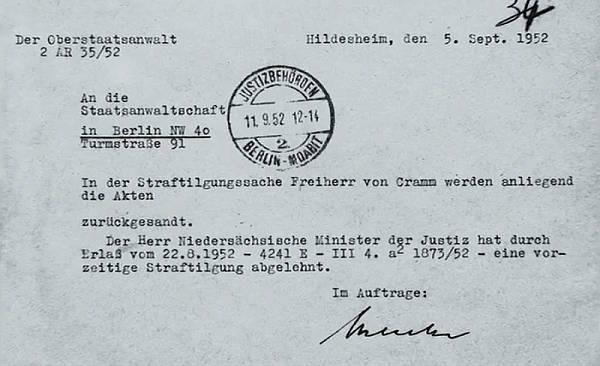
After the public prosecutor explained the hopelessness of the petition, the lawyer withdrew it in June 1952. The subsequent request to erase the conviction from the criminal record was initially denied in 1952, but approved in July 1953. The May 1938 judgment, however, remained valid. This only changed with the Bundestag’s May 17, 2002 resolution to overturn Nazi injustices (see Andreas Pretzel: “NS-Opfer unter Vorbehalt,” 2002, pp. 98, 102-103 and 130; Jens Nordalm: “Der schöne Deutsche,” 2021, pp. 200-201).
Gottfried von Cramm’s Marriage to Barbara Hutton (1955-1960)
Gottfried von Cramm had met Barbara Woolworth heiress Barbara Hutton as early as 1937, before his conviction. For many years they had little contact. They reconnected in 1951 and married in 1955. The marriage broke down two years later, with a 1960 divorce. Cramm struggled with Hutton’s extravagant lifestyle, while she struggled with his homosexuality. Barbara Hutton was married seven times in total and became a fixture of gossip columns. Her third husband was Cary Grant (1942-1945), and her sixth was Gottfried von Cramm (1955-1960). Hutton knew many gay men; her gay cousin Jimmy (James Paul Donahue Jr.) was said to be her closest friend and constant companion. After years marked by drug problems and depression, she died of a heart attack in 1979.
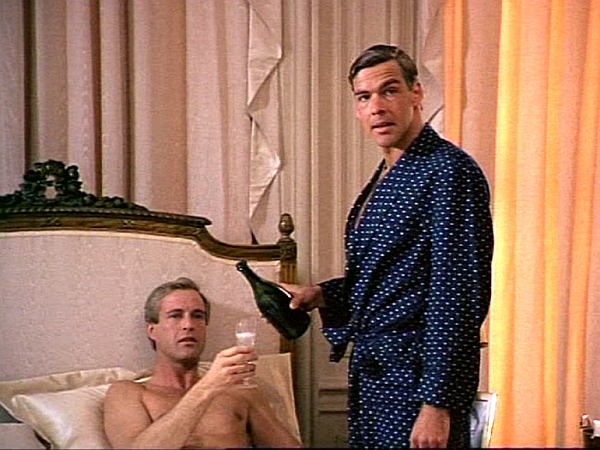
In his biography “Weak Girl, Rich Life. The Life and Legend of Barbara Hutton” (1983), Clemens David Heymann repeatedly addresses Jimmy’s sexuality (pp. 297-299, 332-336, 344-345). His remarks on Cramm’s sexuality contain not only factual errors—such as the claim that Cramm was sentenced to three years in prison (pp. 257-259)—but also reveal an inappropriate choice of words. Heymann describes the events of 1938 as “unpleasant incidents.” In the divorce, Cramm’s “preference for men” is called the “root of the problem,” and he is said to have been unable to fulfill or “the marriage was never consummated” (pp. 384-390, here pp. 388). Heymann also writes: “Barbara increasingly earned a reputation as a ‘tomboyish mom.’ Homosexuality fascinated and astonished her” (pp. 278-279). Heymann also notes how Hutton’s former husband Cary Grant was forced to defend himself because people assumed he was gay (pp. 262). He further depicts how Hutton allegedly caught Cramm in a hotel room “in a clearly intimate situation with another man.” She told him to be more careful: “If any hotel employee had walked in here, it would have been a scandal.” According to Heymann, she thus assumed the “typical stance of an older lady toward gays” — gays who were favored by wealthy women (pp. 389-390).
The Barbara Hutton Biopic
In the biopic based on Heymann’s book, “Weak Girl, Rich Girl: The Story of Barbara Hutton” (1987), Gottfried von Cramm is portrayed by German actor Sascha Hehn. In the first three installments, the script points to Jimmy’s homosexuality and his role as Hutton’s closest friend. Only in the fourth installment is it explicitly stated that Cramm was arrested under the “idiotic pretext of homosexuality” (Episode 4, 9:20). It also shows Hutton attempting to buy him out (Episode 4, 12:45 and 20:40-23:05).
When the two meet again in the 1950s, Cramm has grown older. They become intimate: “You saved my life. (…) I love you” (Episode 5, 8:55-11:55). A few years later, they marry, but that marriage does not bring happiness. In their shared hotel room, Hutton catches Cramm with another man. “I knew it, and even though I knew it, I married you,” she tells him. Yet she did not expect to be confronted with it in a hotel room (Episode 6, 10:40). Only in the final episode is it made clear that Cramm was indeed gay. The film also suggests that Hutton procured his release with a large amount of money.
Friendships and Romances in the Postwar Era
Cramm’s long-standing friendships included his teenage friend Jürgen Ernst Graf Wedel (1890-1956). Letters from the 1950s reveal the men Cramm befriended and desired. Besides Herbst, there was Jean Pierre Alban, whom Cramm accompanied as a solo dancer with the London Ballet across Europe in the 1950s, promoting Alban’s international career and maintaining a close bond for many years. To Wedel, Cramm compared the Swedish tennis player Bertil Blomquist to Antinous, the immortalized lover of the Roman emperor Hadrian. He also raved about the “divine Bastel”—the actor Sebastian Fischer.

Gottfried von Cramm’s Death
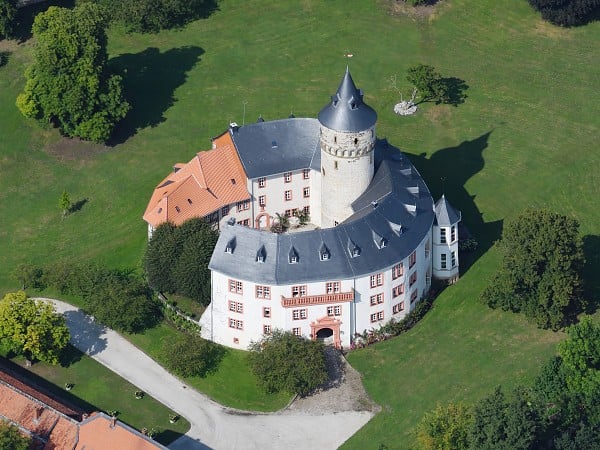
In the 1970s, not only Cramm but several important people in his life passed away: 1971 his friend Hubert von Meyerinck, 1972 his mother, 1973 Jean Pierre Alban, and 1975 his former wife Lisa von Dobeneck. On November 9, 1976, Gottfried von Cramm died in a car accident near Cairo. His grave lies in the family chapel near Schloss Oelber, which belonged to the Cramm family holdings. Because of his striking looks, the castle had served as the exterior shoot location for the German comedy “Das Spukschloss im Spessart” (1960) 16 years earlier. Perhaps by coincidence, a leading role in the film was played by Cramm’s friend Hubert von Meyerinck.
Eldorado. All that the Nazis Hate (2023)
The Netflix documentary “Eldorado. All That the Nazis Hate” (2023) is, for me, one of the best queer-history documentaries. The blend of original footage, carefully staged scenes, and interviews with historians and eyewitnesses is well-done. The film tells the stories of individual queer people from the early Weimar Republic through the 1950s, including Gottfried von Cramm. It recounts his early marriage to Lisa von Dobeneck and how he met Manasse Herbst in the Berlin bar Eldorado. Cramm was a rising tennis star who played Davis Cup for Germany more than 100 times, yet he found himself in the Nazis’ crosshairs (3:15-4:20, 21:35-27:55, 41:25-43:05, 59:10-1:04:40). He was later arrested under Paragraph 175 and convicted on May 14, 1938. His attempt to have the conviction expunged failed in 1952 (1:10:15-1:12:10, 1:20:15-1:21:55). The documentary also features Berno von Cramm, Gottfried von Cramm’s nephew.

“Playing to Survive: von Cramm vs. Hitler” (2024)
The animated film “Playing to Survive: von Cramm vs. Hitler” (2024) is a kind of love letter to Gottfried von Cramm. It honors the forgotten tennis hero of the 20th century, whose career ended far too early due to prosecution and mounting homophobia. The online behind-the-scenes feature “Making-of: ‘Playing to Survive’” offers a good teaser with recreated film scenes and interview footage. The film blends archive material and animation with narration. The character of Gottfried von Cramm is voiced by Pierce Brosnan, known for his role as James Bond.

“Break” (2026)
For 2026, a biopic about Gottfried von Cramm was planned under the working title “Break,” based on Marshall Jon Fisher’s book “Ich spiele um mein Leben” (original title: “A Terrible Splendor”). The director would be Daniel Brühl—a familiar face from “What Is the Use of Love in Thought?” (2004) and the miniseries “Becoming Karl Lagerfeld” (2024), known as a director from “Nabbed” (2021). The lead role was to be played by Felix Kammerer, known from “All Quiet on the Western Front.” In 2025, production was announced to begin in 2026, but so far there have been no indications that filming has started (see “The Spot. Media & Film” report, October 9, 2025).