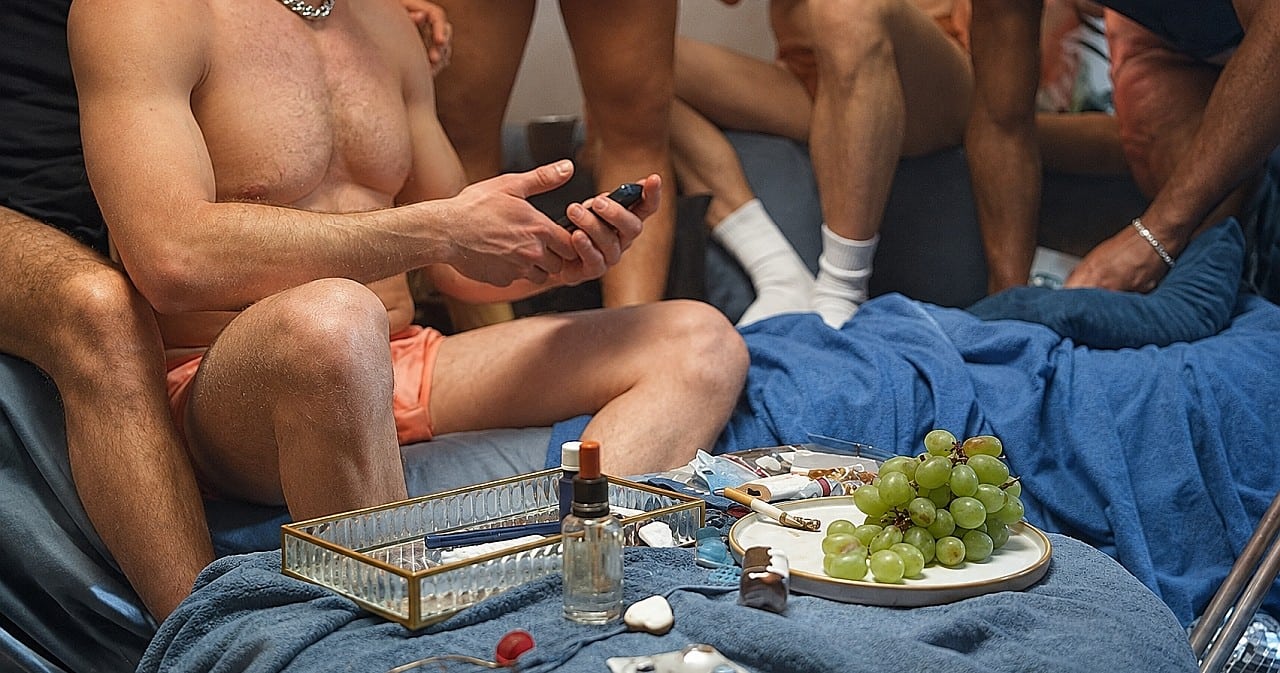
We only see each other as stereotypes, as archetypes—and lose sight of the human being behind them. In “Chill” the characters sit together after sex, talk about their body issues, and stare at their screens, their fingers greedily tracing for more anonymous torsos (TheColu.mn reported). On this sharp observation of the web series we spoke with its two creators, Aviran Edri and Jan-Peter Horstmann: about sexual hedonism, responsibility for one another, and the dark sides of the Chills.
While working on “Chill”: What did you learn that’s new about gay sex culture?
Jan-Peter Horstmann: I’ve always wanted to engage more intensely with why these spaces even exist. Why do queer and gay people need the Chills? And why did they emerge right after the pandemic? This perspective, at times, felt very moving and also quite funny to me.
It continues to fascinate me because I still view these places and the people who meet there as something special: they negotiate something intimate and personal—and do so in situations that can be almost absurd.
Aviran Edri: What I’ve learned is that there aren’t many role models in gay culture for us to look up to. The generation before us largely lived in the HIV shadow. Maybe that’s why we haven’t experienced a full generation showing us different ways of living. Our generation has to decide for itself: Do we lean toward a more heteronormative life model, or do we figure out what our own life could look like?
I believe these spaces are part of that experimentation. Here, people discover what community can mean, how relationships and bonds form, and what it feels like to live in a big city.
You’re treading a fine line: in your press materials you say you want to break stereotypes. At the same time, the series works with exactly these clichés. How much stereotyping can a show tolerate when it actually aims to question the same stereotypes?
Horstmann: First, the question is what a stereotype even is—and who decides it. Of course we have certain figures: the annoying twink, the muscle guy, and all these character types. But these figures have long been part of queer storytelling. One could call them essentially queer archetypes.
I like playing with these archetypes and at the same time continually shifting their traits. In a heteronormative culture there have been countless archetypes and stereotypes interpreted anew for thousands of years. Why wouldn’t we likewise play with our own?
At the same time, it’s important to question why these characters exist, who they are, what position they hold within a community, and who they actually represent. That’s what we’re trying to explore in these three episodes, for example through body image and the stereotypes tied to it—and we want to pursue this in further episodes.
What becomes clear is that having what seems like a perfect body does not automatically equate to happiness or contentment.
Edri: Personally, I’m not afraid of stereotypes. Many of them have real backgrounds. We should be aware of them, study them, and work with them rather than force a clear pro- or anti- stance. Ultimately, almost anything can become a stereotype in one way or another.
It’s precisely the tension between the image the gay community has of these figures and their own self-perception that creates another layer of humanity.
Your episodes are relatively short, around twelve minutes each. Which stories made it into the series, and which ones had to be put aside at first?
Horstmann: The short runtime mainly reflects our production constraints. We’re a very small, independent production and basically realized the series without funding. We eventually had to settle on a realistic number and length for episodes that we could produce virtually unpaid. After all, many people contributed to the production, and we had to lean on the favors and support of many friends.
As for what stories didn’t get told: we asked ourselves what would be a good introduction to a Chill for people who have never been there. We deliberately didn’t dive immediately into the dark sides that exist on Chills. Instead, the series should invite people in and open the door to conversation. We are very interested in those darker sides, though: What happens if people can’t leave a Chill? If they can become sort of stuck there? We want to explore these questions more deeply in future episodes.
We’re aware of how complex these spaces are—probably as complex as the people who visit them. Many bring their traumas and needs with them. Chills can be liberating and light, but they can also be pretty taxing.
Edri: I also didn’t want to paint an exclusively negative picture right away. If our series is meant to reflect this reality and spark dialogue about it, we can’t scare off our audience from the start. Chills aren’t 100% bad or 100% good. They have many facets, and each person must find their own way into them.
Horstmann: I’m also interested in the lives of the characters between the Chills: What’s the life like for the people they visit? What moves them to go to a Chill on the weekend?
What are your characters seeking when they come to a Chill?
Edri: It varies. My character Karim definitely wants to open up his home, meet new people, and create something like a family feeling. Others seek friendships, or affection, or a closer bond—perhaps even something that feels like love for at least 24 hours. Some simply want to escape their problems, lose themselves, and forget everything. Ultimately it’s as diverse as life itself.
Horstmann: Of course everyone has their own needs, but underneath lies a fundamental longing for closeness, touch, and human connection. It’s a simple, deeply human need. And it comes with a certain pain: we live in a world that offers so little genuine human closeness. On the surface, Chill is about fun, sex, and pleasure—but there are many deeper layers that touch specifically on this thirst for human connection.
In the final episode—as introduced—the characters openly discuss their body insecurities and aging. At the same time, they can hardly look at each other in the eyes. Instead, they constantly gaze at their phones and Grindr, always seeking new people for the Chill. This is a reality we need to discuss: We’re constantly seeking something new, and our longing seems never to be satisfied.
Edri: That moment plays out in real time—almost like a documentary. The characters sit for ten minutes together and talk, with no time jumps. We observe a moment when they are physically and emotionally exhausted after sex, while at the same time they communicate through their phone screens.
That says a lot about the commercialization of affection and sex. Everything is catalogued, everything operates according to a particular selection principle. Most of the people on the sofa just two hours earlier were probably visible as torsos on a dating app, and the guy who joins at the end will likely be sitting with the others on the sofa an hour later.
It creates a strange cycle: on the one hand, there’s an intense form of closeness. People open up, share traumas and burdens they’ve carried their whole lives. On the other hand, there’s barely any real connection: they don’t look at each other; they communicate through images. They speak on a deep level, yet simultaneously function on an incredibly superficial level. These two levels exist side by side at all times.
But how can we critique this lack of connection and these body norms without pretending we can fully escape them ourselves? After all, we’re all trapped in a logic where our bodies and desire become commodities.
Horstmann: I think that’s at the core of our series idea: we want to open a particular perspective on something while also giving the audience room to form their own opinion. Some will find the characters’ behavior incredibly dumb; others may recognize themselves in it.
That’s why it was important not to judge the characters too harshly. Otherwise you quickly drift into other things. As a director, I approached them with a disposition of affection. I wanted to protect them—not the actors, but the characters themselves. I hope the audience can feel a certain closeness to them as well.
Edri: I also think it helps to hold a mirror up to the moments. By observing what’s on screen from a certain distance, you can reflect on it and learn something from it—even from the good and bad aspects. Seeing these scenes with some distance can spark new thoughts and conversations about these sometimes absurd situations.
The obnoxious Twink lies unconscious on the floor, and the others just leave him there for two hours. When he comes to, he wants the next line immediately. That’s dark humor, but it’s also a clear critique of sexual and drug-led hedonism.
Horstmann: You’re hitting the nail on the head. Hedonism can bring joy, just as there are moments when escaping everyday life can be appealing. But there are consequences, too. In this season we haven’t yet dealt with it explicitly, but people die from overdoses in such Chills, they’re seriously injured, or they experience sexualized violence. That all belongs to this reality as well.
For the Twink character, it was important to show this complexity: initially we see him as a sexually self-determined person, someone who is genuinely happy and playful.
Edri: This character also runs like a red thread through the entire series. You can see him go through different stages that people can find themselves in within these spaces.
I’ve personally seen or heard of people who simply fall asleep or collapse, and the others carry on with their conversation—as if that were completely normal.
We must speak frankly about G (GHB/GBL), a dangerous drug used in parts of the gay community—and about the damage it causes in one’s environment. There’s also sexualized violence and the physical consequences of its use. How can we address such problems seriously without losing sight of the fact that patriarchal power dynamics are also at play?
Edri: Absolutely. In episodes four through ten, we address sexualized violence, harassment, overdoses, and drug misuse.
Also—and I don’t know if I should reveal this yet—we will launch a companion podcast for the series. There we want to have exactly these kinds of conversations and speak openly about the topics raised in each episode.
Even though we’re storytellers and filmmakers, this subject matters deeply to me. These topics shouldn’t stay swept under the rug for decades. They’re part of many people’s life reality, and many are actually hurt by them. We need to create the possibility to talk about the darker sides and have an honest dialogue—even if the twelve- to fifteen-minute format of our episodes isn’t always enough.
Horstmann: We’re collaborating with Deutsche Aidshilfe. They’ll feature us on their website and, as part of a new brochure on Chemsex, draw attention to the series. Some people may need help and not know where to find it. It’s important to make such resources visible and at least provide some guidance.
For the next block of shooting, we have seven more episodes planned, bringing us to ten in total. To be honest: if we had the resources right now, we could easily write fifty episodes. The ideas and concepts are there.
Edri: Ultimately, it’s mainly a question of financial and staffing resources. That’s why we hope as many people as possible will watch the series and participate, so we can tell these important stories in the future.
What thematic focuses do you want to pursue in upcoming episodes?
Horstmann: We want to examine more precisely what life realities in gay, queer, trans, nonbinary, and intersex communities make spaces like a Chill necessary. At the same time I’d like to explore other forms of Chill. What would a lesbian Chill look like? Does such a thing exist in this form? And how might such spaces be designed and lived differently?
Edri: There will be an episode about sexual harassment. There will also be a look at a psychotic breakdown during a Chill and what we call “Higher Love”: people who are intoxicated by the feeling of falling in love, having their hearts broken, and repeatedly getting caught in the cycle of infatuation and heartbreak. Another episode will focus on open relationships.
Direct link | Trailer to the series
|
What role have spaces like these played in your own lives? Were they places of sexual freedom, but perhaps also of loneliness and self-destruction?
Edri: This is a surprisingly funny story. A few months ago a friend texted me: “Hey, want to come by? I’m at a Chill.” I replied, “Honestly, I’m not really the Chill type.” Then he said, “What? You made a series about it!”
The thing that fascinates me most about these situations—and what I also love about talking to people in general—is the possibility to meet complete strangers and start a conversation with them. Such moments open doors and windows that might never open under other circumstances. A meetup at a cafe or a bar would be totally different. When people disrobe physically, they also reveal emotionally their walls to some extent. I enjoy listening to such people and having these conversations.
Regarding the sexual side, I wouldn’t necessarily call it liberation. I can understand the underlying idea, but for me that liberation can quickly turn into an excess of sex. Perhaps that’s why in episode three the characters sit around for most of the time: even that can be a kind of overdose.
Horstmann: Is it lazy to say I couldn’t have expressed it better myself? (laughs)
In the second episode we see two men who are impressed by how openly younger people handle their sexuality now. What can older men pass on to the younger generation?
Horstmann: Since I wrote the episodes, I should be honest: the question of how sexuality changes with aging has occupied me for some time. At the same time, I don’t want to speak for older men. I’m in my late thirties and don’t want to presume to represent perspectives of men who are ten, fifteen, or even twenty years older than me.
From my own experience, I can say that by my late thirties I feel a different calm and a different confidence about my sexuality. In my twenties I probably hadn’t found that security yet. Looking back, that wasn’t the case.
We live in a society that suggests sexuality is something that happens mostly in youth—when you’re young and physically fit. We should understand that sexuality evolves just like other areas of life. It’s wonderful to realize you can grow alongside your own sexuality. There is no point at which you’re no longer able to evolve and essentially “dead.”
Sexuality in the late thirties or forties is different from the early twenties, but not necessarily worse. Maybe it isn’t better—it’s simply different.
The queer community needs a strong journalistic voice—especially now. Contribute to support the work of TheColu.mn.
How can we foster more solidarity within the community starting from your thoughts about the series?
Horstmann: First, we need representations on screen. Only when we make these experiences visible can we start to develop a common language for them and understand that it’s a social phenomenon. If we can showcase these experiences, we can begin to talk about them openly.
From there, we can develop strategies for better looking out for one another and being there for each other. We can also use existing resources and consider how to make them more accessible.
Edri: This culture has existed for quite a while and has spread widely. I think many people are now also experiencing the exhausting and darker sides more acutely. Now is the time to elevate the conversation to a new level and take a closer look: What’s really happening beyond the surface? We want to give people the chance to perhaps see themselves on screen for the first time and to think about something that has long been part of their everyday life and simply called “Chill.”
Through these characters I also want to reveal other things: kindness, care, and mutual consideration. When I moved to Berlin eleven years ago, what impressed me most about the city was precisely that in the party scene people looked out for one another—even strangers and people they barely knew. If someone needed help, kindness and care were present as a matter of course.
It can be as simple as community: that people truly watch out for one another, see each other not only as torsos but as people with faces, hearts, and feelings. That they meet each other with a kinder gaze and a different attitude.
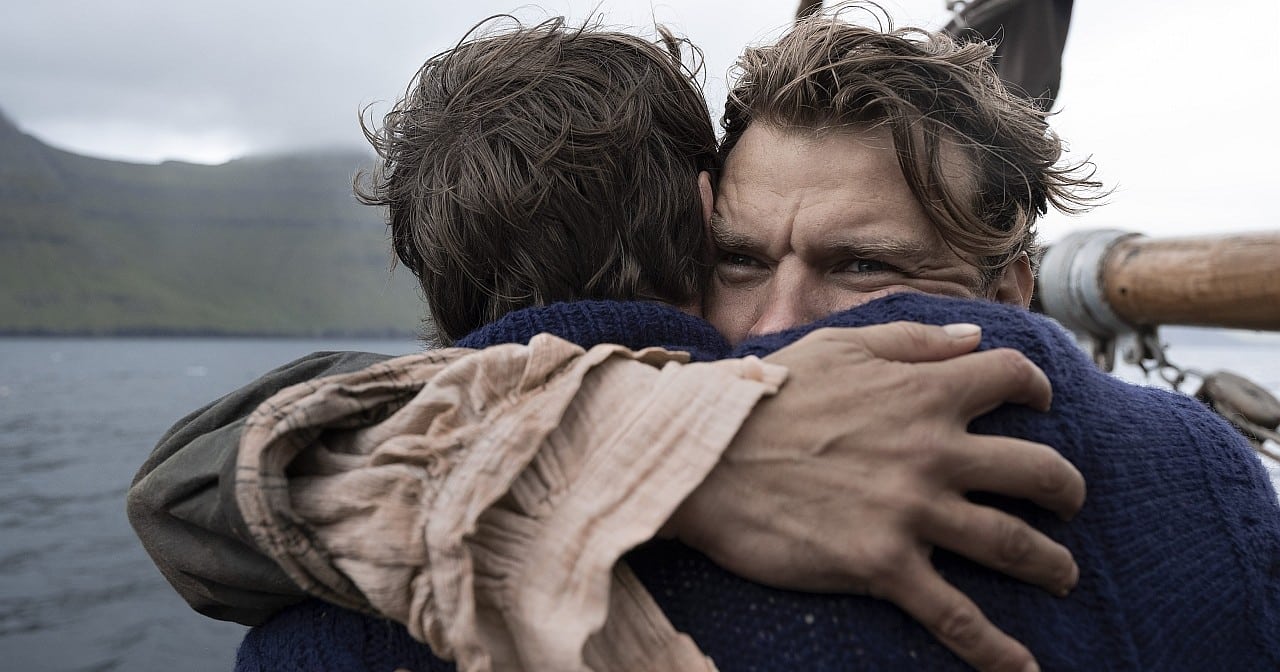
Because ultimately, these are all people who long for something. That’s how we should approach this phenomenon: by recognizing that there is a person behind all of it. Sometimes they need help, sometimes they just want sex—and sometimes probably just a hug.
Note: The first two episodes are already available for 1.99 euros each on the Q Studios Berlin website, with the third and final installment following on November 20. The series is shot in English and is offered with German subtitles, among other language options.