The past centuries have not exactly been short on cruelties. If someone makes it into history as the “Blood Countess,” that probably reflects more the era than a singular achievement. Or maybe it’s simply a good horror story in which a thread of misogyny adds that extra shudder.
The Blood Countess, Erzsébet Báthory, was born in 1560 in the territory that is now Hungary. She was convicted of numerous murders of her maids. It would take almost a hundred years for legends about the countess to coalesce, but once they did, there was little restraint: it was said she bathed in the blood of murdered girls to stay young.
Isabelle Hupperts blutroter Lippenstift
What really happened remains disputed to this day. Was she a serial killer or a victim of political intrigue? Ulrike Ottinger’s latest film also doesn’t chase facts. For the queen of queer camp avant-garde, the Blood Countess serves as a launching pad for thinking about revenants—and for flaunting pomp in abundant measure.
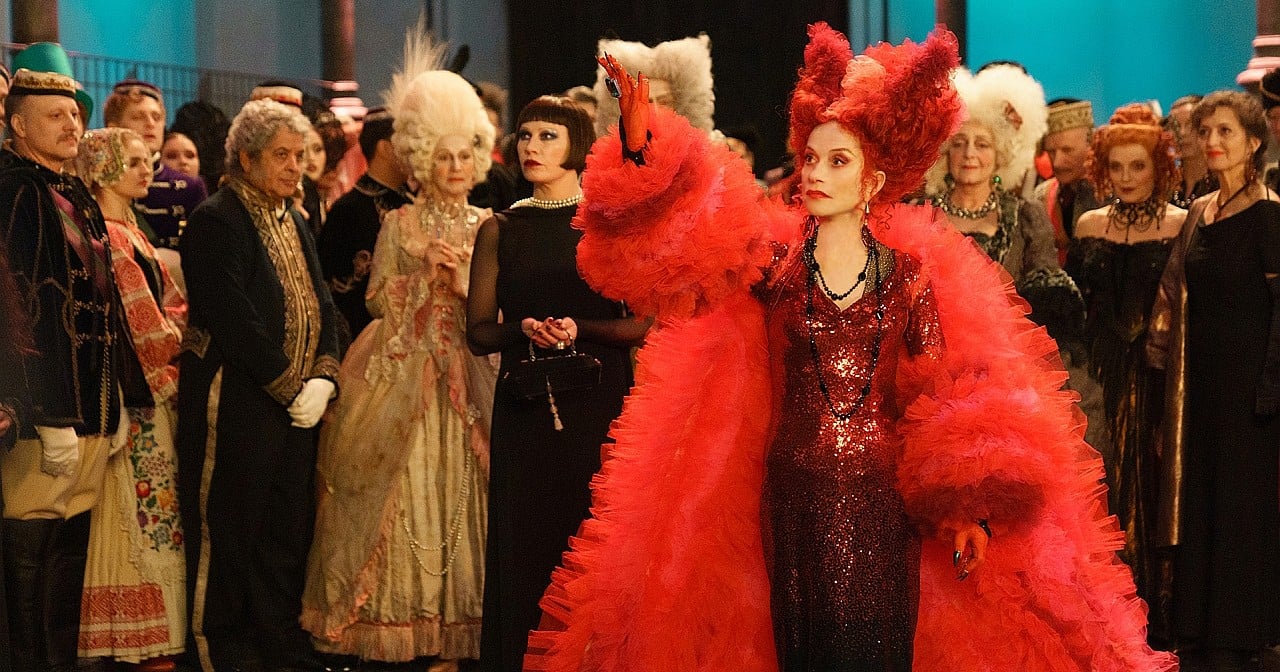
For the lead role she’s enlisted none other than Isabelle Huppert, who, with almost snow-white skin, red hair, and blood-red lipstick, delivers a vampire who is at once elegant and demonic.
Elfriede Jelinek helped with the screenplay
But the Countess Erzsébet can’t drown her troubles in blood alone. She has a problem: her realm is in danger of collapsing. She can only stop it if she can find a life force and a secret book. Always at her side is her maid Hermine, with a dark bob and dark eyes—the Gothic counterpart to the Countess. She’s played by Austrian actress Birgit Minichmayr, one of the most gifted performers in the German-speaking world.
Together they descend into Vienna’s underworld. Ulrike Ottinger, now 84, loves the city of Vienna, and that affection clearly shines in her latest film. Narrenturm, Prater, Pest Column—the vampire practically takes a sightseeing tour of the Austrian capital. Nearly thirty years ago Ottinger conceived “The Blood Countess” while on the way to Vienna, but financing issues kept her from realizing it for a long time. Yet Vienna serves not only as a lavish backdrop. For a touch of Viennese charm, Nobel laureate Elfriede Jelinek contributed a few ideas.
The Vegetarian Vampire
On her adventurous path, the Blood Countess encounters a host of absurdly endearing characters: her nephew Baron Rudi Bubi von Strudl zur Buchtelau, who is a vegetarian vampire and is met with skeptical looks from the rest of the family. “Be a man for once!” his therapist Theobald Tandem (Lars Eidinger) chides him.
Not to be forgotten are the inquisitive vampires Theobastus Bombastus and Nepomuk Nachbiss. Quirky characters, whose humor at times feels a touch old-fashioned. For several very special appearances, Tom Neuwirth, known as Conchita Wurst, appears. Ottinger was so impressed by him that she cast him in multiple roles. He even gets to sing his Eurovision-winning song on screen.
Direct link | Trailer to the film
|
Blutsauger in Wien und Moskau
“Rise like a Phoenix” suits vampires who rise again, of course. In an era of longevity and other immortality fantasies from powerful billionaires, the political undertone of “The Blood Countess” is hard to miss. Not least because the Countess arrives from the frostbitten Moscow—where a particularly fearsome bloodsucker roams and refuses to stay within the borders of his country.
“The Blood Countess,” Ottinger’s first feature in many years, remains a wild blend of camp aesthetics, queer interpretive possibilities, a grandiose Baroque production, and a gleeful silliness that can charm or shrug the shoulders: a vampire comedy in a style only Ulrike Ottinger can deliver.
The Blood Countess. Vampire Comedy. Austria, Luxembourg, Germany 2026. Director: Ulrike Ottinger. Cast: Isabelle Huppert, Birgit Minichmayr, Thomas Schubert, Lars Eidinger, André Jung, Tom Neuwirth. Running time: 119 minutes. Language: German original. Rating: FSK 12. Distributor: Neue Visionen. US release: October 29, 2026.


Die Blutgräfin
5 Bilder