Mixed to disappointing, at least compared to previous years — that was something close to the consensus for many this year when it came to the overall impression of the competition at the 83rd Venice International Film Festival. That does not mean there weren’t strong films on show this year: the Danish Golden Lion winner “Woman Unknown,” the harrowing documentary “Naza,” “Possible Love” from Korean director Lee Chang-dong, and “Wild Horse Nine” were all worthwhile productions that, in the end, also received prizes.
The festival’s lineup, however, was comparatively lacking in queer cinema. The pool of works eligible for the Queer Lion — an award bestowed since 2007 by an independent jury — was certainly smaller and less high-profile than in earlier years. Still, there were a few noteworthy LGBTI perspectives in Venice’s program this year that deserve mention here.
And we’re not talking about The Basics of Philosophy from US veteran Paul Schrader. His story about a philosophy professor (Jack Huston) who obsessively returns to Spinoza, secretly frequents a gay bar in a neighboring town, and, in light of a past lapse involving a minor, tests whether people can change or at least be forgiven, proved to be latent homophobic.
Queer Edward II
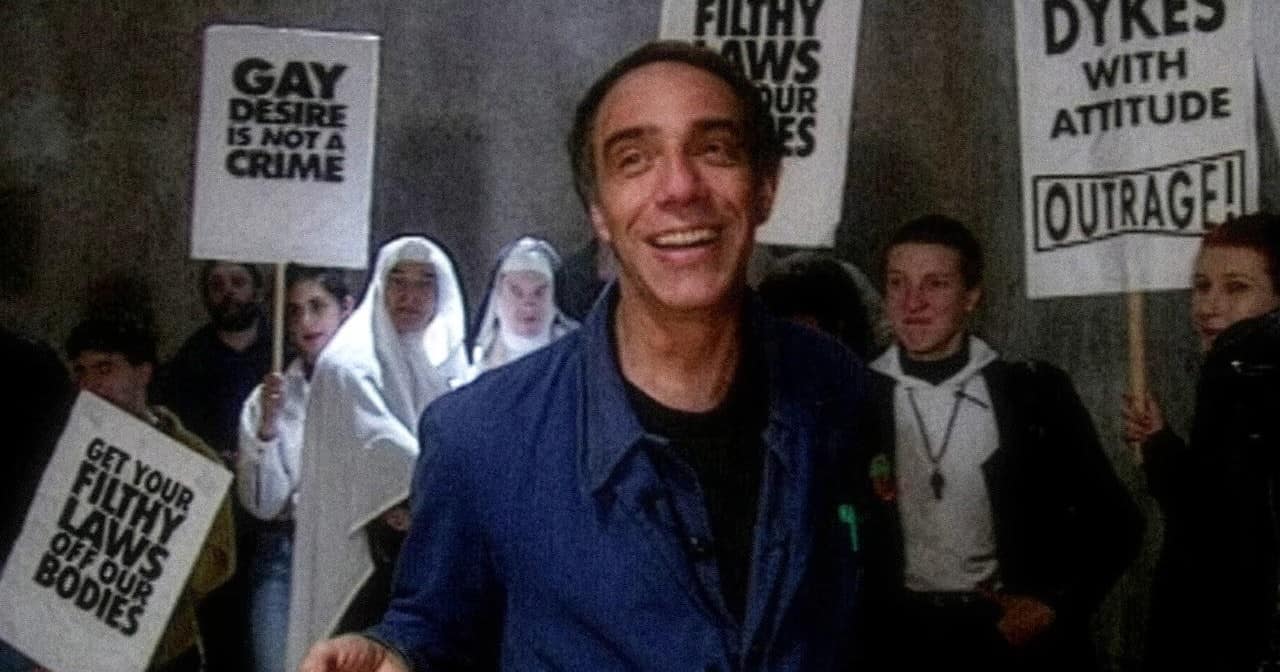
As a genuine little masterpiece, the documentary Queer Edward II by Theo Rollason proved itself, earning one of the two Queer Lions. The Briton looks back to 1991, a time when queer life in Great Britain still faced a far from easy road even after the Thatcher era. The legendary and HIV-positive filmmaker Derek Jarman adapted Christopher Marlowe’s Edward II as a radical, gay protest film for the screen (featuring Tilda Swinton, among others). From an abundance of footage never before seen from the production, Rollason not only crafts a moving, and often wonderfully funny, portrait of an exceptional artist, but also delivers a striking portrait of a era that feels distant yet still reverberates today.
The Color of the Sun
The queer thread in The Color of the Sun, the debut feature by Canadian director Xavier Tera, is subtle. Its protagonist, Kamei, is a quiet, grieving teenager in Okinawa who, while originally attracted to a classmate, also becomes intrigued — in several respects — by the nearly same-age Colin, who lives with his parents on a nearby US military base. The film doesn’t break new ground as a coming-of-age story, but it delivers plenty of moments worth watching: Naoto Shimajiri shines in the lead, Sayombhu Mukdeeprom’s hypnotic cinematography is lush, and the setting itself is a character. Okinawa sits at a crossroads of identities — subtropical and rooted in tradition, conquered by Japan in the 19th century while also bearing the marks of decades of postwar American influence under US administration, with the ongoing presence of the United States Armed Forces even after the handover to Japan.
The Echo Chamber
Direct link | Trailer “The Echo Chamber”
|
As a queer film, The Echo Chamber doesn’t quite fit the bill. Yet as the sole openly queer-director-led production in competition for the Golden Lion, it deserves mention. Four years ago, Italian director Andrea Pallaoro — who has long lived in the United States and makes films in English — staged a sensitive, trans-focused story with Monica in Venice, featuring Trace Lysette. This time, he returns to the last script of his legendary colleague Bernardo Bertolucci, weaving together the tale of a music producer (Luca Marinelli) plagued by back pain and addiction, a doctor (Alicia Vikander) who tends to his physical wellbeing and more, and an aging singer (Susan Sarandon in a Marianne Faithfull mode) with whom he’s working on a comeback album. The result is an atmospheric, deliberately ambiguous chamber piece about pain and absence, which often drifts into lull territory, though the queer sister of the protagonist appears with her partner from time to time.
Hombre al agua
Direct link | Trailer “Hombre al agua”
|
Because the writer of these lines could not attend a few queer titles in Venice due to scheduling conflicts (for example, Victor di Marco and Márcio Picoli’s London, which also received a Queer Lion nod), some non-Queer-Cinema entries appear here as well. Still, there are reasons to include Gael García Bernal’s latest directing project in this piece. Bernal, who stars in this curious blend of family drama, social critique, and melodrama with a healthy dose of telenovela, has cast none other than Ricky Martin in his ensemble (TheColu.mn reported). And Martin plays a gay actor who would, in turn, portray the protagonist’s alter ego as a film about his life is being shot by his wife. A small cameo, but it’s loaded with winks. Bernal himself is — thanks in part to Y tu mamá también and Cassandro — one of our favorite straight allies.
Peau d’Homme

One of the standout queer highlights this Venice season comes late in the festival, closing the side strand Giornate degli Autori. French director Léa Domenach has adapted the French graphic novel of the same name by the late gay author Hubert, to create Peau d’homme. Somewhere between a flipped historical epic and a queer-feminist fairy tale, it tells the story of Princess Blanche (Claire Pommet), who, in the waning Middle Ages, refuses to marry the chosen military leader Melchior (Louis Peres). To meet him, her aunt and fairy godmother (Catherine Deneuve) gifts her a magical “man’s skin,” allowing her to transform into a young man named Léonard (Stefan Crépon). Not only does Blanche feel unexpectedly comfortable in this skin, but Melchior also takes a liking to him. The film’s feminist and queer sensibility, playful spirit, and irony feel unusually bracing for French cinema in recent years. Domenach reportedly toned down explicit sexual scenes from the source material to reach a broader, including younger, audience — a choice that hardly disrupts the film’s impact. The queer musician Pommet, known as Pomme in the credits, delivers a charismatic lead performance, and Crépon alongside Peres are utterly endearing together.