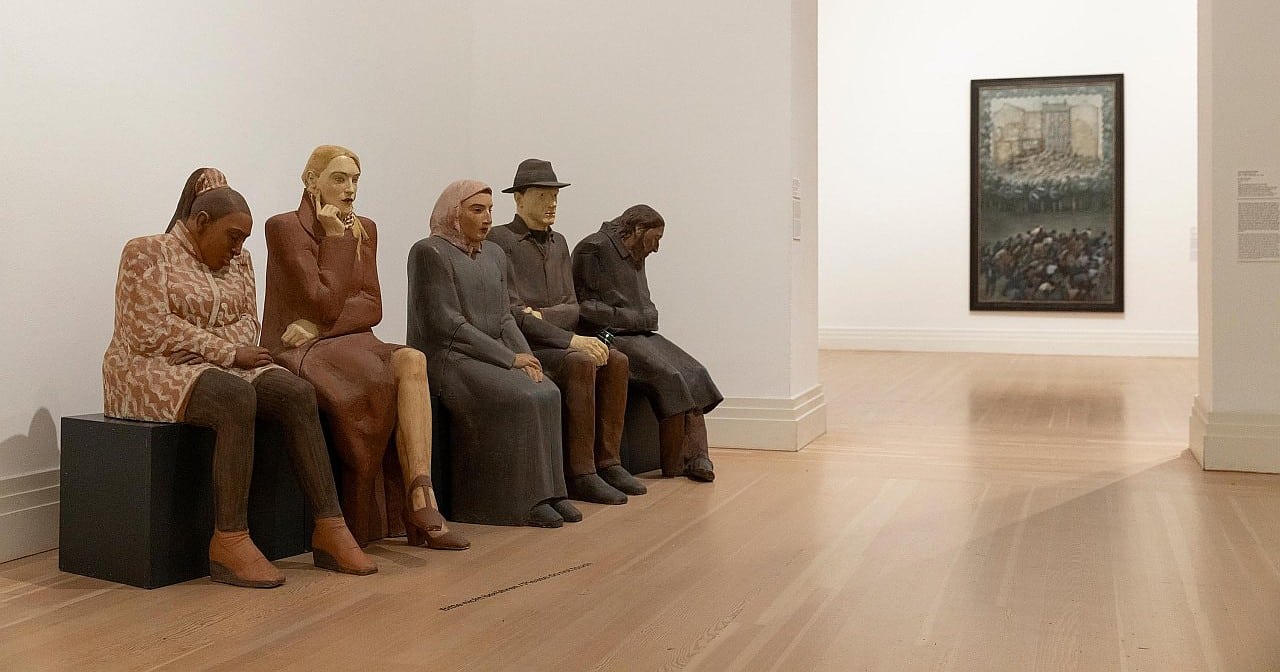
Today, this Thursday, an exhibition opens at the Berlin Martin-Gropius-Bau titled “Kreuzberg: Art and Migration since 1960.” In eleven large rooms, a Berlin art history is presented in a way we have never seen before. The reason is as banal as it is alarming: our lack of familiarity with the images, sculptures, and installations can be explained by a double exclusion.
There is first the racially motivated social exclusion that migrants have endured since their recruitment as “guest workers” in the 1960s—not only in Berlin. And a second reason lies in a broad indifference from art collections and museums to take the artistic work of migrants seriously, let alone notice it.
Why the focus on Kreuzberg?
Why, however, is there this large-scale, belated recognition of migrant art limited to Kreuzberg? That question does not quite make sense to me. And that the presentation ends with the 1980s, i.e., with the fall of the Wall and the political turning point, at least deprives us of the chance to see how living conditions changed again— keyword “Baseball Bat Years.”
Of course, it is understandable that the name Kreuzberg alone carries a special aura— both negative and positive. Namely as a social flashpoint (keyword “urban image” debate and the synonym “Kreuzberger conditions”) alongside a nearly mythical resonance that speaks to all things alternative in and around this Berlin district, with its subcultural overflow and the left-wing milieus it houses.
Where is the Queerness?
As fascinating as this grand art survey is, with discoveries that are certainly worth seeing, and as commendable as the curatorial work may be, by the end of the tour a question lingered in my mind: IsThatAllThereIs? That, by the way, is a recurring question in a Peggy Lee song. That was my question too. Is this really all there is and the whole truth about art and migration?
No, because where, exactly, is the queerness? Were there really no queer, artistically talented migrants, without turning an art school background into a gatekeeping criterion? It happened by chance that yesterday’s opening on Eisenacher Street offered, what I missed at the Martin-Gropius-Bau: queer migrant art.
“The Dress” by Cihangir Gümüştürkmen
As part of Art Week, unfortunately only until Sunday (September 13) is the exhibition “Motherland” at the German-Turkish TAM Museum on view, featuring works by Cihangir Gümüştürkmen, who has lived in Berlin since the late 1970s. At its center is an installation titled “The Dress.” It is a homage to Cihangir’s mother, who came to Germany as a so-called guest worker and eventually, after a divorce, lived in Berlin as a single mother with her two sons. It is also the story of a gay coming out. Cihangir tells about this in a film documentary that accompanies the exhibition.
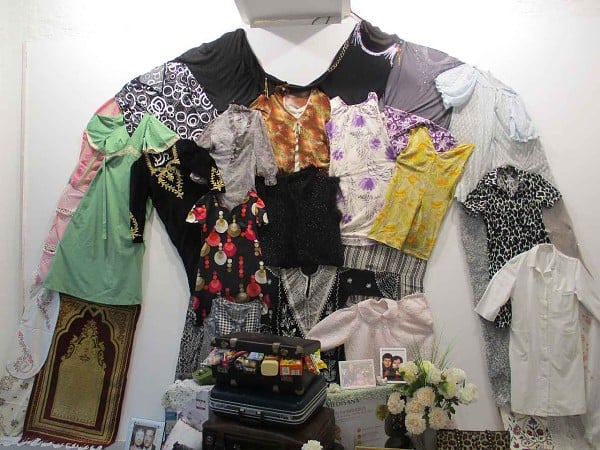
The installation, in turn, presents in a room-filling outline a gigantic dress, assembled from many colorful dresses and countless other items from the mother’s estate. It also narrates a moving life story: there are suitcases that traveled back and forth between Berlin and Izmir, the elegant shoes, even the white lab coat that Cihangir’s mother wore at Siemens, and, finally, the sewing machine. It is at once a touching and poignant altar of memories to a clearly strong and self-assured woman.
For those pressed for time, there is still a chance until Sunday to let the impressions of a Motherland—one that also contains a queer life story in Berlin—wash over you.