In the spring, Berlin’s Querverlag released a new German edition of Leslie Feinberg’s acclaimed trans-lesbian classic Stone Butch Blues, originally published in 1993 (Amazon Affiliate Link). The translation was done by Claudia Brusdeylins, a scholar of English studies. It first appeared in 1996 under the title Dreams in the Waking Morning, but had been out of print for several years.
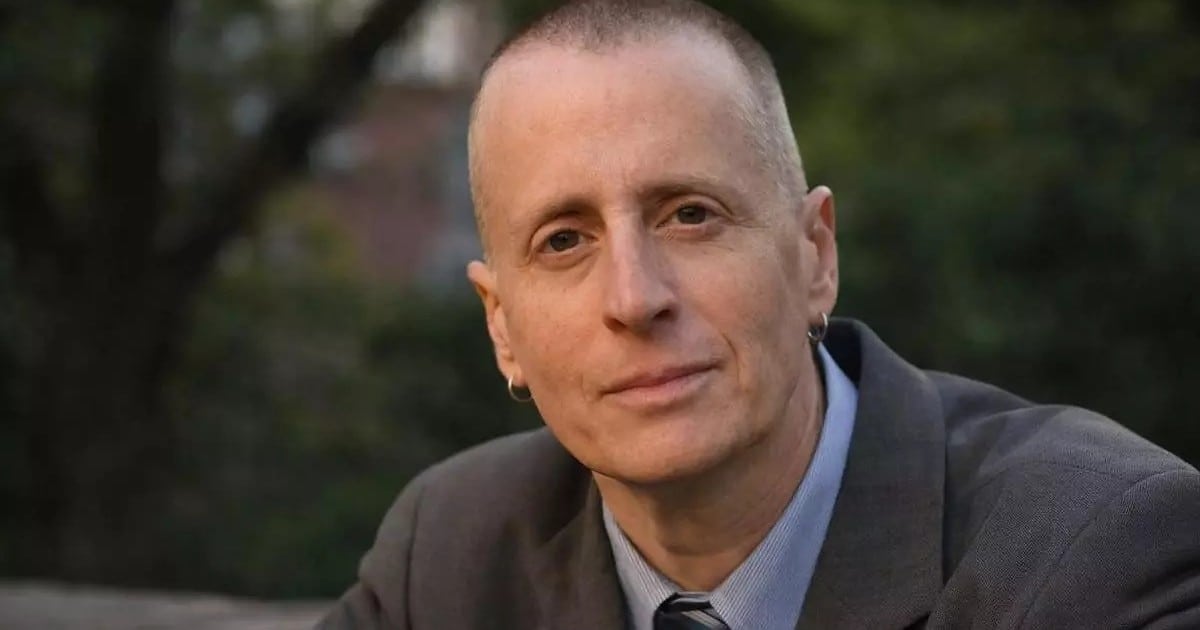
The American author, activist, and butch lesbian Leslie Feinberg (1949–2014) grew up in a Jewish working-class family in Buffalo. At birth she was assigned female; as a teenager she left her parents because they could not accept her presentation as a butch lesbian. In order to masculinize her body, she took male hormones and underwent several surgeries. She worked as an industrial worker and a journalist and belonged to the small Stalinist party Workers World Party. In 1993 she published the fictional, yet heavily autobiographical, narrative Stone Butch Blues. Until her death, she campaigned for transgender rights.
(N)ot an Autobiography
The protagonist and narrator of Stone Butch Blues, Jess Goldberg, is born in the same year as Feinberg and grows up in a Jewish working-class family in Buffalo. From an early age she does not quite feel she belongs to either the male or the female category. Because her tendency toward a masculine presentation is met with incomprehension by her family, she leaves her parents’ home early and earns her living as an unskilled worker. She becomes acquainted with both the union and strike culture of American workers and the gay-lesbian subculture of the 1960s.
She takes on the role and self-description of a “Stone Butch” for herself — a Butch who does not want to be touched on her genitals by her partner during sex. Jess experiences a period of happiness as a Stone Butch with her partner Theresa, a feminine lesbian or “Femme,” for a time. Yet Jess is haunted by the need to appear more masculine, without fully becoming a man. Accordingly, her struggle with gender roles and her embodiment is a central thread in “Stone Butch Blues.” In the end, the question remains whether she has lived her life in a way that was true to herself.
“Pet Rocks” and “Kesse Väter”
The book bears the imprint of its 1993 publication and its action spans from 1949 to the 1980s. This is not only about small details such as the “pet rock” — a 1970s US consumer-culture bestseller that a friend of Jess’s desires — but also about language that can feel strange to readers in the 21st century: the narrator Jess repeatedly uses the term “drag queens.” In today’s usage, a “drag queen” is an artist who presents as overtly and stereotypically feminine through clothing, makeup, gesture, and voice. In the 1960s, however, “drag queen” could refer to a feminine-appearing man or a transgender woman. By Brusdeylins choosing not to force an artificial order onto this array of gender presentations, and by rendering “drag queen” throughout as “Drag Queen,” she remains faithful to Feinberg’s work.
For many contemporary readers, the abbreviation “KV” may be unfamiliar. It appears repeatedly in Brusdeylins’ translation. It stands for “Kesser Vater,” i.e., “Butch.” But while “butch” remains widely understood in English, “KV” was a term used in Berlin’s “Golden Twenties” and is no longer part of everyday German usage. Perhaps, in the next edition of Brusdeylins’ translation, the abbreviation could be explained in a footnote.
Beyond the references to “Drag Queens” and “KVs,” the central motif of searching for a fitting label for oneself remains at the core of “Stone Butch Blues.” Throughout the book, Jess strives to name her inner sense of self clearly. Is she a “he-she” (a male-bodied person)? Is she a “Butch”? Do strangers in a print shop, her first workplace, call her “transsexual”? Does she identify as transgender? Jess ultimately chooses not to pursue a diagnosis or treatment from the health care system as transgender. In Feinberg’s acknowledgments, a term appears that Jess might fit: “transgender.” Thirty-three years later, the fictional Jess, who does not belong to either gender, might describe herself as nonbinary.
A Work Still Relevant Today
So is “Stone Butch Blues” merely a time capsule of a trans-lesbian past? No. Many of the book’s themes remain pressing, which is why it continues to be read as a commentary on our present, even in 2026. The Konstanz-based literary scholar Hans Robert Jauss argued long ago that every era writes its own history of the past and reads the literary traces of that past through its own lens. The question, then, is what significance we as readers in 2026 assign to Feinberg’s work.
The L, G, B, and T communities have long been interconnected. In the bars Feinberg’s narrator Jess describes, gay men and lesbian women, Drag Queens, Butches, and Femmes mingle. All of them disregard the rigid rules of a society in which the gender role of each person is assigned at birth and heterosexuality is deemed the only legitimate form of sexuality and partnership. In the spaces where this community, which has yet to find a name for itself, gathers, diverse life plans can be expressed with relative freedom.
Yet in an intolerant society there is no real safety for sexual and gender minorities, and Feinberg’s narrative includes brutally explicit depictions of violence. Drag Queens are abused by the police in custody, while their friends—Butches—watch and urge them to endure; soon after, the same violence befalls the Butches as well. Shared persecution can break bodies and spirits, but it also forges solidarity among the persecuted.
This collaborative history of persecution and activism challenges the voices of those minorities who want to exclude one or more letters from the LGBTI acronym. Often the argument is that certain concerns emerged only later. Feinberg’s “Stone Butch Blues” disproves these claims.
A Plea for Diversity of Perspectives
Among the book’s significant insights are its glimpses into postwar American workplaces: Feinberg, like Jess, comes from a family of workers and spends her days at machines and in factories. Jess organizes the factory’s butches into a union, securing the right to participate in workplace discussions and to have a say in decisions. In today’s United States, political debates often conjure the image of the male, white, heterosexual worker who is out of touch with the concerns of the LGBTI community. Consequently, some political actors who claim to represent workers contend that queer issues should be kept off the political agenda or even opposed. But alongside white, heterosexual workers there have always been workers of diverse genders, skin colors, national origins, and sexual orientations. Those perspectives are not acknowledged by a political discourse that prefers easy answers, and “Stone Butch Blues” does not shy away from them.
Leslie Feinberg keeps pressing the point: nearly every page addresses social prejudices, disadvantages, and conflicts. Feinberg sketches a plausible trans-lesbian life path in postwar America and tells two deeply moving love stories. It should come as no surprise that the book became a classic of intersectional queer feminism. This classic is now available again in German — in a well-executed translation with only minor caveats.
Leslie Feinberg: Stone Butch Blues. Novel. German translation by Claudia Brusdeylins. 424 pages. Querverlag. Berlin 2026. Paperback: €25 (ISBN 978-3-89656-366-8). E-Book: €12.99.