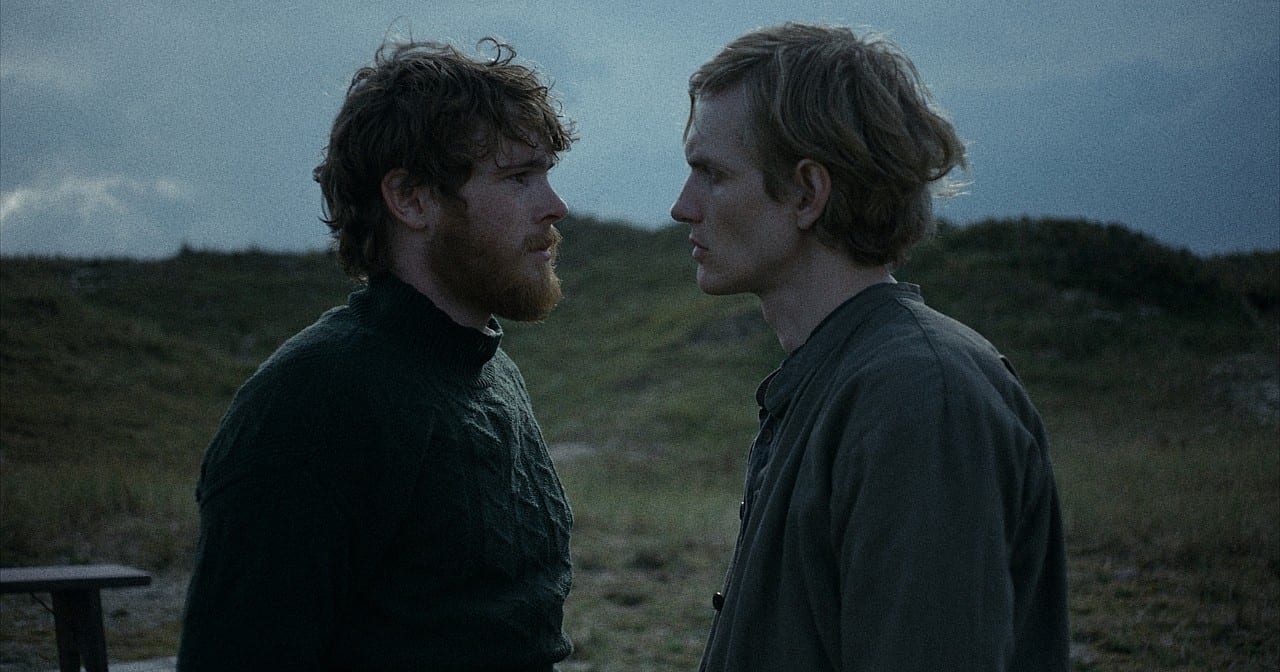
The camera surveys the foamy spray from a bird’s-eye view. In the middle, a small sailboat fights wind and waves. When Hein finally sets foot on a remote North Sea island, an old fisherman looks at him in disbelief and asks, “What brings you to this deserted island?” Hein’s terse reply is, “This is my home.”
The on-screen title “The Homeless” makes clear from the very start that, in fact, that’s no longer true. After 14 years, Hein returns to his hometown—and discovers that he never truly belonged there. The villagers don’t recognize him, greet him with suspicion and rough rejection. To prove that he really is who he claims to be, he is brought before a village court. In a multi-day proceeding, he must establish his identity using shared memories, while former companions testify one after another and recount their version of the past.
For his feature-film debut, Kai Stänicke proposes a premise that is at once original and enticing. From the film’s absurd setup, a tense, intimate drama about memory, belonging, and the painful need to prove to others that you have always been the person you are. At times, the film could have pushed the absurd humor of the premise even further; instead, Stänicke generally opts for a more serious tone. Yet he consistently demonstrates a deep understanding of his characters.
The village isn’t looking for the truth
Paul Boche plays Hein as someone who never quite fit into the island community, even as a child. He did not leave the island because they forgot him; he left because they never made him feel he belonged. This sense is especially palpable in one memory Hein uses to prove his identity: as a teenager, he must properly butcher a fish during an initiation ceremony—a symbolic act in a village whose life and self-understanding are shaped by fishing. Hein recalls this test as a moment full of fear and shame, when his difference was visible to all. In court, his former teacher Jorinde offers a distinctly different version: she remembers that Hein cut the fish flawlessly and delivered an outstanding performance.
Hardly any scene more crisply captures the film’s central motif: the village is not seeking a truth about him, but a confirmation of the image it has always had of him. Hein isn’t seen as the person he is, but as the figure who fits the community’s expectations.
Convincing Ensemble
The rest of the ensemble proves equally compelling. The relationship with Hein’s sister Heide (Stephanie Amarell) unfolds with tenderness. Against the sway of her patriarchal husband, she slowly dares to lean toward quiet agreement, support, and cautious trust. The portrayal of the ailing mother Mechthild is equally affecting, a moment when she recognizes her son only briefly before the memory slips away again. Jeanette Hain as the teacher Jorinde and Julika Jenkins as the village head and the court’s leader lend the film considerable presence.
“The Homeless,” which premiered in the Berlinale’s Perspectives section this year and won the Teddy Award jury prize, repeatedly circles the motif of the card game “Lying.” The game requires reading the other person’s facial expressions. Hein was exceptionally skilled at it as a child, but now seems to have lost that talent—as well as the village’s social cues. The crucial question, therefore, is not only whether Hein can rejoin this community, but whether he even wants to.
Hein becomes a stranger in his own home
That is where the film’s greatest queer strength lies: The Homeless doesn’t simply tell a story about returning home, but about the experience of not truly belonging even before leaving. Hein is constantly asked to explain and prove his belonging—though this very community never granted him belonging as a given. We learn almost nothing about his life in the city; only brief scenes with elementary school children, to whom he paints the city in a more negative light because that is what is expected of him.
The film is less concerned with life beyond the island than with the locals’ gaze on the one who left. Hein becomes a stranger in his own home, excluded not for a concrete deed but because he never fully fit the image the community had constructed. Stänicke carefully probes how a person hides their own identity and the tension between self-perception and how others perceive you. There is also a queer love triangle involving Greta (Emilia Schüle) and Friedemann (Philip Froissant), which is why Hein returns to the island in the first place. The urge to flee is thus understandable and moving: home can be a place of longing and, at the same time, a place that confines you.
Direct link | Official trailer for the film
|
The simultaneity of confinement and freedom
This ambivalence also informs the film’s staging. Shot on the Frisian islands of Norderney and Sylt, the movie thrives on a striking soundscape: the rasp of the wind, the rush of the waves, the dull slap of a fish against wood. Yet the production design is even more striking. When Hein steps onto the island, it quickly becomes clear that the village’s houses and buildings function more like theater sets than actual rooms. The façades are unfinished, wind and weather seep inside, and through open windows you can glimpse other people in the background—a redolent nod to Dogville.
This open architecture makes the community’s fragility visible: there are only facades and fragments of infrastructure, a village whose supposed stability can collapse at any moment. At the same time, the permeability of the spaces creates different vantage points and opens the community to the surrounding nature. This is where the film delivers a particularly potent queer moment: the simultaneity of confinement and freedom, the longing for belonging and the necessity of finding oneself outside existing structures. The title already signals the core of the story: home is not necessarily the place you were born, but the place where you feel seen and accepted.
The Homeless. Drama. Germany 2026. Director: Kai Stänicke. Cast: Paul Boche, Philip Froissant, Emilia Schüle, Stephanie Amarell. Running time: 122 minutes. Language: German original. Rating: FSK 12. Distributor: DCM. Theatrical release: August 27, 2026