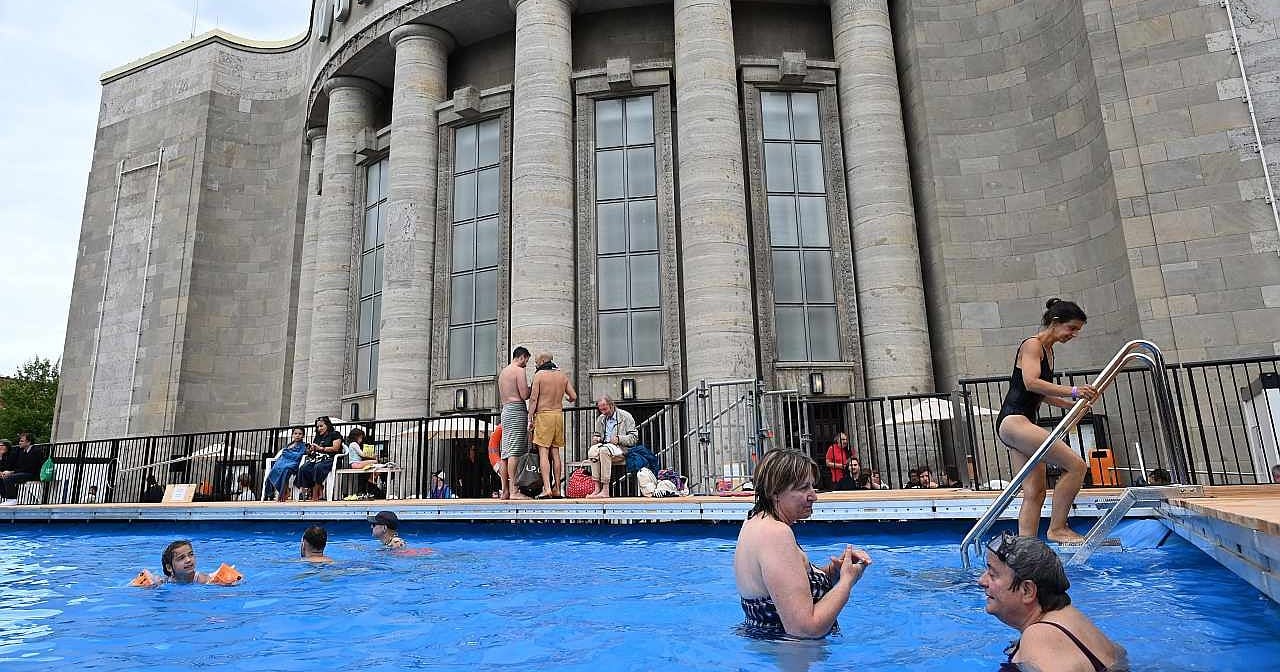
You had to wonder for a moment whether this was actually a joke. A few weeks ago, the new director of the Berlin Volksbühne announced plans to install a summer swimming pool right in front of the theater. A 25-meter lap lane! And a fries stand! Matthias Lilienthal wants to show that he understands theater as more than just drama, including “when two people spray each other with water.”
But for him, the project is also a protest against the crumbling infrastructure of the capital. “We’re really happy to slightly offset the pool shortage for two months,” Lilienthal said in the late spring. On Friday, the pool finally opened.
In front of the monumental theater, the turquoise-blue pool glitters. Changing rooms were set up, lifeguards and security personnel hired. The project, also conceived as a welcome gesture to the neighborhood, is already making headlines before it even fully opens.
Now, the Volksbühne would not be one of Germany’s most important theaters if it weren’t known for spectacular stunts. Former director Frank Castorf revolutionized theater with fake blood, a video camera and shouting. His successor’s appointment sparked protests and disruptions.
After two failed approaches, René Pollesch took charge, but he died unexpectedly two years ago. Now Lilienthal is following in his footsteps. The 66-year-old had previously worked at the Volksbühne, led Berlin’s HAU and Munich’s Kammerspiele. His visions of theater did not always align with those of Bavaria’s governing party, the CSU.
What the temporary swimming pool costs
Officially, Lilienthal’s first season will begin in October, and while the theater’s main machinery is still being modernized, he’s already staging the summer spectacle. The pool can be visited for free—you can book a time-slot ticket online. Is a temporary outdoor pool, assembled for only a few weeks, a foolish idea or a brilliant one?
Approximately €300,000 funds the project, drawn from the theater’s budget. About €90,000 goes toward the pool itself, roughly €210,000 toward staff, planning and security. According to the theater, the costs are on par with those of a major theater production.
The Volksbühne receives more than €20 million in subsidies each year. SPD member Dunja Wolff, a member of the Berlin Parliament, views the pool project under budgetary pressure with a critical eye: “I would have preferred that money go toward smaller venues, especially youth theater.” Rather than realizing the swimm master’s dream, “better to fill the seats at performances.”
“The Volksbad is already the talk of the town”
The Volksbühne also aims to attract people who might not otherwise go to the theater. For Lilienthal, it’s also about highlighting a social ill, he said in a recent interview with rbb: the inadequacy of infrastructure such as pools, S-Bahn lines and schools. “And the Volksbad is a political protest against that.”
A theater spokesperson explained that they, too, see the situation of independent theater as challenging and wanted to support their interests. “The project hopefully helps demonstrate the importance of culture in Berlin and strengthen it.” When the opening day arrived, the first bathers swam laps, people ate fries and took photos.
Lilienthal understands how to generate buzz for his institution, said journalist Arno Frank, who writes for outlets like Der Spiegel. The season opening in October with Rimini Protokoll’s “House of Hopes” is known only to those truly invested in theater. “But the Volksbad is already the talk of the town. Soon enough, probably the whole country,” he added.
Lilienthal is moving the stage outdoors, opening it to the entire public and using the project to critique the commodification of public spaces. When was the last time a new public outdoor pool opened? The Volksbühne is putting money up and betting that in people’s minds a renewed sense of what this city could be will take root.
What else is in the works
The program also envisions activities like a crawl class from the queer sports club Vorspiel or synchronized swimming with the Berlin Rainbow Trout. And because Germany plays by the rules, there are also guidelines about how many people can be in the water at once according to DIN standards—up to a maximum of 46. The pool will remain open through October, with an expected turnout of about 20,000 bathers by then. The basin was rented. Other materials are planned to be repurposed for future stage works later on.
Inspired by performance artist Florentina Holzinger, who is currently presenting the Austrian pavilion at the Venice Biennale, the project incorporates provocative ideas. She has women riding jet skis naked there, or diving into a tank allegedly filled with clarified urine.
At the Volksbühne, Holzinger previously staged works such as Sancta (about the church) and A Year Without Summer (featuring a lesbian orgy and a fecal‑fight) and Ophelia’s Got Talent—an artful nudity showcase featuring performers in a large water basin. Lilienthal credits Holzinger with sparking the idea for the Volksbads, the name the Volksbühne has given to the temporary pool.
Holzinger is slated to direct a new piece at the Volksbühne in 2028, and she already has an action planned for the back end of the pool’s run. Details remain to be seen. For now, there will be splashing and fries. However, dunking in with a cannonball is not allowed—the pool depth is only 1.30 meters.