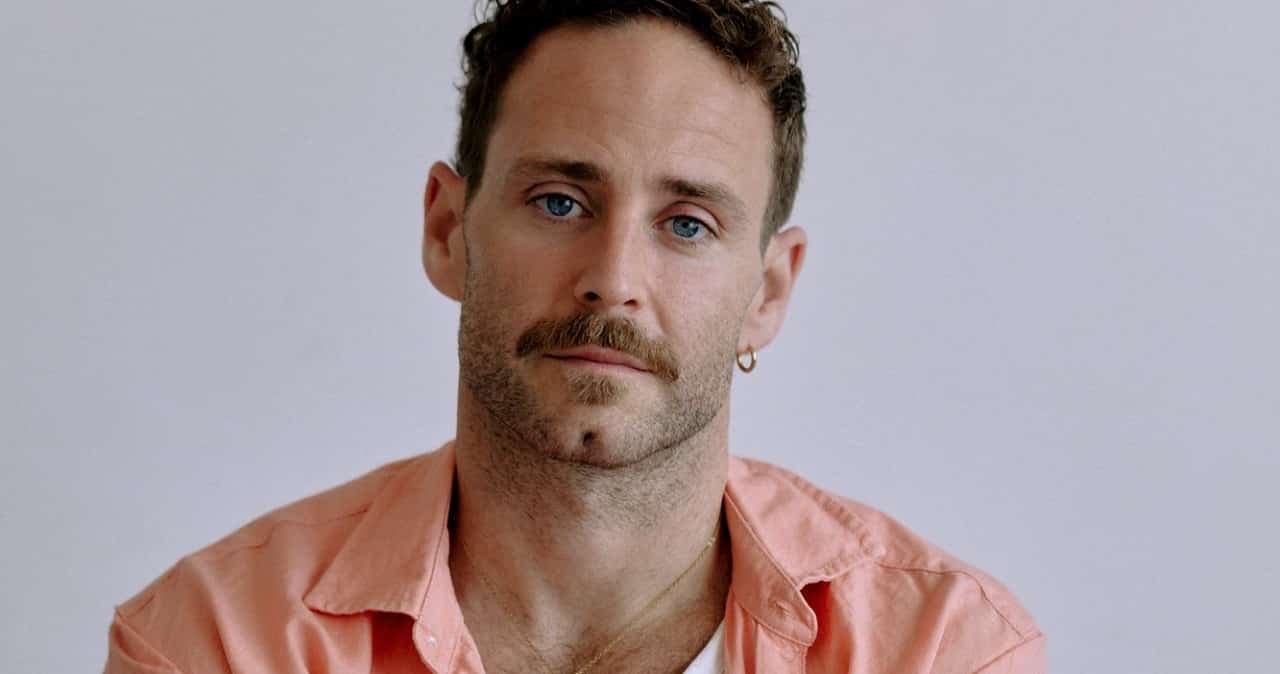
Author Saleem Haddad has been hailed since his debut Guapa as one of the most important voices in post-migrant queer contemporary literature. In his new novel Flood Lines he distills the political tempests of the 20th century in the Middle East into a gripping family saga. At the same time, it tells the story of a gay relationship marked by contradictions. We spoke with Saleem Haddad about queer battlefields, sources of inspiration, and the life-affirming power of art.
Saleem, your debut “Guapa” appeared about ten years ago. The novel received international recognition and you even won the Stonewall Book Award. How do you look back on that success today?
“Guapa” was incredibly important for me. While writing the novel I explored my own queer identity and, in a sense, made peace with it. When I took the book on a worldwide tour for two years, readings were often followed by people coming up to me saying they felt seen by the book. Some expected to meet Rasa, the main character from “Guapa.” But readers quickly realized that I differ quite a bit from my quite angry protagonist. And that’s partly because writing the book made me a more peaceful person. Many of the battles Rasa still has to fight, I left behind through working on “Guapa.” So I’m still grateful for the book and for how well it was received.
Your new novel “Flood Lines” also opens with an angry gay protagonist: Nizar. Do you understand why some readers might see Nizar as a continuation of Rasa’s arc?
Yes, absolutely. It’s actually quite accurate. The two figures grew up differently, but they share a very similar temperament.
“Flood Lines” begins with a sequence that vividly and at times starkly renders Nizar’s inner rage (the reading excerpt on TheColu.mn). The chapter traces how Nizar copes with his traumatic experiences as a war correspondent and the breakdown of his relationship with his boyfriend Alfie through obsessive CrossFit training…
Yes, the training is his attempt to reclaim control. It’s a reflex I’ve observed in many people, including myself. I started getting into fitness when the world felt increasingly scary and untamable. When humanity feels like it’s losing its mind, the body becomes one of the few resources you can actually control. That’s how Nizar experiences it too. He’s witnessed the world collapse, endured brutal wars, and gone through a breakup, which fuels a deep sense of hopelessness. This nihilism drives him into a somewhat manic fitness phase.
He even goes so far as to compare the development of his body to the world’s battlefields. A metaphor for the “battlefield” of gay body obsession?
That’s part of it. But more broadly I wanted to explore CrossFit in social media culture. I find those videos incredibly intense, almost fanatically aggressive. The idea of war comparisons didn’t enter my head until I learned about workouts named after soldiers who fell in Afghanistan and Iraq. That struck me as powerful and worth exploring, though I didn’t want to overstate it.
Nizar is one of four main characters in “Flood Lines.” The book’s primary plot follows his mother Zainab and her sisters Isthar and Mediha, who are locked in a bitter fight over their father’s artistic legacy. After focusing mainly on male perspectives in “Guapa,” did you intend to center women this time?
No, that wasn’t a deliberate plan, but it developed organically. At the start I knew I wanted to move away from the tight, time- and space-limited focus of “Guapa” and write something that required extensive research, went deeper historically, and used multiple voices with a multi-perspective approach. I also knew I wanted to write about Iraq and a family in the middle of an art-going dispute. In “Guapa” a lot of elements from my Lebanese-Palestinian paternal family appear. “Flood Lines,” by contrast, draws more from the Iraqi branch of my maternal family. Consequently, the sisters’ dispute mirrors many real conversations we have within our own family, even if we don’t express them as openly as the siblings in the book.
“Hostile” is almost an understatement. The psycho-duels and verbal battles between the sisters are mercilessly sharp, almost campy in their energy…
There was indeed a campy inspiration for some scenes. While I was drafting the early version of “Flood Lines,” my partner started watching “The Real Housewives.” He kept telling me I should watch it too. At first I resisted; the loud, chaotic energy grated on me. Then his partner left for ten days, and the house grew quiet. In those writing breaks I finally started watching “Housewives” to give my brain a rest. I got hooked. I’ve since watched every season and the various spin-offs. The dynamic among the Housewives is incredibly compelling. Part of that energy seeped into the heated exchanges among the three sisters in “Flood Lines.” In terms of milieu, it fits—these are strong, intellectual, cosmopolitan women from the upper-middle class who live in close quarters with one another.
They’re also very different. Isthar is a lesbian with bold, radical artistic visions; Zainab is heterosexual and conventional; Mediha is a young feminist. Was your aim this time to tell queer characters within a broader historical and social frame?
Tell me you want to write a queer book, and I’ll probably resist it. Yet I’m queer myself and, as a result, queer characters tend to take on life on their own as I write. Their queerness, unlike Rasa in “Guapa,” doesn’t become a problem because of their surroundings. Isthar grew up in a creative, cosmopolitan Baghdad bubble in the 1970s and studied in London, where she now lives. Nizar grew up without a father, with a mother who accepts his sexuality. I enjoyed writing about characters who don’t have to wrestle with their sexuality. But when we flash back to 1950s Baghdad, I also wanted to give voice to the queer lives that were buried, barely archived, in that era. There is a discreet subplot there that touches on those experiences, without wanting to spoil too much.
You’ve mentioned that after Guapa people told you queer readers felt seen by the book. Do such responses create a sense of duty to keep addressing queer stories and characters in your work?
Not in a straightforward way. Still, I will certainly continue to write queer characters because I’m drawn to their perspectives, especially from an Arab viewpoint. I’m currently collaborating with a friend on a screenplay about digital nomads in Lisbon. So far there isn’t a single character with an Arab background in that script. That feels almost like a betrayal to me.
You grew up in several Middle Eastern countries like Nizar, but you never lived in Iraq and spent the last decade in London and Lisbon. How did you manage to render Iraq and the city of Baghdad so vividly in “Flood Lines”?
I visited Iraq as a child with my mother and spent some time in Najaf through my work with Doctors Without Borders. When I began writing “Flood Lines,” political reasons made it impossible to travel to Baghdad. Most Baghdad sequences in the novel occur before Saddam Hussein’s rise to power, so I relied on research for that era. A crucial part of the process was talking at length with my uncle, who knows our family history and the Iraqi art movements well. I built a sense of modern Baghdad initially through long phone conversations with an Iraqi friend who lives there and works as a journalist. In the manuscript’s final stages, the political climate loosened enough that I could travel with my mother to Baghdad again. I even rewrote some sequences after those trips—the scene where Isthar searches for the family’s old house and can’t find it happened to my own mother in real life, which gave it a symbolic resonance. Ultimately, the novel centers on how memory can be dazzling and manipulative at the same time.
A central line in the book goes: “Art has always saved us.” Do you truly believe art can save lives?
“Art has saved us” is a family motto of sorts. The anecdote about my great-grandfather being released from prison by Atatürk because of his art is a true family story as well. But to answer your question more plainly: I wouldn’t claim that art can stop wars. It can save individuals, though. It certainly saved my life.
In what way?
The literature I discovered saved me. The conciliatory effect of writing Guapa for my own relationship to queerness is a prime example. Writing is how I process questions, internal conflicts, and destructive feelings. I don’t know where I’d be without that outlet. Reading can also be life-saving. Wagui Ghali’s Beer in the Snooker Club, for instance, was the spark that led me to write Guapa in the first place—an inspiration to craft a novel about a gay man.
Can you name a queer book you’d call life-saving?
Abdellah Taïa’s wonderfully revealing essay, Homosexuality Explained to My Mother, articulates things I never thought could be put into words. Reading it creates a sense of shared humanity that I also consider life-saving.
And did writing Flood Lines have a similarly reconciliatory effect on you as Guapa?
I revisited questions about my own relationship in the dynamic between Nizar and Alfie. Nizar wrestles with the idea that, as an Arab in exile, his suffering stems from his heritage, while Alfie—the Brit whose country and people bear responsibility for the pain in Iraq—does not feel that same pain. I’ve been with a British partner for eighteen years and continually grapple with these questions. There are no easy answers. But in the end, Nizar finds a way to reconcile these contradictions and perhaps achieve a kind of peace that allows him to love—and, perhaps, to heal us all. This closing resonates with a hopeful strand, one that invites us to consider how reconciliation may help us all find the healing love we need.
Saleem Haddad: Flood Lines. Novel. German translation by Andreas Diesel. 416 pages. Albino Verlag. Berlin 2026. Hardcover with dust jacket and ribbon: 28 € (ISBN 978-3-86300-410-1). E-Book: 19.99 €