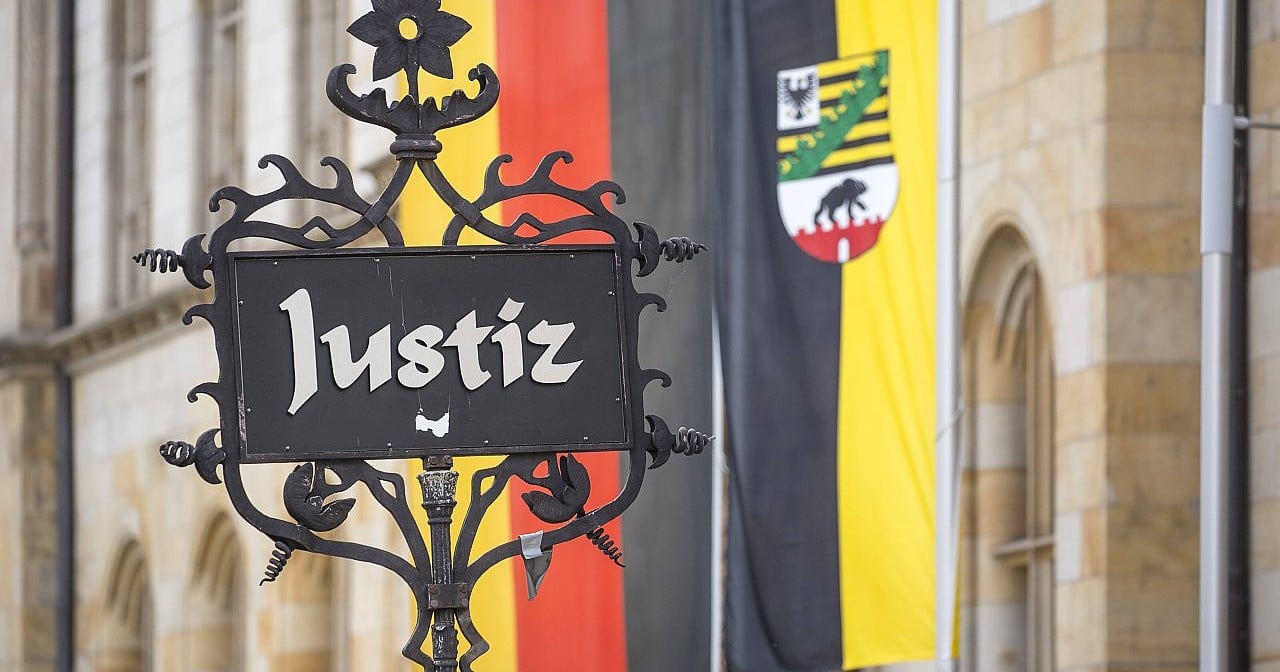
Since 2017, prosecutors’ offices in Saxony-Anhalt have maintained dedicated contact persons for victims of anti-LGBTQ+ hate crimes. They are intended to accompany victims through criminal proceedings, answer questions, and be available as fixed points of contact. On paper, this is an important pillar in the fight against queer-hostile violence; in practice, many victims could hardly locate the contact persons for years.
Those seeking their help often had to laboriously search through the judiciary’s contacts. The contact persons were not publicly discoverable for a long time. This is now confirmed by the Ministry of Justice and Consumer Protection. In a February 2024 directive, the department states that the contact persons were not publicly visible on the Internet and should therefore be publicized — at that time the service had existed for about seven years.
In response to a parliamentary inquiry by independent state parliament member Henriette Quade, the state government acknowledged further action was needed and pledged improvements. In response to TheColu.mn, ministry spokesperson Lars Fischer explained that public visibility is currently being reviewed. Why a service that has existed since 2017 only became easily findable years later remains open.
“Concept works – if you can find it”
That the idea works in principle is demonstrated by the experience of the Mobile Victim Counseling Halle. There, the counseling center has worked for years with the contact person at the Public Prosecutor’s Office.
Counselor Antje Arndt reports: “Overall I welcome the existence of the contact persons. With the contact person from Halle (Saale) we have also had positive experiences both as a counseling center and as part of the LSQpRT [Lesbian, Gay and Queer-Political Round Table; Ed.], and with our clients.”
Not without caveats. “As always, it depends very much on the commitment of individuals,” Arndt says. “Where prosecutors take the role seriously and actively collaborate with the community and counseling institutions, the service can indeed make a difference.”
“It gives the impression of a paper tiger”
The slow rollout in other parts of the country draws clear criticism. After an earlier parliamentary inquiry had revealed deficits, Quade pressed for answers again this year (the parliamentary inquiry and the government’s response are available as a PDF). From her perspective, the problems have not been solved to date.
“It is not understandable that the contact persons are still not findable and that the ministry’s decrees are obviously not implemented,” Quade criticizes. “Contact persons must also be reachable. If that is not the case and, apart from Halle, there are no discussions and inclusion, they can hardly be effective.”
Her assessment: “If accessibility is not established despite repeated acknowledgment of the problem and despite the ministry’s decrees, it creates the impression of a paper tiger.”
With regard to attacks on several Christopher Street Day events last year, she emphasizes that clearly named contact persons are needed so that victims can develop trust in the police and the justice system.
“Many people know nothing about the offering”
Kritik kommt auch aus der Community. According to LSVD+ Saxony-Anhalt, many queer people still do not know the contact persons. Board member Sophie Wieser says: “From our perspective these contact points within the queer community are not yet sufficiently well known. Many victims do not know that this option exists or what specific duties these contact persons undertake.”
From her experience, victims often learn only through counseling centers or community offerings whom to contact. “There needs to be broader awareness so that people do not have to discover, after their own experience with hate or violence, where they can get support,” Wieser demands.
She expects that visible contact persons will reduce barriers to police and justice and will increase the willingness to report queer-hostile crimes.
An offering only helps if people know about it
Where contact persons are visible and collaborate with counseling centers, they are viewed positively by victims and the community. The idea isn’t the problem — it’s the implementation.
Politicians, counseling centers, and the community share the same emphasis: an aid program can only work if victims actually become aware of its existence. As long as visibility and accessibility across large parts of the country depend on the commitment of individuals, the protective effect remains limited.
The Ministry of Justice announces that it intends to further improve the public visibility of the contact persons. Whether these promises translate into concrete steps will likely become evident in the coming months — especially given the rising numbers of anti-LGBTQ+ hate crimes to which LSVD+ and other associations point.
For queer people in Saxony-Anhalt, what matters in the end is whether they can quickly reach a contact person in the justice system if attacked — or whether the victim protection offered by the prosecutors remains, for the most part, a paper tiger.
Halle & Naumburg
Sebastian Lüdecke (Prosecutor)
Email: sebastian.luedecke@justiz.sachsen-anhalt.de
Phone: (0345) 220 38 06 or 220 36 81
Halberstadt
Email: sta-hbs@justiz.sachsen-anhalt.de
Phone: (03941) 58 38-0
Magdeburg
Email: sta-md@justiz.sachsen-anhalt.de
Phone: (0391) 606-0
Stendal
Dagmar Regel (Prosecutor)
Email: sta-sdl@justiz.sachsen-anhalt.de
Phone: (03931) 58-0