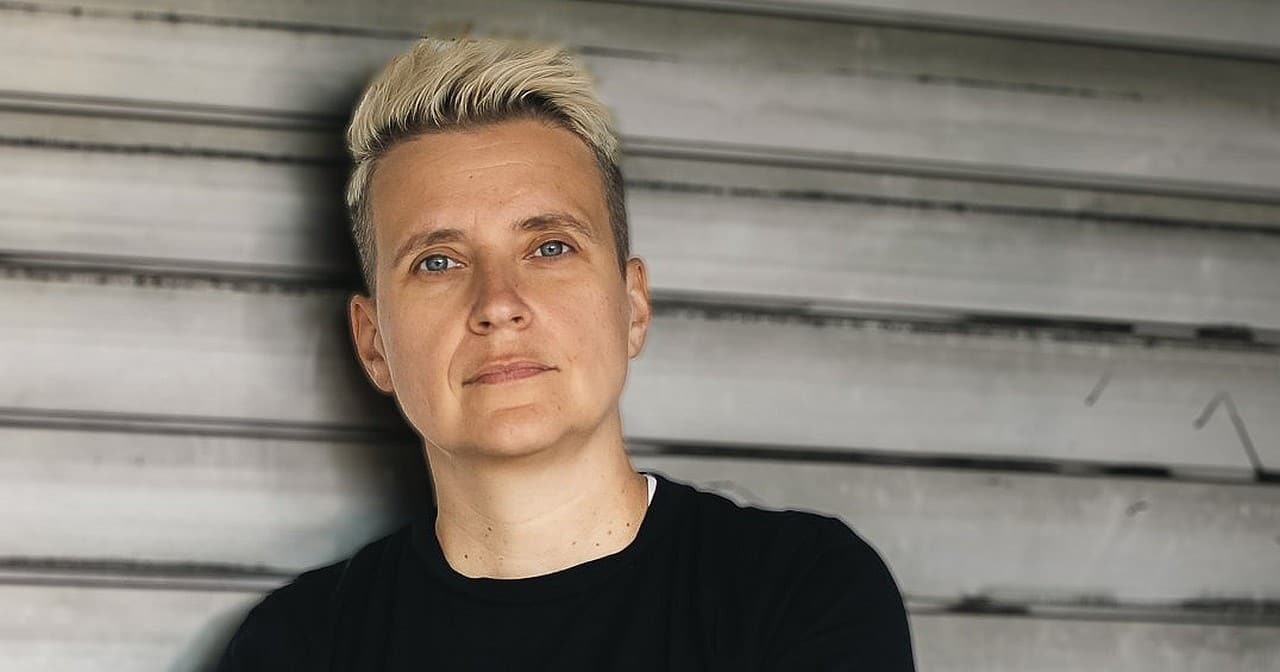
Congratulations on your election to the party’s executive board. How does it feel, especially as the first nonbinary member of The Left’s leadership?
I haven’t quite wrapped my head around it yet, largely because we won’t have our inaugural meeting until mid‑July. But I can already sense that members of our party are coming to me with requests and expectations. That’s new and notable.
The first nonbinary person I was, actually, was as a member of ZDF’s Television Council. I can compare the two experiences. The positive thing about the party’s executive board is that everyone can relate to queer and nonbinary voices. That wasn’t the case at the start in the television council. On the party board, we don’t have to do all this sensitization and education work around these topics—that’s a relief and a kind of relief I deeply appreciate.
I have immense respect for the task ahead. But I’m excited about it, and I’m really energized. I’m looking forward to the perspectives of the other members. It’s not just about my own topic—queer feminism—just as it isn’t only about migration for my migrant comrades. It’s about bringing in diverse viewpoints and lived experiences to tackle shared issues. I believe it’s crucial to shape policy through these varied angles. It’s not enough to say “We also need to think about queers” or “We must also consider marginalized migrants.” We need a holistic, comprehensive view.
Are you generally satisfied with the outcome of the party congress, including the topics championed by Die Linke.queer?
Yes, absolutely. I’m thrilled that we finally have a FLINTA plenary. We worked for a long time to build understanding and sensitivity around this issue. To change the party’s rules to create such a plenary, we needed two‑thirds of the delegates’ votes, and I spent the last year traveling nationwide, offering workshops to explain what a plenary is, what we want to discuss there, and what topics we should cover to feel safe. It’s a campaign against patriarchy in any form, and our constitutional amendment passed with 84 percent—an enormous achievement.
Equally important is the resolution that strengthens the rights of sex workers, with a clear emphasis on social rights—health care, safety, and social protections for sex workers. It’s about avoiding prejudice and really listening. We recognize that many sex workers come from precarious circumstances. We’re Die Linke; we don’t want people to have to work under precarious conditions. We want to bolster workers’ rights for sex workers as well. It was a vigorous debate, and it even gave me a few gray hairs in the process. Still, I’m proud that Germany’s party stands firmly beside sex workers.
View this post on Instagram
Instagram
|
Another debate around the congress focused on anti-Semitic chants in internal chats of the Linksjugend. An emergency motion for the convention was proposed but not discussed. How did that shape the congress or the decisions on anti-Semitism and the Middle East conflict? And will there be consequences, even within the party, following this scandal?
That topic did not define the party congress. We did address issues related to the Middle East, and we adopted a resolution from BAG Shalom. We also reaffirmed our clear stance on Israel’s right to exist and our support for an integrative two‑state solution.
We decided to use the term genocidal acts in Gaza, but we also decided that it’s OK not to use that term in every context. I won’t use it myself. Still, what’s happening in Gaza is not okay, full stop. It’s also not acceptable that innocent people die in Israel. There’s no need to argue over terminology here. Where lives are being lost, something is deeply wrong and must be condemned.
Israel’s right to exist is non‑negotiable for me. That does not mean we can’t criticize the actions of Netanyahu’s government. We must condemn those actions just as clearly as we condemn Hamas and Hezbollah. And of course I envision a Palestinian state in which Palestinians have rights and are not stateless, constantly on the run. I want peace for all people, but I’m not in possession of a one‑size‑fits‑all recipe. There is no easy, universal solution right now.
Now, to the Linksjugend. I do think, at times, there are problematic views and authoritarian tendencies there. We as the party leadership need to engage in conversation. It’s also clear to me that the blatantly antisemitic statements—intentionally omitted here to avoid repeating them—cross a red line. I have no patience for authoritarian thinking, no matter the subject.
We must examine this together, engage in dialogue, and then assess what our statutes, program, and resolutions actually cover. If someone believes they must depart from the core principles, they’re in the wrong party. I reject all forms of Stalinism and antisemitism, and that matters deeply to me personally.
Finally, a look to the future. With state elections in Saxony-Anhalt and Mecklenburg-Vorpommern on the horizon, are there queer political goals you consider especially important?
I believe the federal program “Democracy Lives!”—which has recently been trimmed—still matters greatly, especially for rural areas, because it carries a lot of queer and social infrastructure. We must—and will—advocate for these funds to return, ensuring that money continues to flow to the states. It’s vital that queer youth in rural communities have somewhere to go, a safe space to grow, and the freedom to be themselves. If funding disappears and support networks vanish, that’s a serious problem.
The second priority is gender-affirming health care. In large cities like Berlin, Hamburg, Munich, or Cologne we have access to doctors who understand and are trained to meet our needs as queer people. But rural areas often lack such options. I’m grateful that Queermed has existed for years, helping people find queer-friendly doctors or therapists. Still, medical training should include sensitivity to these issues, and there must be entry points for queer people in rural areas to obtain health care without fear of coming out or postponing a transition simply because they don’t know where to go. We need a health care system that deserves that name and that is genuinely gender-affirming.
As a long‑time member of The Left, and in light of your election to the board, do you have utopian visions or desires for the party’s course in the future?
Let me answer plainly: I want a society where queer people facing housing shortages don’t face extra barriers simply because of who they are. We already struggle with housing as it is; with deteriorating health care, it would be intolerable if being queer created another hurdle. The party must think intersectionally—consider the needs of people with disabilities, those who are racialized or migrant, and so on. I want a world where everyone can afford to see a doctor, where no one has to worry about moving for work, and where long hours don’t jeopardize a person’s ability to retire with dignity. Identity politics isn’t a barrier by itself, but it must connect to broader social issues. Queer topics are social topics, and vice versa; they affect everyone, and often queer people are affected even more directly. That’s my vision: a party that consistently links identity issues to real-world, material concerns.
And I want The Left to stand for this in people’s minds. When people hear “The Left,” they should know we’re not only about identity politics in isolation but that we link it to concrete social issues. Queer topics are inseparable from housing, health care, wages, and living conditions. All people—regardless of whom they love or what they are—deserve to be treated as decent human beings. And given the global slide toward the far right, I want us to build a broad coalition that resists fascism, unites a wide spectrum of people who stand against oppression, and demonstrates that living together with kindness—and tolerating each other’s quirks—is not only possible but preferable to constant conflict. I’m ready to help lead that revolution.