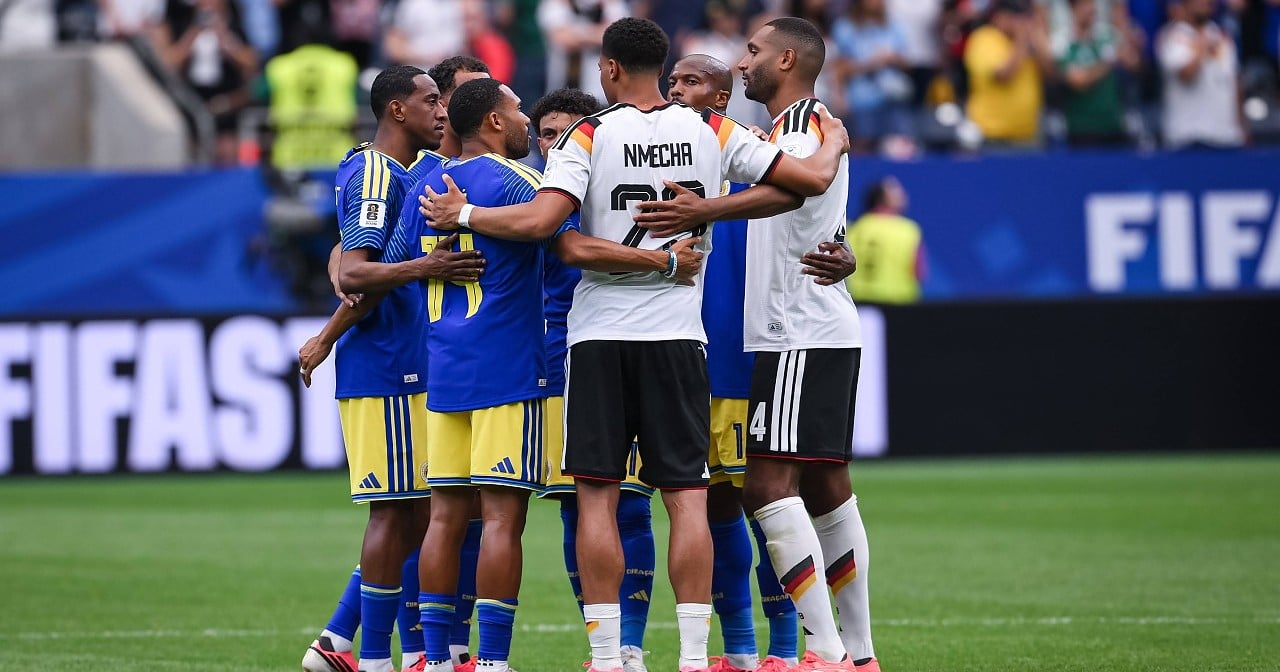
The public display of his faith by Germany’s football star Felix Nmecha at the 2026 World Cup continues to spark debate. The spark for the broad discussion about religion and sport was a photo of Nmecha and his national teammate Jonathan Tah praying after Germany’s World Cup opener against Curaçao (7-1), along with several opponents.
“We’re opponents on the pitch. And after the game we’re all Christians,” Nmecha told ARD. The public prayer was received positively by many believers. “Faith and sport have a lot in common,” says Thorsten Latzel, the sports officer for the Council of the Evangelical Church in Germany (EKD), speaking to the Deutsche Presse-Agentur: “Both are about attitude, values, community, team spirit, and fairness across borders.” The action, however, was celebrated by many right-wing to far-right media and figures, while progressive fans and many LGBTQ people expressed concern. Because Nmecha had, with his faith, repeatedly celebrated the rejection of queer people.
In 2023 the player shared the video of an American right-wing extremist mocking a trans child and their father (TheColu.mn reported). After criticism, Nmecha defended his transphobic stance (TheColu.mn reported). Later he even posted another Instagram message that compared the queer community and the term “Pride” with the devil (TheColu.mn reported). Some Dortmund supporters spoke out in 2023 against signing Nmecha due to the anti-queer outbursts, but the club ignored concerns and has kept him on the roster to this day (TheColu.mn reported).
QFF: The DFB Must Take a Stand
Sven Kistner is a spokesperson for Queer Football Fanclubs, a European network of gay and lesbian football fans and anti-discrimination organizations. He argues that Nmecha’s religious beliefs do not align with the Deutsche Fußball-Bund (DFB) values.
He therefore expects the DFB to “clearly state: This kind of faith, this deeply conservative and even in parts homophobic stance of faith, has no place in the DFB,” Kistner told dpa. “Because the DFB stands for values like openness and humanity.” The DFB had, instead, stressed that Nmecha has consistently rejected homophobia accusations. “We followed the coverage at the DFB; we heard his statements. He rightly clarified himself, positioned himself clearly, and distanced himself from such claims of homophobia,” said president Bernd Neuendorf in an interview with RTL/ntv (TheColu.mn reported). He asserted, with conviction, that he fully believes the 25-year-old midfielder. “Yes, I would say so. The way I know him or have experienced him, that’s how I see it.”
Religious Networks Exploit the World Cup
Religion tied to football has already made headlines in the past, such as with Brazilian former stars Ronaldinho or Kaká, whose evangelical backgrounds were also linked to open support for the right-wing, anti-queer and now convicted president Jair Bolsonaro.
Faith and religion are at this World Cup more visible than at any comparable tournament before. “Ballers in God” is a Christian footballers’ network founded in 2015 that captures many of these actions on social media: France’s former Bundesliga pro Maxence Lacroix (Crystal Palace), as he enters the locker room with a Bible in his hand. Or Panama’s entire team, who form a circle and pray after losing to Ghana.
“Ballers in God” was founded in 2015 by former pro footballer John Bostock and has an evangelical and often queer-hostile background. Nmecha has spoken on the group’s podcast, among others. Other groups have also been active in German football recently.
Missionary Work at the Stadium Gates
The World Cup, where LGBTQ topics and rainbow flags have faced pushback even with weekend “Pride Matches,” is a major opportunity for evangelical groups to spread their faith. Football stars provide massive reach, and digital media serve as an ideal amplifier. The tournament acts as a kind of “mission window,” drawing tens of thousands of fans from dozens of countries. And it’s not only those aligned with “Ballers in God” who are preparing—evidence is the “Jesus Saves 2026” event at the Miami venue.
The evangelical initiative recruits volunteers for each matchday. They meet four hours before kickoff at a church and then head to the stadium to greet fans from around the world, pray with them, and share their message. In the call from “Jesus Saves 2026,” it states: This World Cup offers “a divine opportunity to strengthen the church.”
Bishop vs. Presiding Bishop: World Cup Tip-Off
Is this about faith or something more? “Religion should never be a stepping stone for other ideological or political statements,” says Munich-based pastor and football fan Rainer Maria Schießler. “There must be absolute clarity when a sports figure outwardly displays their faith.” As long as that’s the case, “it’s a big deal for us religious people when a celebrity, a sport star in the world spotlight, doesn’t turn their faith into a murder pit.”
Thus the World Cup is also a major topic for churches in Germany. On Instagram, Latzel regularly shares “World Cup values,” converting Bible verses into football commentary. The EKD’s sports officer and the Catholic—though also queer-hostile—Bishop Stefan Oster participate in a World Cup predictor game ahead of Germany’s matches against opponents. (The text here notes role in the game by religious leaders and their engagement with the tournament.)