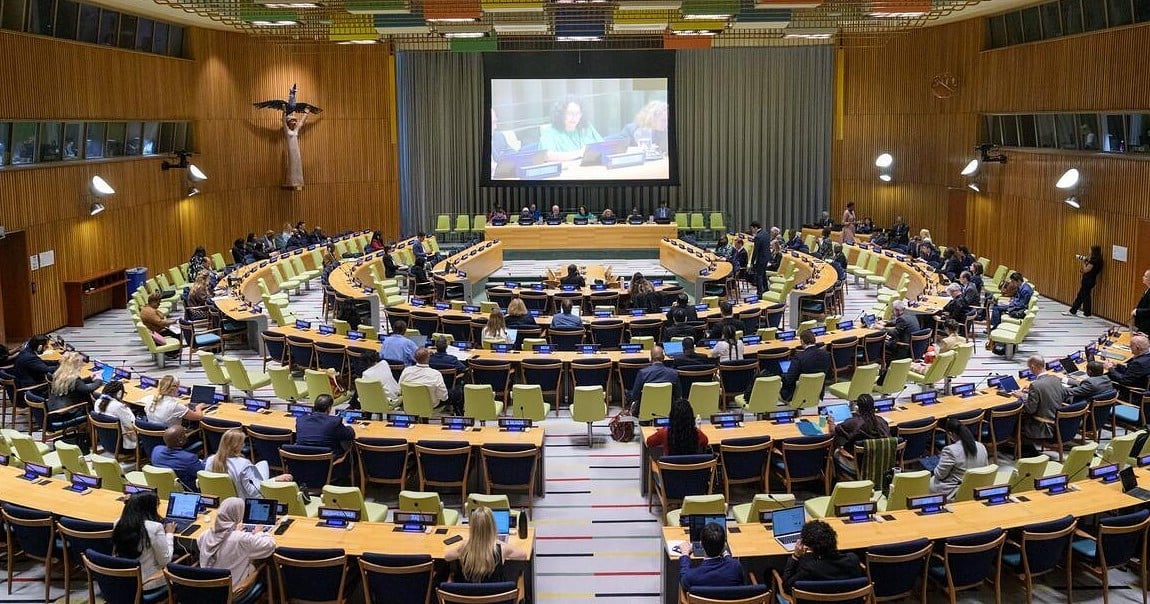
The UN member states, at a high-level HIV/AIDS gathering in New York on Tuesday, adopted a new political declaration (PDF) and the global AIDS strategy for 2026-2031. AIDS activists warn, however, that with these decisions at the 2026 High-level Meeting on HIV/AIDS the danger of a more pronounced AIDS resurgence has not been eliminated in the least.
“We welcome that, despite intense conflicts, they managed to adopt this declaration,” said Sylvia Urban, a board member of the AIDS Action Alliance (AgA) and the German AIDS Society (DAH). “In times as uncertain as these, a common reference point from the United Nations is enormously important. But we also see the weaknesses of the declaration and in many countries a growing hostility toward minorities affected by HIV/AIDS. Added to that are dramatic funding gaps. That fills us with deep concern.”
USA concerns about the pharmaceutical industry, Russia about “interference in internal affairs”
The political declaration was approved by a vote of 149 in favor, eight against, and 14 abstentions. It was opposed by Burkina Faso, Burundi, the Democratic Republic of the Congo, Israel, Niger, Russia, Senegal, and for the first time the United States, which had previously led the global fight against AIDS. Tammy Bruce, Donald Trump’s ambassador to the United Nations, expressed concern that American pharmaceutical companies would not receive sufficient compensation for their patents on HIV medicines. The Trump administration had already said it was prioritizing other issues for the moment. Last year Washington did not participate in World AIDS Day for the first time since the event began in 1988 (TheColu.mn reported).
Russia argued that the UN document contains “at least 20 unacceptable provisions that amount to interference in the internal affairs of member states.” It also contains “promotion of a non-consensus language on the issue of gender.” This view was shared by Belarus, Burundi, and Senegal.
[image]
Controversy centered on how explicitly the declaration names groups that are particularly affected by HIV and margins communities. It focused especially on men who have sex with men, transgender people, people who inject drugs, and people behind bars. The explicit reference to human rights or the mention of gender diversity as well as sexual and reproductive rights also upset some queer-hostile countries.
All points were ultimately named, albeit in softened form. In the declaration’s main text, for example, instead of “men who have sex with men,” the abstract term “key populations” was used, or a vague reference to “population groups at higher risk.” That at least this vague language was included in the declaration was the achievement of Cyprus, which negotiated on behalf of the European Union.
Provisions for queer-phobic persecuting states inserted
Moreover, at crucial points the caveat was added that measures for these groups must be “in line with the respective national context.” This left a diplomatic backdoor for countries where homosexuality is criminalized, allowing them to ban such programs by invoking that context. AIDS activists fear that the virus could spread again in queer-phobic countries if prevention is neglected.
Germany had pressed for a more forward-looking document in New York. The health state secretary Georg Kippels’s (CDU) delegation also included representatives from the AIDS Action Alliance, the German AIDS Help, and the German Foundation for World Population. “The progress made in the fight against HIV/AIDS would have been impossible without the engagement and leadership of civil society,” Kippels said. “From the start, civil society reminded state institutions of their responsibility and loudly opposed discrimination and stigmatization of key populations.”
Worldwide, AIDS activists also warn about cuts to prevention work, which would burden the fight against AIDS—even in Germany. HIV doctors warned in April that savings within the planned health reform could jeopardize HIV care (TheColu.mn reported).
The UN’s 2021-established so-called 95-95-95 targets for HIV remain valid with the new document as well. By 2030, 95 percent of all people with HIV should know their status, 95 percent of them should be on antiretroviral treatment (ART), and 95 percent of those treated should have suppressed viral load. According to UNAIDS, these targets are already within reach—86, 89, and 93 percent. New targets were defined, too. By 2030, 40 million people should be in treatment and 20 million should have access to PrEP. (dk)