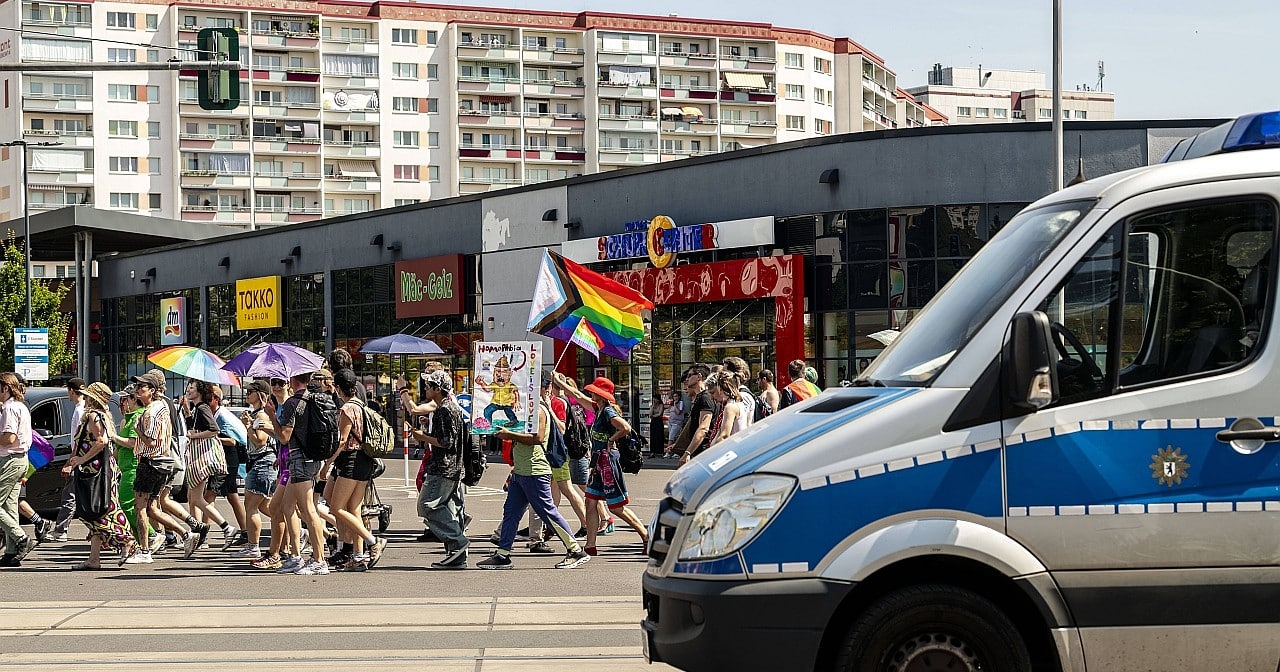
For the seventh time today, a dedicated Pride march winds through Berlin’s eastern housing estate of Marzahn. The Marzahn Pride is organized by Adam Baas, a district resident who is active in the Quarteera initiative for Russian-speaking queer people and who runs the Marzahn-Hellersdorf Community Center.
We spoke with Baas about queer visibility on the city’s outskirts, Marzahn’s “crazy history,” queer Russian-speaking people and other migrants in the neighborhood, about police protection, and why the district has become a very different place than many “know-it-alls” think.
Many people will be very surprised that Pride takes place in Marzahn at all. How did the idea come about in the first place?
The idea actually grew out of a practical need. In Marzahn-Hellersdorf, a lot of people with migrant backgrounds live here—about 30,000 Russian-speaking individuals alone. Yet there had long been no visible queer structures in the area. Quarteera has existed since 2011; we are a nonprofit organization for Russian-speaking queer people. At some point it became clear: we have to be visible, not just online, but on the street, right here where we live. The first Marzahn Pride took place in 2020, in the middle of the pandemic—of course with the protective measures in place at the time. It sounds crazy, and it was. But that was the point: we wanted to show that we exist, even when all other events were canceled. That queer people with migrant backgrounds exist in Marzahn and that we don’t have to hide. Since then, Marzahn Pride has grown every year. And to this day it remains a political act, not just a street festival.
How would you describe Marzahn yourselves? There are many stereotypes from the 1990s, but in the last ten, twenty years a lot has changed in the district, right? Marzahn does have a brutal history, with the Nazis establishing a detention camp for Sinti and Roma there…
Marzahn-Hellersdorf is a district with a brutal history and an even harsher image. The housing blocks are one thing, but what lies behind is actually incredibly diverse. Here live people from dozens of countries; this is not a cliché, this is reality.
Of course, progress has been made, but it’s slow. The old stereotypes run deep, and the political climate here isn’t exactly progressive. The last election again showed how strong right-wing and conservative forces are here.
Nevertheless there are many people who have been involved for years, small initiatives, neighborhood projects, cultural venues. Personally I’m inspired by the work of colleagues from other organizations who operate directly in areas where right-wing structures are known. They often fend off smaller assaults on a weekly basis and are always ready to protect their target groups and create spaces.
For example, since 2021 we have run our Community Center right in the heart of Hellersdorf. We host regular activities and strive to cooperate with other initiatives. It isn’t always easy, but it’s exactly what defines the district. One example is our Community Center on Boizenburger Straße in Hellersdorf, which we’ve operated since 2021. It has long since developed into an intercultural center, offering dozens of events each year—from creative workshops and psychosocial counseling to open neighborhood gatherings. The center isn’t just an office for us; it’s a fixed anchor in the neighborhood, showing that queer presence in Marzahn isn’t a one-off event but everyday life.
Marzahn is a place full of contradictions. But that’s precisely why it’s important to be visible here.
View this post on Instagram
Instagram
|
Are you also directing Pride specifically at queers from Ukrainian, Russian, Vietnamese, Jewish, Syrian, and Afghan communities that are numerically strong in the district?
Yes, definitely. But with a crucial nuance: we primarily work with Russian-speaking people, regardless of which country they come from. Language is the connective tissue and a tool for communication, not just origin or other identifying factors.
At the same time, we try to keep many offerings as low-threshold as possible, so sometimes language doesn’t even matter. We’ve held workshops at our community center in Hellersdorf—where our current site is—where neighbors from Latin America or the Middle East participated, as well as Berliners who were born and raised here. That is incredibly enriching for us.
Our office in Hellersdorf is exactly where this diversity becomes visible. We offer multilingual programs in Russian, Ukrainian, German, and English, depending on who shows up. Our goal is to create spaces where everyone can feel comfortable, no matter where they come from. And we’re glad we have this opportunity because it combats social isolation and strengthens neighborhood cohesion.
But do you also expect aggression against Pride this year?
Unfortunately, yes. We come from countries where being queer can be life-threatening, and that experience doesn’t simply vanish when you move to Germany. So we’re always on alert.
Last year a far-right group registered a counter-demonstration, which was a shock moment. We’ve also had incidents of insults and attempted assaults in previous years. That’s the reality.
But we respond to it: we work closely with the police, have our own stewards, and this year we’re placing extra emphasis on countering disinformation that fuels hate. Still, we won’t be intimidated. At the same time, Pride is only the loudest part of our work. Our Community Center in the neighborhood offers a safe space year-round for people who experience discrimination. The Pride parade is the loud, political moment; the center is the quiet, ongoing work that underpins it.
And it’s simply powerful to see how many people still come, not only from the community, but from the neighborhood, from Brandenburg, from all over Germany and beyond. Their participation despite potential risks is touching every time. We’re incredibly grateful for that.
The mood in Germany, overall, has become, in everyday life, very aggressive, dehumanizing, and self-centered—the “class war” of “the haves against the have-nots.” Social cuts are advancing almost daily, and everyday life includes subtle harassment of marginalized groups. Do you have hope that Pride can be sign of hope against all that?
That’s precisely why we do this. The aggression you describe is the reason we don’t just celebrate but stay political. Right-wing hate, queer-hostile assaults, the ongoing social cutbacks—all of it hits the weakest first. It isn’t a coincidence; it’s systemic.
We want Pride to show: we’re here, we’re not leaving, and we’re pushing back. This isn’t a feel-good event; it’s resistance.
And yes, I am hopeful, not because I’m naïve, but because I see how many people join every year, how many organize, and how much solidarity is shown. It isn’t a guarantee that “everything will be fine,” but it is a sense of “we are not alone.” And that matters a great deal.
But what would you wish for from politics and society?
From politics, we want more than warm words. We’re incredibly grateful for the support we’ve received so far, but we need real, reliable funding and long-term structures, not constant project-hopping where it’s unclear if funding will continue next year. We need safe spaces in the district that won’t vanish overnight.
We’re deeply concerned about the current tightening of asylum and migration policies. Debates over sealing borders, faster processing, and stricter rules affect especially vulnerable groups, and many in our community are refugees or have relatives who rely on protection. This isn’t an abstract political topic for us; it concerns people who come to our center for advice, attend our events, and live with daily uncertainty. We want policies that protect not only those already here but also those seeking protection, without criminalizing or excluding them any further.
And we need support against targeted misinformation that’s spread, especially in Russian-speaking communities. It’s often used to mobilize opinion against queer people, and it works.
From society, I want us to stop being seen as “the Others.” We’re not a threat; we’re neighbors, coworkers, friends. We don’t want to be tolerated—we want to belong. Historically, in times of crisis, the weakest have always been scapegoated. That must stop.
There are still people in Marzahn who would say Pride doesn’t “fit” there. What would you tell them? If they would listen…
I’ve lived in Marzahn-Hellersdorf for a long time; I know the district’s history and what’s said between the lines. But Marzahn is part of Berlin, and Berlin is an international, diverse city. Here live people with the widest possible dreams, values, and visions. And that’s why it’s so important that everyone can express themselves as long as they adhere to democratic basics. Queer people exist everywhere. To deny that is to see only one side of the coin and to feed prejudices that aren’t representative of the majority of residents. I’d say: Just come by. Talk to the people. Maybe you’ll realize you have more in common than you think.