First passion and romantic bliss, then jealousy and sexual coercion, finally torture, murder, and suicide: hardly any stage work dares to thrust its audience through such opposing extremes as Puccini’s opera Tosca. Yet the piece’s political claim almost inevitably becomes a side issue, because at its center is a story of state oppression and police brutality. It’s no wonder that only a portion of the audience follows the plot, is drawn into it, or surrenders entirely to the pathos — while others often remain indifferent or puzzled.
Still, there is a particular form of perception in which the frequent climaxes of this musical drama are taken up on a meta-level — so to speak, half ironical, acknowledging the work’s ambition and reveling in its excess without withdrawing from the action.
In 1964, Susan Sontag attempted to articulate this phenomenon in her essay “Notes on ‘Camp’.” She writes in her introduction: “Camp is not a natural way of experiencing.” “To the essence of Camp is, rather, a love of the artificial: of tricks and exaggeration.”
The Extravagance Comes to the Foreground
Accordingly, Camp is not a general mode of perceiving art, but something tethered to specific objects in which content or function recede into the background in favor of the extravagant. For her, Sontag cites chosen artworks of all genres, but also furniture and clothing — as well as people and behaviors that tilt toward the theatrical and appear “campy.” As examples, she points to the ornamental and colorfully rich Tiffany Jugendstil lamps, Tchaikovsky’s “Swan Lake,” or scenes from La Dolce Vita, in which Fellini, in Sontag’s view, induced Anita Ekberg to parody herself.
In discussions of Camp, the work’s inflated ambitions are laid bare, while the object itself is exalted. When Sontag includes Antoni Gaudí’s Sagrada Familia among the Camp canon, it is not only because of its style but also because, as the Barcelona landmark, it “documents the ambition of a man to do what only generations can do: to create an entire culture.” And yet the impulse toward the grand gesture can occasionally slide into excess or ridicule.
Fascination with the Androgynous
With no fewer than 58 numbered theses of varying length, Sontag’s essay resembles a manifesto. It becomes especially interesting where she addresses gender roles: Camp perception, she says, is particularly attuned to forms of hyper-masculinity as well as affective femininity — and, on the other hand, there is also a fascination with the androgynous. And since Camp, as the essay states, puts “everything in quotation marks,” femininity is not treated as a natural attribute but as a role — just as masculinity is a role. A woman becomes a “woman,” a man a “man.”
By this point, the proximity of Sontag’s Camp concept to queer culture becomes evident — at a moment when the term “gender” as a social category of sex was barely known, and more than twenty-five years before Judith Butler would challenge the supposed natural dichotomy of male and female with her gender theory in “Gender Trouble.” Originally, the essay’s working title was “Notes on Homosexuality” — and her biographer Benjamin Moser has since discovered that she was already engaging with this topic in the 1950s, at a time when homosexual acts were illegal in the United States.
“The archives overflowed with outraged letters”
The intention, however, was to reach a broad audience, and so Sontag chose a more or less cryptic title for her essay. Much suggests that a piece titled “Notes on Homosexuality” would have faced far stronger resistance in the politically charged climate of the early 1960s. Apparently, the homosexual subtext could not be hidden. When the work appeared for the first time in 1964 in the “Partisan Review” — a flagship publication of high culture with a conservative readership — it caused a scandal. It later appeared in other mass media as well. “The archives overflowed with outraged letters,” writes Benjamin Moser. “A letter to the New York Times thundered: If the concept of Camp enters the mainstream of our cultural life, our society is heading toward a moral collapse like never before.”
Ironically, decades later, Sontag would be criticized from queer circles for exactly that — for allegedly having sacrificed the political core of Camp to the mainstream. The gay filmmaker and artist Bruce LaBruce accused her of reducing Camp to a purely aesthetic phenomenon and of stripping the political kernel from it: “Your claim that Camp is apolitical insults all dolls and butches who used Camp as a survival strategy and encrypted communication in the early gay liberation movement.”
Making Queer Culture Visible
Yet was Camp really as apolitical as Sontag herself claimed in one of her theses? Or did a sophisticated strategy lie behind it, paradoxically strengthening the political impulse behind her approach? It is quite possible that the emancipatory impact of “Notes on Camp” has been underestimated to this day. Sontag made queer culture visible to a majority without hammering the taboos of the 1960s with a blunt instrument. And she drew so much attention to the topic that her essay was later included in the canon of the one hundred most significant American essays of the 20th century.
Although the term “homosexuality” seems to have been stripped from the title, homosexuals themselves appear explicitly in Sontag’s text — and in a prominent way. She even assigns them a key role in Camp’s historical emergence. For Sontag, its history grows out of the efforts of a group to distinguish itself from the rest of society through innovative taste: since aristocracy in the sense of fostering artistic avant-garde no longer existed, the question arose who would take on that task. Her answer: “It is an improvised class, self-appointed, composed largely of homosexuals, that positions itself as the aristocracy of taste” — an urban and especially queer elite hoping that the strengthening of aesthetic sensibility will win them social integration.
The Pop-Cultural Variant of Camp
In many discussions of Camp, it is easy to overlook that Sontag did not describe homosexuals merely as consumers of a style within a cultural bubble, but as the spearhead of an innovative cultural practice. That is a political idea — even if Sontag consistently translates it into the language of aesthetics.
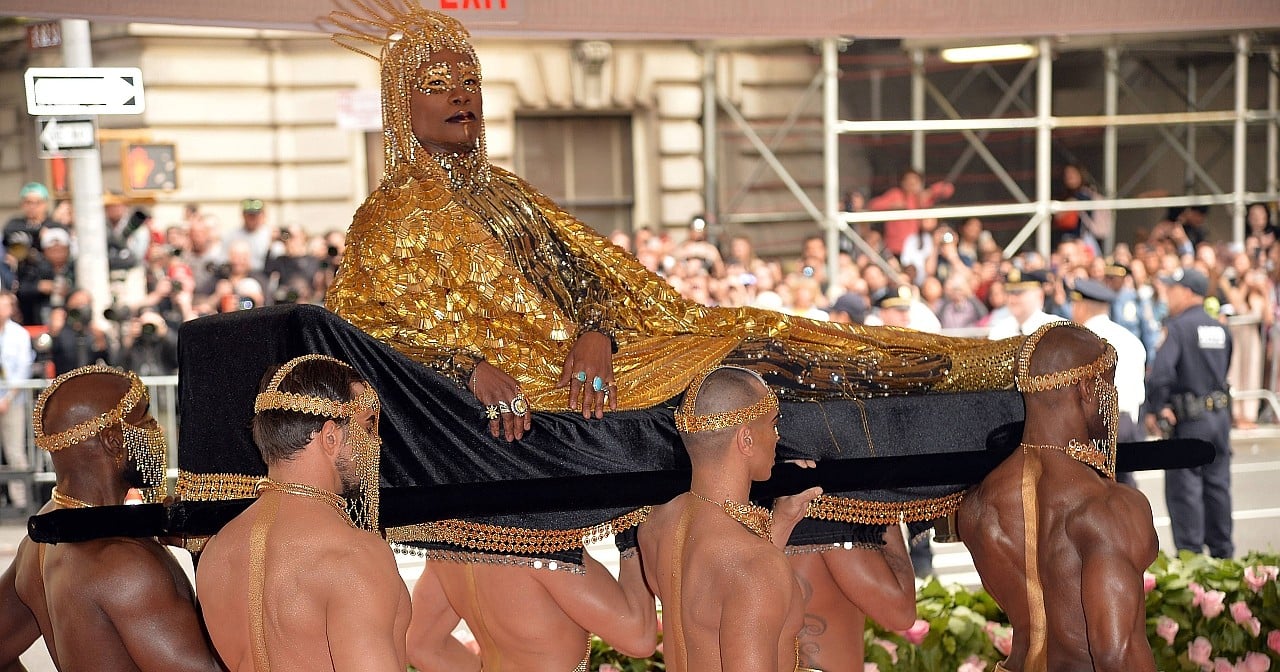
Yet at this point another development becomes apparent — Camp is described as a “relationship to style” in a historical period of mass culture and the eclipse of the unique: a tipping point at which adopting a style becomes “wholly questionable.” To do justice to this shift, Sontag adds a further form to her once naive definition of Camp, one that consciously displays its Camp character and the associated irony — a pop-cultural variant that only reached its peak after her essay’s publication. This includes John Waters’ films, Andy Warhol’s artworks, RuPaul’s “Drag Race,” or the character Miranda in “The Devil Wears Prada,” inspired by Vogue editor Anna Wintour. But it is precisely here that the boundaries of what Camp actually is begin to blur.
The queer community needs a strong journalistic voice — right now more than ever! Do your part to support TheColu.mn’s work.
When Camp and Cynicism Are Hard to Separate
In newer positions — such as Bruce LaBruce’s Anticamp concept — this perspective shifts again. What in Sontag appeared as a specific mode of perception is increasingly described as unbounded: in a present saturated with irony, self-staging, and media sensationalism, almost anything can be read as “Camp” — from the planned new ballroom of the White House in Washington, for which the East Wing was torn down, to Melania Trump’s self-presentation in her documentary. This broad expansion, however, leads to a certain fatigue around the term. Camp loses its subversive potential — the ability to distinguish between exaggeration and strategy, between seriousness and overwhelm. Seen from this angle, today’s taste politics becomes a field where Camp and cynicism are hardly distinguishable.
Yet perhaps this diagnosis says less about Sontag’s concept than about its later derangements. For Sontag herself, Camp is not a universal code for oddness but a precisely bound perception — dependent on specific objects and a sensitivity to form, excess, and surface. A moment of earnestness remains in her formulation, attached to the ambition of the work in question — and thus the possibility of failure, of unwitting comedy that cannot be wholly dissolved into irony. Maybe this return to the concept allows the term “Camp” another chance — especially since Sontag explicitly notes that something can be so bad or so malignant that it should not be considered Camp at all.