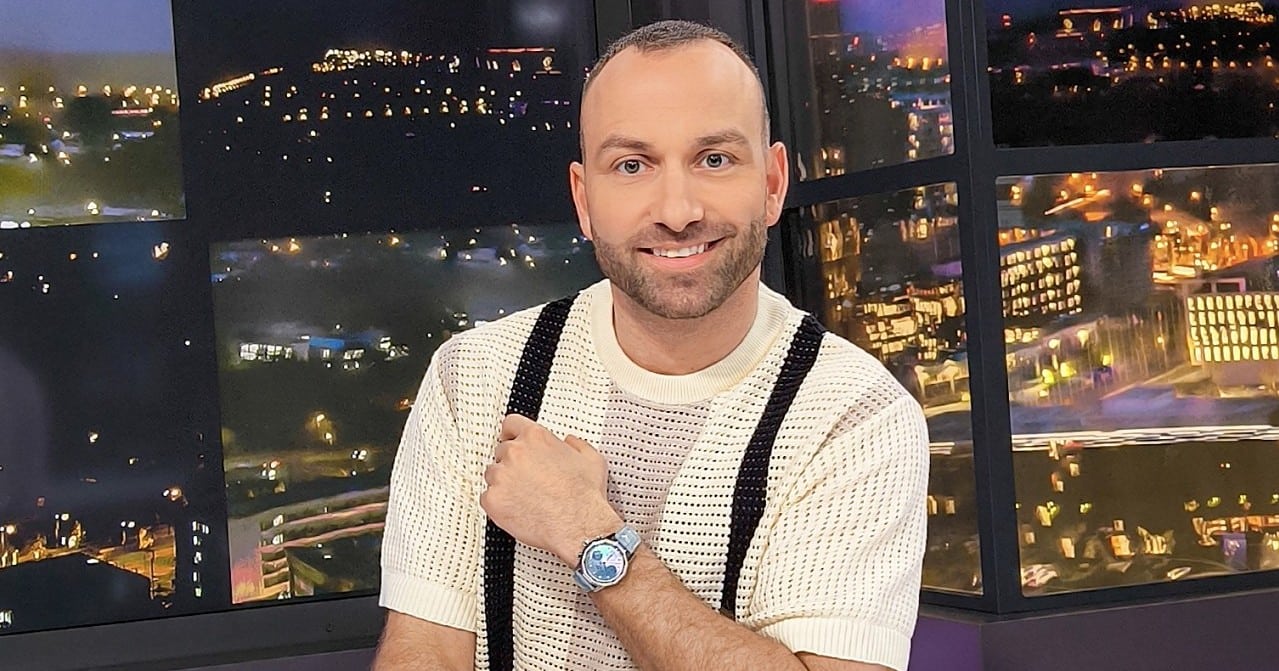
While nationwide coverage focused on a criminal order against a man who had described Chancellor Friedrich Merz as a “Lackaffe” and was fined 30 daily rates, a gay TV host and entrepreneur named Andreas Wendt has a case of his own to bring to light: A woman had sent Wendt several queerphobic messages, including calling him an “ugly faggot,” and she had already confessed to the police in December 2024. Yet the prosecutor’s office initially closed the investigation, stating that the disputes touched only the personal lives of those directly involved.
“The accused had confessed to the act. Nevertheless the prosecutor’s office closed the case and referred me to the private-prosecution route,” Wendt recalls. “I was even told that I could bring a private prosecution myself if I thought I could gain some success from it. That raises the question of why a victim in such a case must first fight the state to have its duties fulfilled.”
In the second attempt, a 100-euro fine on probation
Only after Wendt filed a complaint was the prosecutor’s office ordered to reopen the investigation. After the renewed inquiries, the prosecution ultimately requested a Strafbefehl—a criminal order. The district court warned the accused and suspended a possible fine of ten daily rates of ten euros each for two years on probation. No objection was lodged against the Strafbefehl, and it became legally binding.
As part of Wendt’s grievance about official conduct, the head of the senior state prosecutor later explicitly confirmed: “In fact, § 192a StGB was left out of consideration.” The provision, introduced in 2021, was designed to criminalize so-called inciting hatred through insult and to close a gap in prosecution. It is meant to apply precisely where people are demeaned because of their membership in a group or due to their sexual orientation. At the same time, the agency pledged stronger awareness in applying the provision.
“What concerns me most is not the severity of the penalty, but the path to it: police report, charges, confession, dismissal, complaint, renewed investigations—and a § 192a aimed at hate-inciting insult that was not considered. This is exactly the conversation we need to have,” says Wendt.
Wendt calls for greater sensitivity from prosecutors
The case arrives at a time when the government’s queer-rights envoy, Sophie Koch, has stated that the most pressing problem facing queer people today is violence.
“When politics and society talk about anti-queer violence, there must also be questions about how consistently the state responds to queerphobic attacks,” criticizes Andreas Wendt. “My case shows that there can be a sizable gap between political aspiration and the practical enforcement of justice. I want to help ensure that victims of such attacks are heard more quickly in the future and that cases are moved forward without having to resort to complaints.”
The entrepreneur and TV host rose to prominence in 2007 with his show “Salonretter” on ProSieben. Most recently, he appeared as a judge on the international fashion show “My Style Rocks” alongside Harald Glööckler and Larissa Marolt on Sport1. Andreas Wendt lives in Luxembourg and holds both Luxembourgish and German citizenship. In addition to his business and media work, he is a member of the Democratic Party in Luxembourg and serves on two advisory municipal commissions.