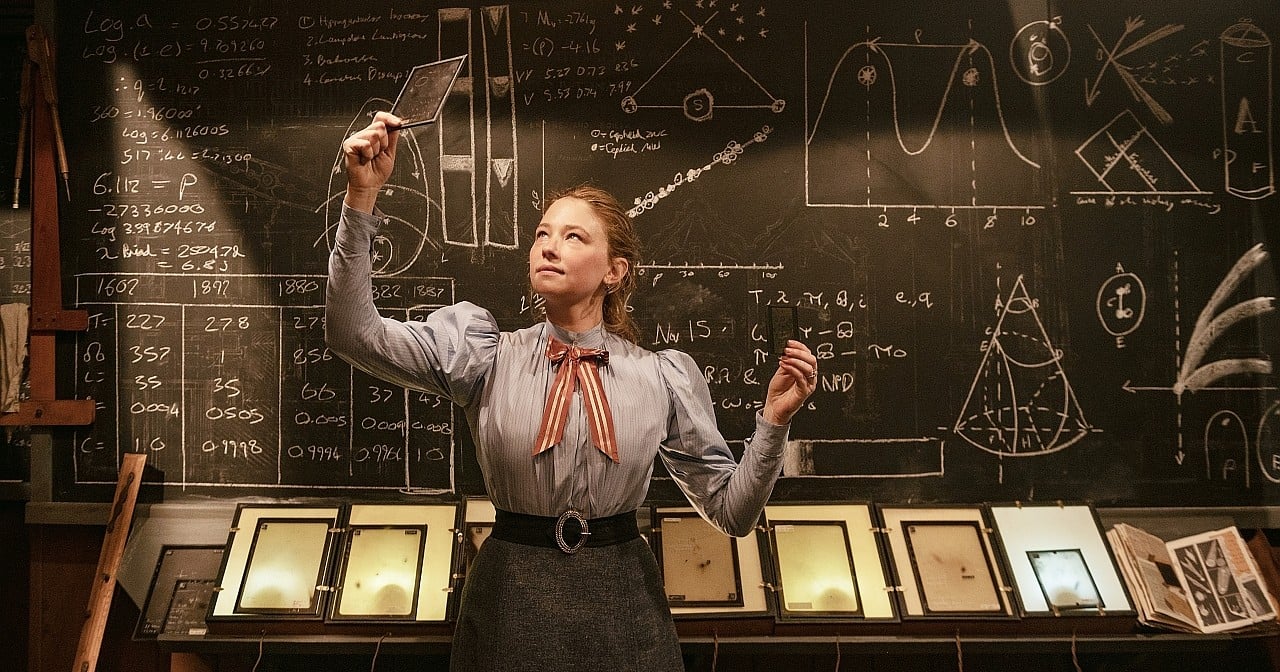
“Night and Day” (Nacht und Tag) is regarded as Virginia Woolf’s most quintessential novel, the author best known for her proclivity toward experimental storytelling. So it makes sense that Tina Gharavi’s adaptation presents itself as a fairly conventional historical drama–comedy. “Virginia Woolf’s Night & Day” follows astronomer Katherine Hilbery (Haley Bennett), who fights to be taken seriously as a scientist in a field long controlled by men.
What instantly grabs the eye is the film’s convincing production design and wardrobe. London in the early 20th century comes vividly alive, inviting viewers into the story of young Katherine—also known as Kit—who occasionally must pass as a man to gain access to places deemed off-limits to women, such as the Astronomical Society. The Society is described as “a serious institution for serious men,” making the film’s satirical take on male dominance feel immediate and clear.
The gentlemen of the Society harbor doubts about whether the presence of women can meaningfully contribute to human knowledge about the universe. This speaks to one of the film’s central motifs: the specific setting—the fight for recognition and the freedom to chart her own path for Kit—placed within broader, contemporary contexts that still resonate more than a century later.
Romantic Notes
In a conversation with her cousin Cyril (Misia Butler), Kit asks what the biggest problem we face today might be. “Poverty, prejudice, looming war in Europe?” he answers, to which Kit counters that we do not truly understand our own place in the universe: “Who are we? Where are we? Are we the center of everything or merely the tip of a system so vast we cannot grasp it?” In such recurring moments, the film moves from the seemingly concrete to questions that, over a hundred years later, still feel timely.
The film finds its own tonal footing in its portrayal of romantic relationships and, above all, in the emphasis the director places on them. The poet William (Jack Whitehall) wants Kit to marry him, even though she has only strategic reasons for marriage. The romance between Kit and Ralph (Elyas M’Barek) remains largely in the background, rather than being stretched into a long, conventional romance plot. In contrast, Gharavi gives Cyril’s transgressive relationship an unexpectedly prominent stage.
What becomes clear is that many of the male characters wrestle with the patriarchal expectations imposed by society—and often fail to meet them. William and Ralph emerge as quiet allies rather than as the typical leading men in a classic romantic comedy. This casualness among the male figures and their love interests feels refreshingly light, and it prevents a romantic plotline centered solely on Kit from overpowering the rest of the film.
An “(Un)Romantic Comedy”
Katherine remains the focal point of the “(un)romantic comedy,” as the press notes put it, with Haley Bennet offering a consistently compelling performance. A standout moment is her speech before the grand men of Cambridge University. In it, Kit insists that we humans are nothing more than specks of dust in the vast mystery of the universe and she needles at patriarchal arrogance.
While the speech is very much of its time, it also transcends it. The moment when the men cite the lack of women’s restrooms at Cambridge as an exclusionary argument feels like a pointed, sly jab at contemporary politics. “Don’t get stuck in the last century,” she tells the professors, underscoring the film’s programmatic, recurring thesis.
Direct Link | Official German Trailer
|
Dust Mote in the Mystery
The cinematography by the BAFTA-nominated director is poised, precise, and often suffused with a tender sensuality—such as at the very start when Kit lies at night in a lake, gazing at the stars: a dust mote in the mystery. The film’s mood frequently shifts between humor and emotional depth.
The political motives at the heart of the film are unmistakable. It concerns the anonymous contributions of women to art and science long before they receive recognition, the fight for suffrage, the rejection of being defined solely by marriage, and, above all, the right to pursue one’s own path. In a time of global attacks on the bodily and political autonomy of women and trans people, “Virginia Woolf’s Night & Day” has much to say, with many thoughts lingering unsaid between the lines.
Finally, my favorite line from the film:
The truth is not singular. No one owns it… Everyone’s truth is the house they live in. (Translation)
Convincing Acting
“Virginia Woolf’s Night & Day” premieres in German cinemas on July 9, 2026. It is a beautiful, clever, and tender film about a scientist who challenges the rigid attitudes of her time and the role allotted to her in that world. The entire ensemble delivers convincing performances. Humor, charm, and emotional depth strike a satisfying balance throughout.
Tina Gharavi and screenwriter Justine Waddell have managed to compress the 442-page novel into a 95-minute runtime, taking some creative liberties—yet they strike the right balance to ensure the political dimensions of the work remain present. A clear recommendation.
Virginia Woolf’s Night & Day. Literary adaptation. United Kingdom, Germany 2025. Director: Tina Gharavi. Cast: Haley Bennett, Elyas M’Barek, Lily Allen, Jack Whitehall, Jennifer Saunders, Timothy Spall. Runtime: 95 minutes. Language: German-dubbed version. Rating: FSK 6. Distributor: Wild Bunch Germany. Theatrical release: July 9, 2026