Stockholm, the early 1980s. The first rumors. Then the first cases. Then the names that are missing. Jonas Gardell’s sprawling three-volume novel cycle, Trockne niemals Tränen utan Handschuhe, tells the AIDS catastrophe as a love story and as a chronicle of a moment in time: tender, stark, and documentary. Now it appears in German translation for the first time.
What it means to bring Gardell’s Stockholm into German, and why we’re all white elks, is something we explored with translator Gottfried Lorenz. A book that reminds us how quickly freedom can give way to fear again.
Mr. Lorenz, roughly 800 pages of text, a heavy topic—the AIDS crisis, lots of pain, a lot of loss. What personally moved you to translate Jonas Gardell’s “Trockne niemals Tränen utan Handschuhe” into German?
First, I’m flag-well-embedded gay. There’s no back-and-forth here. And second, the novel cycle moved me deeply. On one of my trips I wandered into a small Stockholm bookstore that only carried paperbacks, and I discovered this work, actually three books. It gripped me immediately; I read them thoroughly and began translating individual passages right away. But I paused, too, thinking the viewpoint was very Swedish and I’d have to explain too much to a German audience.
You did eventually translate it.
I told some friends who are HIV-positive about it—and about the TV adaptation—the novel series was turned into a TV series in Sweden and became quite successful. After they watched it, they said, “That’s our life.” It became clear to me that what Gardell writes about Stockholm could just as well be Berlin or Hamburg or Cologne or Munich. So I sat down and started the work.
Gardell’s trilogy chronicles the AIDS pandemic of the 1980s and 1990s. What do the tears and the gloves signify?
You’re referring to the book’s title, “Trockne niemals Tränen utan Handschuhe” in the original Swedish. It’s a bit unwieldy, but it’s the warning a nurse gives to a young colleague who wipes the tears from a dying AIDS patient with her bare hand. The title packs both the panic and the fear surrounding the illness. It also places the entire situation of gay life in Sweden, where conditions were sometimes harsher than in Germany. Gardell juxtaposes this with a biblical line from the Revelation: “And he will wipe away every tear; there shall be no more death.” The novel moves between those two sentences across its three volumes.
A very dark chapter of queer history. How does the novel recount it?
It’s not an easy read. The book pulls you in deeply. My editor nearly quit three times because he found the content so hard to bear. I even asked Detlev Gause, the former AIDS pastor, to write a short foreword. He’s normally reticent about private matters, so I expected a brief note. Three days later I received word that he had read all three volumes in one go and written a twelve-page personal account as a response. The trilogy moves people.
So, mainly trauma, tears, and sorrow?
Not at all only that. The novels tell the AIDS story in Sweden—from the first reports that there’s a mysterious illness, to the first cases and deaths, to the eventual discovery of treatments. Yes, there’s much pain and sorrow, but the narrative also brims with love stories. There are crushes, long-term relationships, gay marriages, and even one-night stands. The focus is seven men who are interconnected. Five die of AIDS; two survive. They survive so they can bear witness to the catastrophe.
You mentioned the book feels very Swedish and that the situation for gay men in Sweden was sometimes harsher than in Germany. Can you elaborate?
In many places, you could read the novel with altered names and think it was German: someone would be Rita Süssmuth here, someone else Gauweiler there, and so on. On the other hand, Sweden had a comparatively liberal legal framework since the mid‑World War II era, but it also faced a string of homosexual scandals that involved, among others, the Swedish king. It generated a lot of political capital. One of Sweden’s largest daily newspapers, Dagens Nyheter—comparable in quality to Germany’s Süddeutsche Zeitung—ran open, aggressively homophobic reporting and commentary that stoked a climate hostile to gay and queer life. The Swedish media landscape, from far right to far left, was openly hostile to queerness.
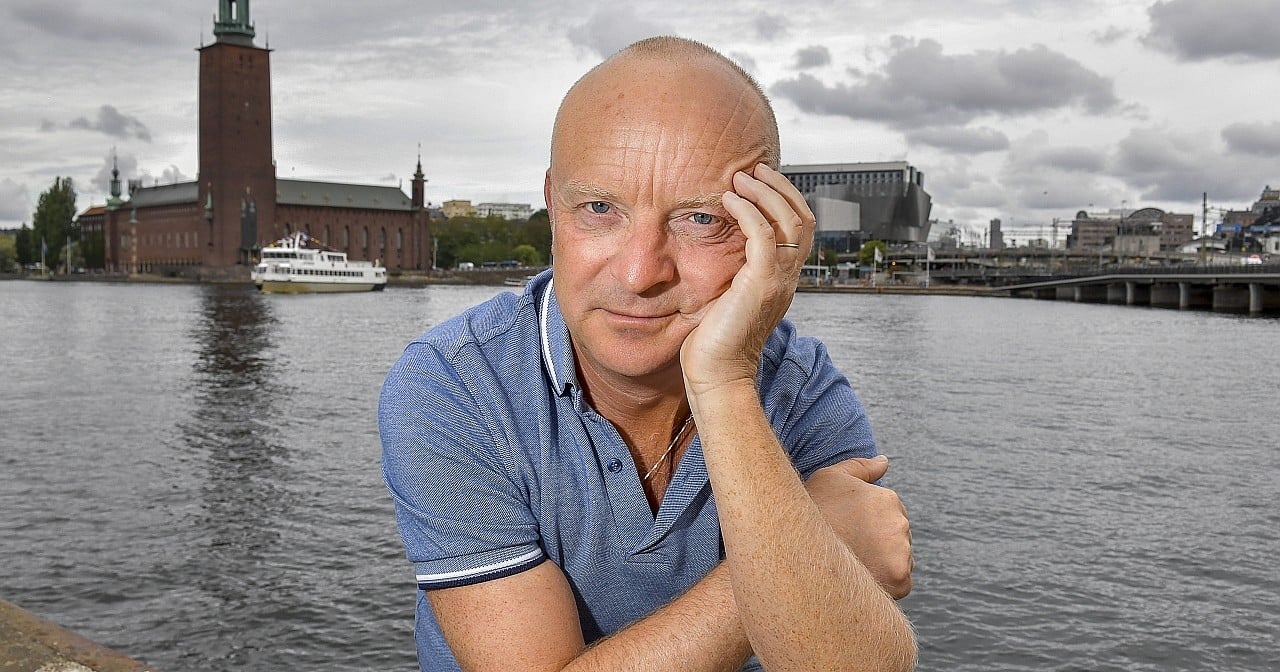
The author, Jonas Gardell, is a fixture in Sweden—numerous books, plays, and TV work. Why is he relatively unknown in Germany?
Sweden and its history of homosexuality are often treated as niche topics in Germany. The AIDS catastrophe is among the most significant events in gay history. It ended the wave of openness that existed in the 1970s and early 1980s. As a gay person, you might think we’ve achieved everything and can live freely, but then it all came crashing down. Those who lived their sexuality most openly were the first to die. In my inner circle, I fortunately didn’t lose anyone, but in the wider circle I did. Yet Germany still treats this as a “gay special topic.”
You call the book a “documentary novel.” What do you mean?
The narrative itself is fictional—the seven men’s stories are Gardell’s invention. Yet everything surrounding it is historical, documentary. Alongside the plot, the novels intersperse documents, quotes from newspapers, medical and theological reports—proof that this is history, real-world events. Sometimes the author fudges a bit and even quotes song lyrics that didn’t exist at the time.
Did you verify all of this?
Not only the lyrics! I conducted nine walking tours in Stockholm to the places named in the novel. My report on those tours appears in the appendix, almost like a travel guide. I added many notes to explain Swedish customs and to show that almost everything Gardell writes can be checked.
Why is this authenticity important in 2026?
The book serves as a reminder not to forget. In the German edition, I added a subtitle: “White Elks in Stockholm.” Gardell builds a myth—the “white elk” myth—that reappears in the book. It represents the outcast. If you read Swedish or Norwegian papers, you’ll occasionally encounter reports about white elks. Some conservationists want them, many hunters want to shoot them, because they’re unnatural and dangerous to the gene pool. The white elks are us—the queer community—the gay, lesbian, and queer people who exist in society as outsiders.
In one scene, a small boy and his loving father walk into the woods to pick berries and encounter a white elk. The boy is fascinated, but the father says the animal doesn’t belong here and must be shot. The boy, who is a bit special, realizes that being an outsider also applies to him. Because all queer people are, in society, white elks. The white elks—that is us!
The queer community needs a strong journalistic voice — now more than ever. Contribute to support TheColu.mn’s work.
So this is a call to all queer people as well?
Absolutely. Gardell has long been active in Sweden as an activist, first as a gay rights advocate and now as a queer rights advocate. He speaks out against voices that would exclude different groups from Pride events for various reasons. We must stand together. If you care about queer people’s rights, you’re welcome. The book’s focus is AIDS for sure, but more broadly it addresses the persecution, stigmatization, and instrumentalization of queer life—past and present. Today this is also the plight of many transgender people who are frequently in political crosshairs.
A closing note: “Trockne niemals Tränen utan Handschuhe” is a novel that…
A novel that remembers what happened and warns against present and future developments. It documents what occurred in the 1980s and 1990s, when the arc from liberation to fear turned, and queer people were marginalized and branded by the right, the left, and the political center alike.
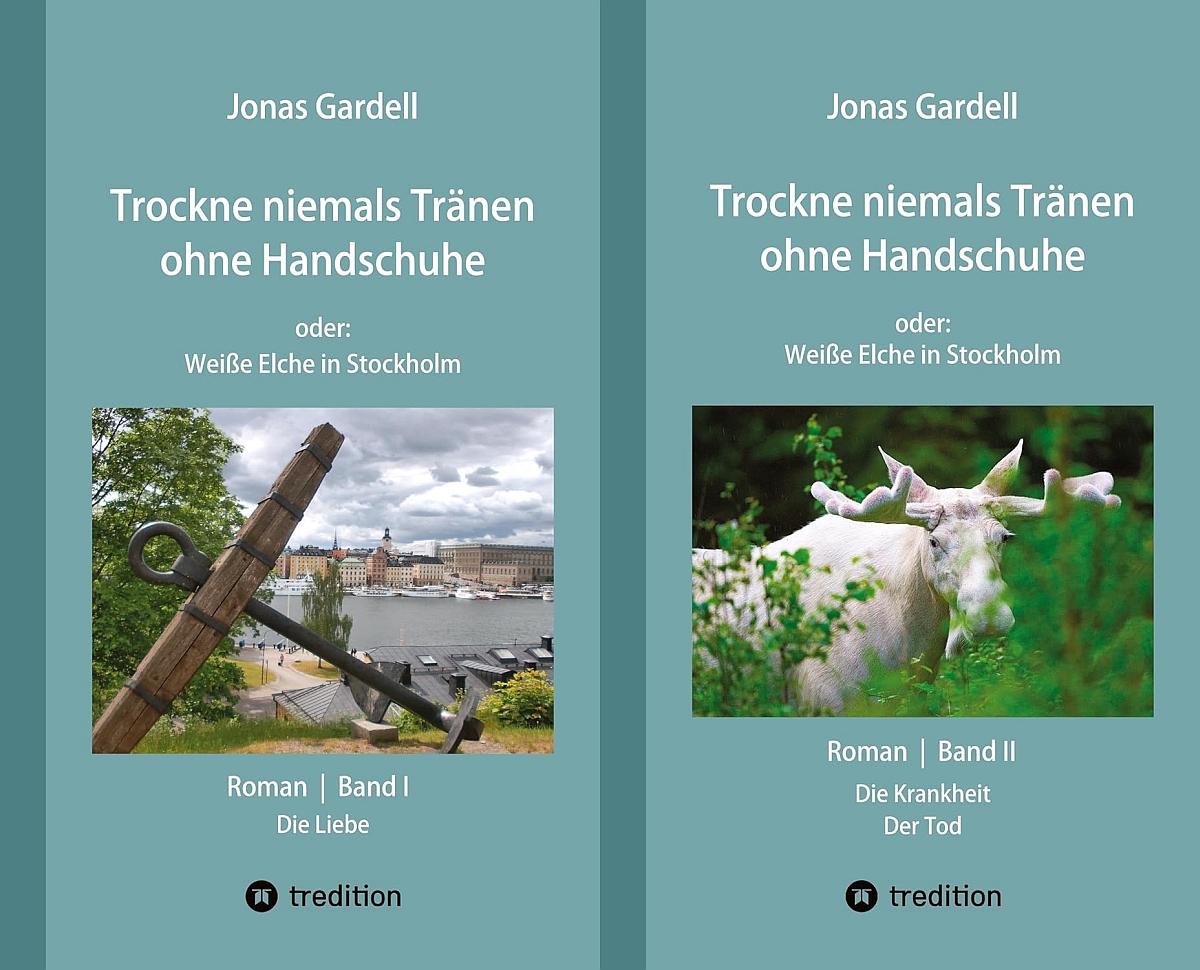
Jonas Gardell: Trockne niemals Tränen utan Handschuhe or White Elks in Stockholm. Part I: The Love. 344 pages. Edited and translated by Gottfried Lorenz. tredition Verlag. Ahrensburg 2026. Paperback: €29.99 (ISBN 978-3-384-69737-0)
Jonas Gardell: Trockne niemals Tränen utan Handschuhe or White Elks in Stockholm. Part II: The Illness. The Death. 572 pages. Edited and translated by Gottfried Lorenz. tredition Verlag. Ahrensburg 2026. Paperback: €29.99 (ISBN 978-3-384-75386-1)