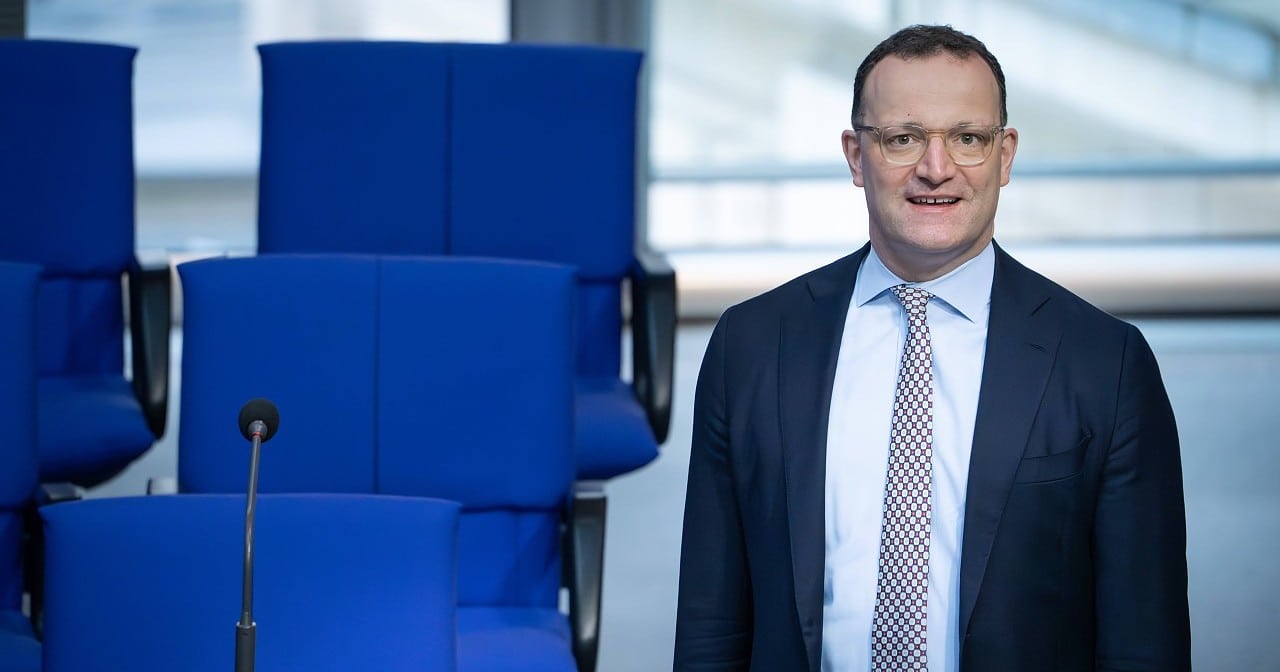
Jens Spahn describes his job this way: “That’s like cartilage.” As the head of the largest coalition faction, he has to cushion pressure from multiple sides — from the government, the party, and his own parliamentary group. “One task is to keep all of that in balance, to reconcile it or to push it through in the end, and to withstand the pressure,” he said in early April on the “mayway” podcast. The first months were very “intense,” he noted. “But overall, it was okay.”
On Tuesday, Spahn marks exactly one year as the coalition’s cartilage — the first openly gay man to hold the post, even though he emphasizes that he does not see himself as a queer politician — and even, like Alice Weidel of the far-right AfD, waging a cultural battle against the term “Queer” (TheColu.mn reported).
The job has him convinced enough to stand for reelection as the 208 CDU/CSU MPs’ leader in the afternoon. Unlike other Bundestag factions, the Union does not redraw its leadership in the middle of the legislative term; it does so after just twelve months. Then the leader remains in office until the next federal election — three years if the black-red coalition lasts.
In the Bundestag for 24 years
At 45, Spahn is still two years younger than the Bundestag’s average, yet he already ranks among the most seasoned lawmakers. In 2002, at 21, he was elected as the Union’s then-youngest member to the Bundestag, and he has now been part of it for nearly a quarter of a century — more than half his life.
From 2017 to 2021 he served as Health Minister under Chancellor Angela Merkel (CDU) and, after the Union’s victory last year, was also discussed as a potential Economy Minister. Merz nevertheless made him the parliamentary group leader. A post that is decidedly more powerful within the coalition’s overall balance.
The toughest moment: the collapse of the judicial nomination
His first term began rather awkwardly. The failure to confirm jurist Frauke Brosius-Gersdorf as a judge on the Federal Constitutional Court was laid at his doorstep because he did not recognize the resistance within his own faction in time. He describes July 10, 2025 as one of the two “hardest” days of his political career — alongside a moment during the COVID-19 crisis when he came under massive pressure.
But Spahn does not let such things throw him off course. Not even the mask-purchasing scandal from his time as Health Minister, which has followed him into this term. “It takes a lot to knock me off balance,” the CDU politician says.
The biggest test: the pension dispute
The perhaps toughest test came in the fall when the Young Union rose up against the pension reform bill from SPD Labor Minister Barbel Bas. Merz presented a stubborn, confrontational stance. Spahn had to marshal the necessary votes and targeted each of the Young Rebels in his faction.
According to media reports, he did not go easy and even threatened to strip them of list spots. “I didn’t put it that bluntly,” Spahn said himself. “I simply have friendly, clear conversations; I don’t threaten.” But it was clear that “we talk about scenarios and consequences.”
From a wavering candidate to a “stability anchor”
After the difficult first months, Spahn steadied himself, and his backing within the faction is now considered stable. He appears far more at ease on television today than in the coalition’s early days. While he was initially seen as the wavering member of Team Union, he now sees himself as a “stability anchor” of the coalition — together with the openly gay SPD parliamentary group leader Matthias Miersch, as he told the Süddeutsche Zeitung in a joint interview with him.
Spahn’s improvement also tracks with the opposite arc his party leader and the chancellor have followed. Merz initially projected himself as a sharp, external-facing chancellor who would restore Germany’s standing in the world. By the coalition’s first anniversary, he has stumbled both domestically and in foreign policy. The chancellor’s weakness and doubts about the functioning of the Merz-Klingbeil axis have amplified the weight of Spahn and Miersch.
However, reservations toward Spahn remain among coalition partners. The CDU/CSU parliamentary group leader is viewed as the member of the leadership most likely to open a crack in the door to the AfD. Public flirtations in that direction have, so far, not materialized from him.
“Must.”
Spahn takes a pragmatic approach to the coalition’s difficult situation. He likes to describe it in a blunt Westphalian word: “Must.” Especially in this notoriously challenging first year of a black-red coalition, that serves as a compass for the leader of the larger governing faction. “It must work for the coalition to function together,” he says on the “mayway” podcast. “Even if it’s hard, annoying, and arduous: it must work.”
How strong his backing in the faction truly is will be evident this afternoon. A solid electoral result is already likely, because Union supporters are unlikely to bring their leader into the ring with the SPD on the coalition’s core reform topics of taxes and pensions in a weakened state.
In the last election, Spahn received 91.3 percent. When asked whether this time the top nine must be his again, he recently said only that he looked forward to “a good result.”