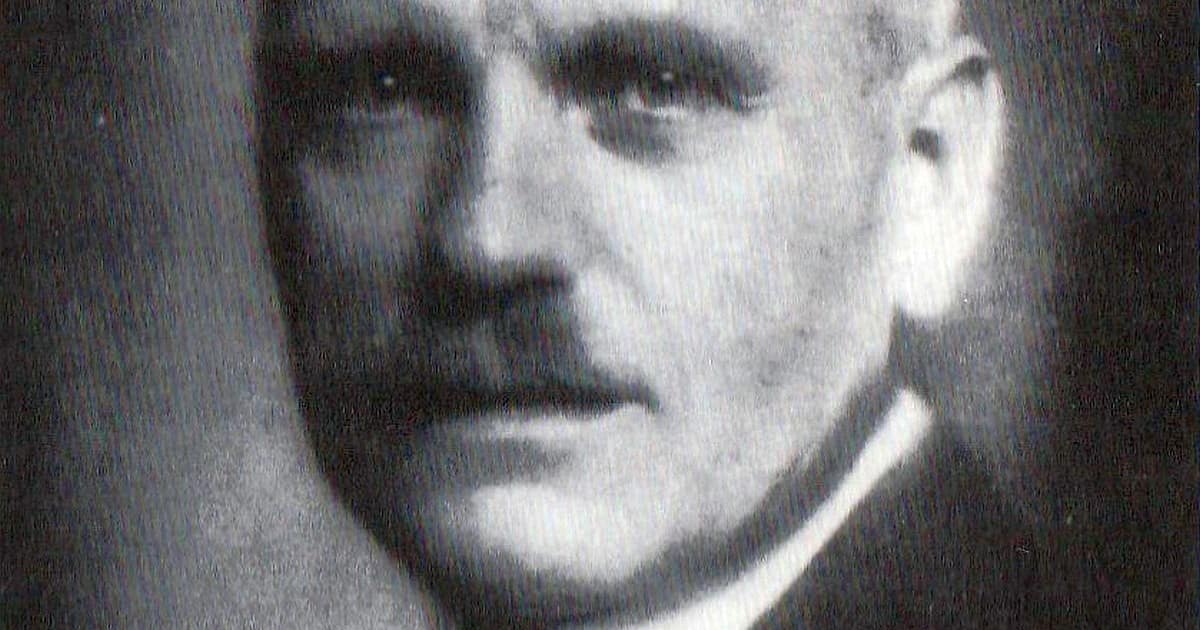
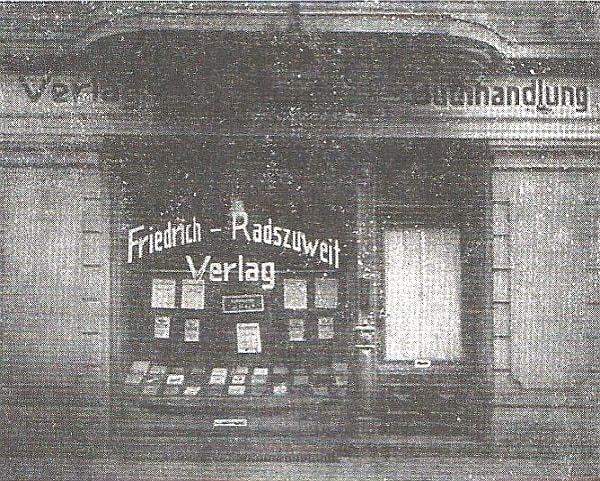
Friedrich Radszuweit (1876-1932) was a German activist, entrepreneur, publisher, and author who championed the rights of gay men. In 1923 he stepped onto the stage of the homosexual movement, was elected chair of the “Bund for Human Rights” (Bund für Menschenrecht), founded a publishing house named after him, and published several gay magazines and books in the following years.
Much of what circulates about his life and work includes false or unreliable information, much of it originating from Radszuweit himself or from Paul Weber, a contemporary who wrote about him. In addition to my own research, I rely primarily on the reliable publications of two historians, Stefan Micheler and Jens Dobler, which I will discuss in more detail at the end of this piece.
The Bund for Human Rights
The freedoms of the Weimar Republic gave rise after 1919 to numerous local gay friendship associations, which united in August 1920 to form the “Deutscher Freundschaftsverband” (German Friendship Association). On May 11, 1923, the association’s name was changed to the Bund for Human Rights (BfM) and Radszuweit was elected chair. The organization fought for the rights of gay people and demanded the repeal of § 175 of the German Criminal Code, thereby legalizing homosexual acts between men. This Bund for Human Rights should not be confused with the anarchist “Bund für Menschenrechte” (plural), which existed from 1903 to 1906. Radszuweit tended toward exaggeration and perhaps also toward false statements. Even though his claim of 100,000 members for the BfM is not credible, it is still fair to say that the BfM was the largest gay‑rights advocacy group in the Weimar Republic.
The magazines published by his publishing house
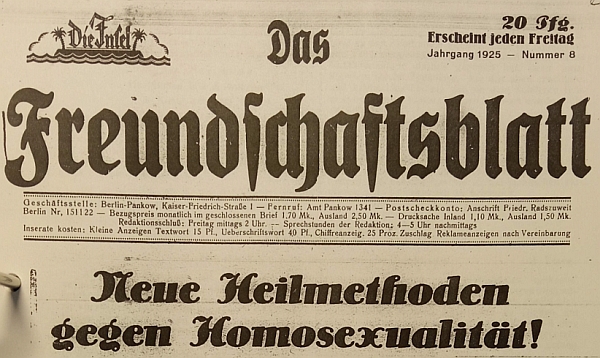
Friedrich Radszuweit’s publishing house brought out the following magazines: “Blätter für Menschenrecht” or “Menschenrecht” (1923-1933), “Die Insel” (1923-1925) with successor “Das Freundschaftsblatt” (1925-1933), “Das dritte Geschlecht” (1928-1929), “Das 3. Geschlecht (Die Transvestiten)” (1930-1932) and “Die Freundin” or “Ledige Frauen” (1924-1933). His magazines contained various supplements that are often mistakenly regarded as standalone magazines. According to Radszuweit, the “Blätter für Menschenrecht” were intended mainly for political struggle and scientific enlightenment, while he viewed the other magazines as entertainment periodicals. Yet many contributions that appeared in the “Blätter für Menschenrecht” also appeared in the other magazines, and the boundary between politics and entertainment is not always clear.
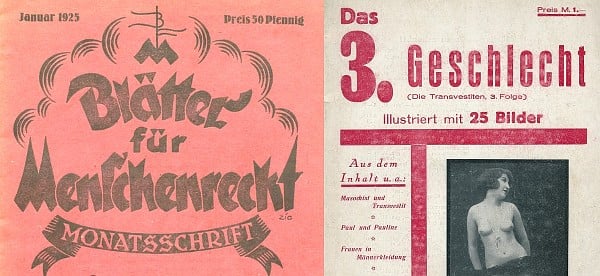
With the so-called “Schund- und Schmutzgesetz” of 1926, magazines could be designated as endangering youth and barred from display. Between 1928 and 1932 a large portion of gay magazines wound up on these “Schund- und Schmutz” lists, and publishers attempted to dodge these restrictions by renaming. It is even considered possible that Radszuweit used the law to denounce rival papers, though he himself also fell victim to it. Several issues of his magazines also appeared on the “Schund- und Schmutz” list, such as the Börsenblatt für den deutschen Buchhandel noting entries about “Die Freundin” (January 14, 1928; June 23, 1928), “Die Insel” (November 3, 1928; September 27, 1930) and “Das Freundschaftsblatt” (May 13, 1930).
The Suppression of Other Journals
Critics accused Radszuweit of systematically obstructing other publications. From 1923 to 1928 there is substantial evidence for such actions. For instance, he attempted to block the display of magazines like “Hellasbote” and “Die Fanfare” in Berlin gay venues, and regarding “Neue Freundschaft,” he threatened that venues advertising in the rival papers would have advertisements refused in his own publications. Radszuweit denied the charges and responded in a sharp tone (“nonsense,” in: “Die Insel,” January 9, 1925). He was even called a “dictator” for allegedly wanting to exclude readers of Hellasbote and Freundschaft from the Berlin branch. He apparently aimed to prevent any competition from arising. “This strategy ultimately paid off, with the exception that only ‘Freundschaft’ and ‘Eigene’ remained as the bourgeois-educated clienteles’ magazines,” writes Stefan Micheler in “Self-Images and External Images of the ‘Others'” (2004, pp. 60-61).
Other points of contention
Within the scene, Radszuweit’s interest never lay in cooperation; he pursued a clear leadership claim and clashed with others as a result. A joint action committee to abolish § 175 formed around 1923 with activists Magnus Hirschfeld and Adolf Brand, but it did not last. Divergent views on the age of protection and on penalties for male prostitution were too far apart. When a major police raid against male prostitution occurred in early 1924, Radszuweit welcomed the police crackdown, lamenting the “unruly behavior” that the police supposedly would eradicate.
In the same year, Radszuweit proposed founding his own “Homoerotic Friendship Party” and running as a candidate in the Reichstag, which could have been theoretically possible given the proportional representation system with no threshold. Other activists spoke strongly against the idea (“Homosexuals, stand watch!”, in: “Die Fanfare”, 1924, issue 15) and explicitly warned against Radszuweit as a potential Reichstag candidate.
The books of his publishing house
Radszuweit is often named as the author of books, but as a publisher he released work from 1923 to 1925 rather than publishing many standalone titles himself. In addition to the Radszuweit Verlag, the Orplid Verlag is also cited as publishing works connected to his network and associated with the BfM.
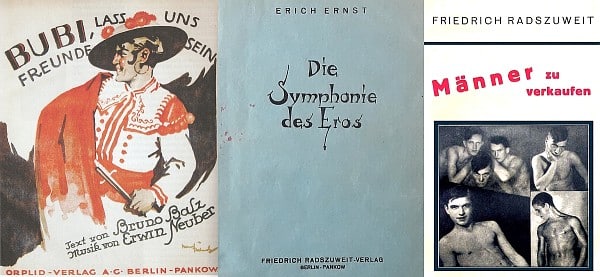
In 1925, Radszuweit published Erich Ernst’s novel “The Symphony of Eros” in his publishing house. See my article on TheColu.mn about this novel. In the online Swiss gay magazine “Schweizerisches Freundschafts-Banner” (1934, issue 11 part 1; issue 12 part 2; issue 13 part 3) the third chapter of the book (1925, pp. 19-25) was printed as a sample, with its linguistic style representing the whole work. Sometimes other novels are named, including works by Eduard Oscar Püttmann, which are cited as “ghost titles” but likely never appeared.
In 1924, three political education pamphlets appeared in the series ” Volksbücherei für Menschenrecht” (People’s Library for Human Rights): “Gesetz wider Gesetz. Die homosexuellen Menschen im Kampf um ihr Menschenrecht” by Kurt Leipzig (likely a pseudonym), “Die deutsche Bewegung zur Aufhebung des § 175 R. St. G. B.” by WhK activist Ferdinand Karsch-Haack, and “Unsittliche Sittlichkeitsbestimmungen” by Ernst Emil Schweitzer.
Radszuweit’s own publications
Radszuweit published many of his own texts within his magazines, but rarely standalone books. Among the exceptions is the 14-page educational brochure “§ 175 muss abgeschafft werden. Denkschrift an den Deutschen Reichstag zur Beseitigung einer Kulturschande” (1929).
Already in 1923 Radszuweit published “Paul Titzki. Die Lebensgeschichte eines einfachen Mannes,” a work that would be republished a year later under the title “Paul Titzkis Lebensweg” (1924). In it, the heterosexual soldier Paul Titzki meets the homosexual comrade “Fritz Bi.” and the text appears to reflect Radszuweit’s own influence (Jens Dobler: “Nachwort” in Friedrich Radszuweit: “Männer zu verkaufen,” new edition 2012, p. 165). Outwardly, this publication presents the life story of Paul Titzki, who, according to Radszuweit, he only edited. The device of presenting a fictional novel as a real life story is a common literary trick to suggest authenticity. This impression is reinforced by the text’s apparent aim to praise wartime comradeship and include homosexuals in it. This recognizable narrative purpose is an indicator of a text largely written by Radszuweit himself.
Famous is Radszuweit’s novel “Männer zu verkaufen. Ein Wirklichkeitsroman aus der Welt der männlichen Erpresser und Prostituierten” (1931, reprint 1932) — an indictment of a discriminatory society in which gay men were quickly exploited by blackmail. From today’s perspective, it is an interesting moral portrait of Berlin in the 1920s, but also marked by Radszuweit’s broad-brush denunciation of male sex workers. A worthy reprint appeared in 2012 from Männerschwarm Verlag.
“Bubi, let us be friends”
The hit song “Bubi, Let Us Be Friends” (1924) is, after the “Lila Lied,” probably the second piece written and composed in the 1920s for a gay audience. Bruno Balz wrote the lyrics, and Erwin Neuber contributed the music. Balz was editor of the Radszuweit-published magazine “Die Freundin” from 1928 to 1930. The song appeared in the Orplid Verlag catalog. However, it apparently could not match the success of the “Lila Lied” (see my article on TheColu.mn). A contemporary recording of “Bubi” is not known; it was likely published only as sheet music and lyrics.
The lectures of Friedrich Radszuweit and the Bund for Human Rights
For two TheColu.mn article series about gay life in the years 1924 and 1925, I also studied Radszuweit’s political activities in those two years in more depth. Regarding 1924, I identified five lectures by Friedrich Radszuweit, including talks he gave on the gay serial killer Fritz Haarmann.
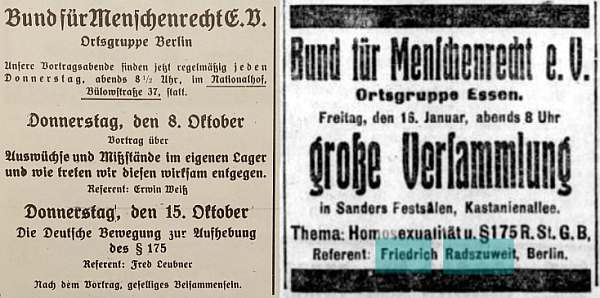
In 1925 Radszuweit delivered at least four lectures: “Our Movement” (January 5), “Homosexuality and § 175 R.St.G.B.” (January 16), another talk on planned criminal-law reform (February 2), and one on “Men’s Fraternities and Prostitution” (March 2) (see my article on TheColu.mn). The most significant of these was likely his second talk on January 16, 1925 in Essen. The Essen Arbeiter-Zeitung (Social-Democrat) advertised the speech on January 14 and 15 and gave an extensive report on January 19. I suspect that the BfM organized around 30 lectures that year, almost all announced and discussed within the homosexual “bubble.”
No External Impact — Friedrich Radszuweit in the Bourgeois Press
A closer look at non-homosexual newspapers shows that Friedrich Radszuweit, his gay magazines, and the BfM played almost no role in general news reporting. In the newspaper digitization project “Zeitpunkt” for papers in present-day North Rhine-Westphalia, there are 3,784 pieces about Magnus Hirschfeld and only three about Friedrich Radszuweit. These three are the pieces linked above from the Essener Arbeiter-Zeitung.
An analogous result emerges from ANNO, the digitization project of the Austrian National Library: among 1,215 articles about Magnus Hirschfeld (see ANNO), there is a single article about Radszuweit, which is merely a short note about a ban on his magazine “Die Freundin” in Austria (the “Österreichische Buchhändler-Correspondenz” of June 8, 1928).
The Friedrich-Ebert-Stiftung in Bonn has digitized many social-democratic newspapers, making full-text search possible. There are 469 references to Magnus Hirschfeld (see Friedrich-Ebert-Stiftung) but only two articles on Radszuweit. This contrast is notable, especially since Radszuweit was at least intermittently a member of the SPD, implying a political affinity. At the very least, these two articles are so intriguing that it is worth engaging with their content in greater depth.
The members of the BfM — self-assured, demanding, and combative
Two pieces in the social-democratic press discuss conflicts with BfM members. It may be coincidence, but they confirm the impression that Friedrich Radszuweit and the members of his federation were not only self-assured but also combative and ready to push boundaries. The growing self-confidence of many gay people appears connected to the new freedoms of the democratic Weimar Republic.
The “Sozialdemokrat” (June 30, 1927) reported that on Monday, June 27, 1927, at the Berlin Komische Oper, during the performance of the revue “Streng verboten!” there were whistles and heckling. Twelve members of the Bund for Human Rights declared they were offended by the show. They were taken into custody and charges of trespass were filed. This incident does not appear to have been widely known in lesbian and gay historical scholarship. The article does not specify what exactly drew the protests from BfM members. Further research in Berlin’s newspapers would be needed to clarify.
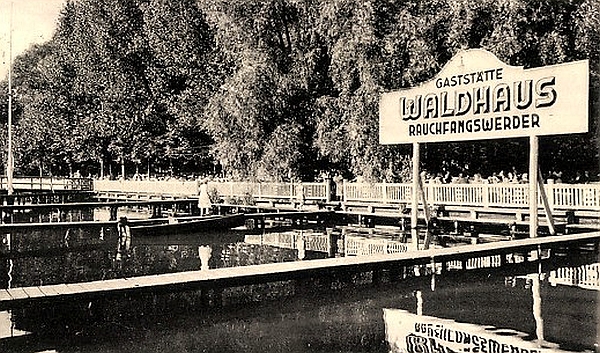
Three years later, the SPD’s central organ Vorwärts (July 8, 1930) reported under the headline “Homosexuals against the Schupo” that in the night from Saturday to Sunday (July 5–6) a brawl broke out between BfM members and the police at the Waldhaus restaurant in Rauchfangswerder on the outskirts of Berlin. A group of BfM members, including those described as “Transvestites” in women’s clothing, had rented a hall in the forest house and encountered 250 to 300 police officers who were at the same venue celebrating a summer festival. The two sides clashed. The police’s account claimed the behavior of the homosexuals was “scandalous,” and that they were responsible for the violence; but according to the description in Radszuweit’s “Freundschaftsblatt” and in the innkeeper’s account, it was the police who initiated the confrontation with homophobic insults and provocations. (For more on this event, see Jens Dobler: “From Other Shores,” 2003, pp. 75, under the heading “Rauchfangswerder Was a Riot.”).
The Rise of Fascism and the End
The BfM consistently presented itself as politically neutral, a stance that did not fundamentally change with the rise of the Nazi Party. An antisemitic attack on Magnus Hirschfeld (“Die Freundin,” 1931, issue 6) remained an exception. When the homosexually inclined SA chief Ernst Röhm was denounced in 1931, the Bund for Human Rights accused the SPD of instrumentalizing his sexuality. The BfM even called for boycotting the SPD because it had denounced Röhm as a homosexual, but it never managed to boycott the NSDAP.
A striking historical document is Radszuweit’s letter to Adolf Hitler, printed in “Die Freundin” (1931, issue 32) in which he referenced Ernst Röhm’s homosexuality. He described the NSDAP’s planned execution of homosexuals as an “agitational phrase of your party.” He went on: “I suppose, Mr. Adolf Hitler, that you do not know much about homosexuality (…). Then again I would like to remind you that you could gain even more popularity if you publicly supported the abolition of § 175.” This effort to persuade Hitler and the NSDAP to adopt the demands of the homosexual movement now seems naive or reckless. Perhaps it also reflects the fact that the BfM’s membership increasingly included NSDAP sympathizers.
On April 3, 1932, Friedrich Radszuweit died of tuberculosis. The Nazi rise to power came before he could witness the full consequences. By mid-March 1933, no more gay magazines were published. The end came apparently suddenly; no issues warned of impending repression. There is no evidence to support the common claim that associations or magazines were banned by decrees. On November 9, 1934, the removal of the BfM from the association register was requested on the grounds that the organization now had only three members.
To read more
Stefan Micheler’s dissertation “Self-Images and External Images of the ‘Others’” (2005). The online article “Journals, Associations, and Locales of Homoerotic Desire in the Weimar Republic” (2008) is an expanded version of a chapter from that work. Stefan Micheler also contributed the essay “Journals and Associations of Homoerotically Desiring People in the Weimar Republic” (in: Invertito, 2008, pp. 10-56). Jens Dobler published the online essay “The Bund for Human Rights” (2003), a corrected and slightly shortened version of a chapter in his book “From Other Shores. The History of Berlin’s Lesbians and Gays in Kreuzberg and Friedrichshain” (2003, pp. 71-76). He also wrote the afterword to the aforementioned reprint of Friedrich Radszuweit’s novel “Männer zu verkaufen” (2012, pp. 159-178).
The five issues of the Radszuweit-published magazine “Das 3. Geschlecht (Die Transvestiten)” (1930-1932) appeared in 2016 in a reprint from Männerschwarm Verlag. The editor Rainer Herrn’s work helps illuminate the magazine’s creation, analyzing its contributions and restoring a piece of queer emancipation history.
As for the world’s first lesbian magazine, Die Freundin, published by Radszuweit, it holds a special place. 194 issues of this magazine have already been made available online by Forum Queeres Archiv München, and Berlin’s Humboldt University now hosts all years of Die Freundin online.
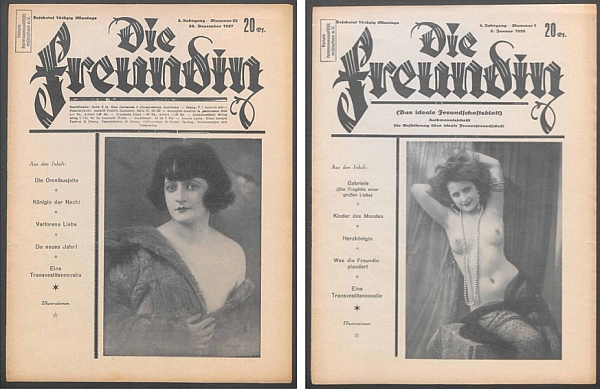
Further reprints or online digitalizations of other magazines from the Radszuweit publishing house are not known to me. Antiquarian copies of his magazines almost never appear for sale. A single issue of “Menschenrecht” is currently offered for around 400 euros, underscoring the rarity and the perceived value of his work.
Further viewing — Videos on YouTube
On YouTube I found two videos about Friedrich Radszuweit from the United States. The first video is titled “Friedrich Radszuweit: LGBTQ+ Stories from Nazi Germany” (9:27) and is part of the “Pink Triangle Legacies Project.” Here Radszuweit is compared with Adolf Brand and Magnus Hirschfeld. The title is misleading, however, because Radszuweit’s work took place during the Weimar Republic, not in Nazi Germany.
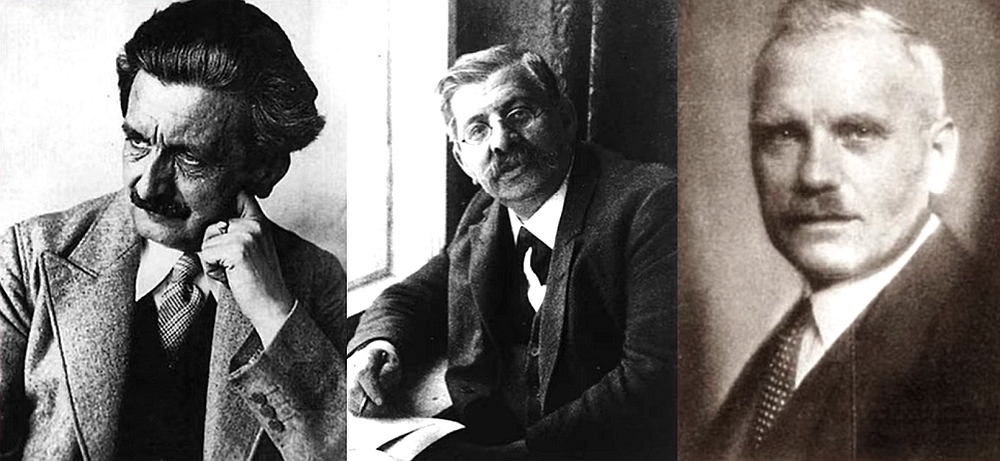
In the video “Bad Gays: Friedrich Radszuweit” (noting segments around 12:15-26:10) the discussion covers not only historical background but also today’s Magnus Hirschfeld Society in Berlin and the historian Rainer Herrn, who published the reprint of Radszuweit’s magazine “Das 3. Geschlecht” (talking points at 16:40-17:00; 26:50-29:15). It also mentions Ben Miller, who published the online article “Friedrich Radszuweit” on outhistory.org, one of the major online platforms for LGBTQ history in the United States.
Conclusion
Radszuweit’s work has now been thoroughly examined in scholarly contributions. There is no contradiction in noting that he played a significant role in the homosexual movement from 1923 to 1932, while remaining largely invisible to the mainstream heterosexual society. Perhaps no other figure shaped the internal development of the homosexual movement from 1923 to 1930 as decisively as he did. Yet he could not—unlike Magnus Hirschfeld—reach into the heterosexist majority. Hirschfeld and the WhK (WhK: Wissenschaftlich-humanitäres Komitee, the scientific-humanitarian committee) could present themselves as the established, more “serious” representation of gay interests. Hirschfeld had been recognized since the Kaiser era as a sexual scientist, and the WhK did not operate as a commercial enterprise.
The queer community needs a strong journalistic voice — especially now. Make your contribution to sustain TheColu.mn’s work.
Radszuweit was not an academic and perhaps could not achieve Hirschfeld’s renown for that reason alone. It may also have been his dominant leadership style and the way he mixed his own business interests with those of the movement. At any rate, for nine years—1923 to 1932—he was a frequently challenged but never toppled leader of the friendship associations. He demonstrated that it was possible to build a working business model—through periodicals and organizations—serving a broad gay audience, even under censorship. By the way he reached gay people through his magazines and, likely, helped boost their self-confidence, he earned his place in the history books.
The details of Radszuweit’s private life are difficult to reconstruct. From 1925 onward, he lived with his wife and his likely life partner, Martin Butzko (1903-?). A few weeks after his wife’s death, he adopted Butzko on March 28, 1929, which served as a legal safeguard for intergenerational relationships. Not long after, Butzko, who took on the Radszuweit family name, worked within the BfM and, in 1930, the Friedrich Radszuweit-Verlag became the Martin Radszuweit-Verlag.
The March 1933 turning point marks not only a break in gay history. It is typically assumed that the later gay movement did not reconnect with the early movement after 1945. In Switzerland, the gay magazine “Menschenrecht” appeared for several years (1937-1942) and later merged into “Der Kreis” (1943-1967). If one intended to revive the tradition associated with the magazine “Menschenrecht” in Germany, one would have to carry forward something of what Radszuweit achieved.

 <
<