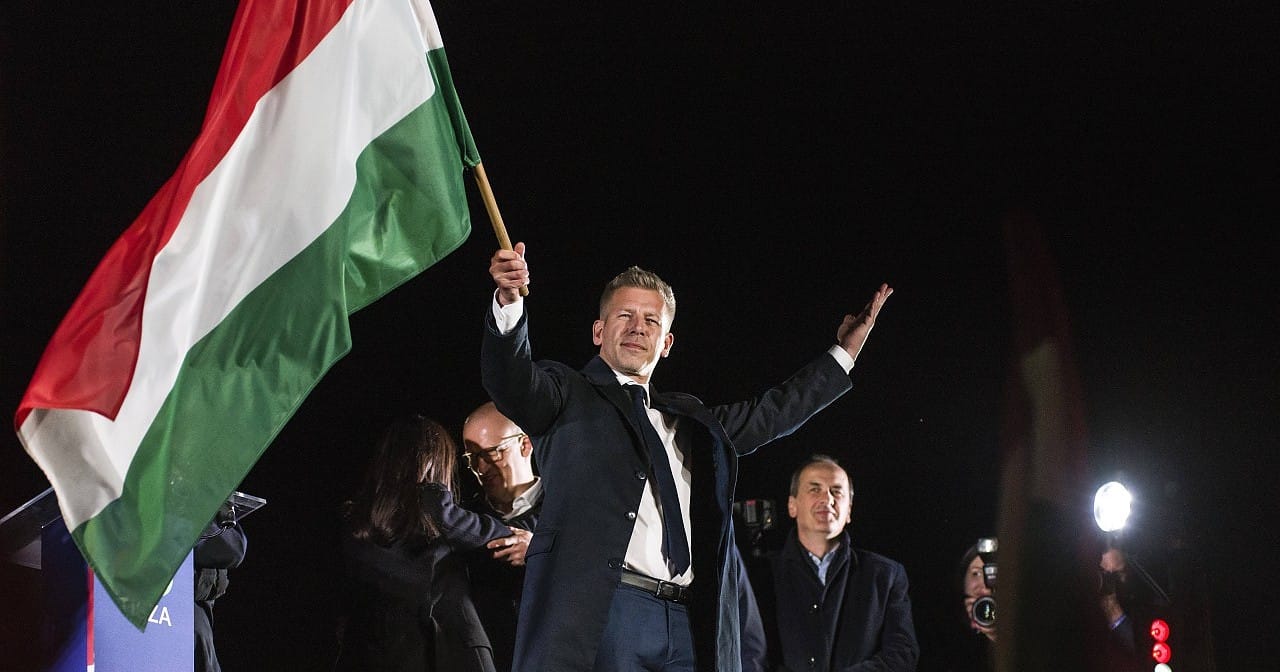
The Triumph will be celebrated. As it became almost certain that his Tisza Party would win a two-thirds majority in Parliament, Péter Magyar, flag in hand, moved through the crowd of his fervent supporters. Then he stepped up onto the stage prepared on the Buda side of the Danube, directly opposite the impressive, brightly lit Parliament building — a setting that could yield images worthy of history books for his speech.
The parliamentary election on Sunday indeed carried the aura of something historically significant. After 16 years in power, the right-wing populist, pro-Russia and openly anti-LGBTQ, Prime Minister Viktor Orbán suffered a devastating defeat. With votes still being tallied from nearly all polling places, the centrist Tisza Party, according to the election commission, won 138 of 199 seats and captured 53.2 percent of the vote — the Tisza party being part of the European People’s Party at the European level, along with CDU and CSU. Orbán’s Fidesz party secured 55 seats with about 38.3 percent of the vote.
The far-right Our Homeland party (Mi Hazánk) cleared the five-percent threshold with 5.9 percent of the vote, winning six seats. The party adheres to a traditional far-right worldview, also in regard to LGBTQ rights: it would constrain queer life, for instance by banning Pride events. No other party managed to enter Parliament. In the new legislature there will be no left-wing, green, or liberal parties.
Facebook / EuropeElects
|
Mentally, the LGBTQ+ community breathed a sigh of relief after the victory as well: Magyar is not a fighter for queer rights but more of a moderate conservative. He is not a culture warrior like Orbán, who implemented a “Homo Propaganda” law and, modeled on Russia, barred Pride events against the queer community. Magyar, after the Pride ban, did not openly align with the Pride movement; instead, he asserted that under his government no one would be obstructed from exercising freedom of assembly. The 45-year-old does not push for broader LGBTQ+ rights — such as legal marriage equality for same-sex couples — but there is hope that a Tisza government will end the state’s hostile rhetoric and reconnect more firmly with EU fundamental rights.
With the Two-Thirds Majority, Magyar Has a Free Hand
In his speech before tens of thousands of jubilant supporters, Magyar spoke about the options opened up by the parliamentary two-thirds majority. “It will make the transition more efficient, more peaceful, and smoother.” Orbán himself had governed with such supermajorities since 2010. He used them to entrench his authoritarian power structure with constitutional amendments, laws of constitutional rank, and loyalty-based appointments. Among the constitutional changes was a ban on same-sex marriage or recognition of nonbinary people.
“I call on all puppets that the (Orbán) government has set on our necks to resign,” Magyar cried to the crowd. He specifically named the president of Hungary, Tamás Sulyok, the chief public prosecutor Gábor Balint Nagy, and the heads of the Constitutional Court and the media supervisory authority. With the two-thirds majority in Parliament, Magyar will be able to oust these officials and appoint new ones.
But ruling through as Orbán did, ultimately focused only on erecting an authoritarian system, will not be enough. Magyar faces the enormous expectation of a electorate eager for relief from economic stagnation, entrenched corruption, and foreign policy isolation. With a party formed in just two years, attracting many people who are excellent specialists yet highly independent personalities, Magyar will have to deliver soon.
Europe Is Relieved
Orbán had driven Hungary away from the European Union, of which Hungary has been a member since 2004. His erosion of democracy and the rule of law clashed with the spirit and letter of the EU Treaties. The European Commission, led by President Ursula von der Leyen, had sued Hungary over the “Homo Propaganda” law and other measures. His alignment with Russia’s Vladimir Putin became more evident after Moscow’s 2022 invasion of Ukraine, deepening the rift with the EU.
Recently, Orbán blocked a 90-billion-euro EU loan to Ukraine with his veto — even though Hungary had contributed little to it. Just before the elections, transcripts surfaced of phone calls in which Orbán spoke with Putin and Hungary’s foreign minister Péter Szijjártó spoke with Russia’s Sergey Lavrov. The way Hungary courted its Russian interlocutors shocked observers. Szijjártó reportedly relayed EU internal matters to Lavrov and provided him with confidential documents (TheColu.mn reported).
Magyar described the election result as proof that “the Hungarians see their place in Europe.” The country would again be a strong partner in the EU and NATO, he promised. A Hungary that does not block Ukraine would allow the EU to regain its agency in the matter.
Hungary has chosen Europe.
Europe has always chosen Hungary.
A country reclaims its European path.
The Union grows stronger.
Magyarország Európát választotta.
Európa mindig Magyarországot választotta.
Egy ország visszatér az európai útjára.
Az Unió ersebbé válik.Ursula von der Leyen (@vonderleyen) April 12, 2026
Joy also came from other democratic politicians around the world: “The opposition’s victory in Hungary yesterday is — like Poland’s 2023 election — a victory for democracy, not only in Europe but around the world,” wrote former U.S. President Barack Obama on X. The Trump administration had previously backed Orbán’s campaign (TheColu.mn reported).
The victory of the opposition in Hungary yesterday, like the Polish election in 2023, is a victory for democracy, not just in Europe but around the world. Most of all, its a testament to the resilience and determination of the Hungarian people and a reminder to all of us to
Barack Obama (@BarackObama) April 13, 2026
The queer organization of the German Left party expressed relief as well. “The end of Orbán’s rule shows once again that the far right can be defeated. That is also a signal to the AfD. No nightmare lasts forever,” said Daniel Bache and Maja Tegeler, spokespersons for Die Linke queer. At the same time, they warned against too-high expectations: “Opposition leader Péter Magyar is a dissenter from Orbán’s Fidesz party, who in the end knew how to ride the mood for change. His restraint during the banned Budapest Pride last year was deafening.” They urged the German government to press the new Hungarian government to advocate with vigor for Maja T. The nonbinary German individual had been illegally extradicted to Hungary from Germany over a year and a half ago for alleged involvement in bloodier attacks on suspected right-wing extremists and was sentenced to eight years in prison in early February (TheColu.mn reported). Many activists called the harsh sentence politically motivated.
In Budapest, the ousting of Orbán sparked a fanfare unparalleled since an election: crowds gathered around Batthyány Square, where Magyar appeared, and along the Grand Ring Road on the Pest side, singing and celebrating with young people late into the night. The “Budapest Carnival” may well become part of the history books as well. (dk)