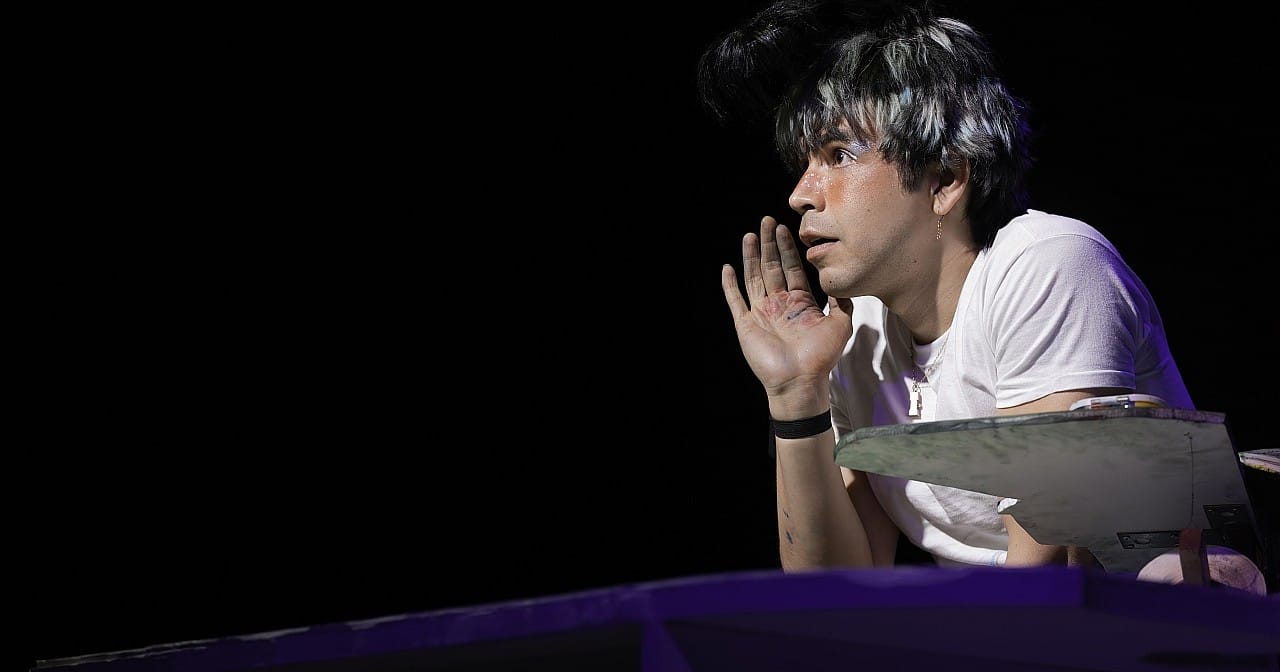
After studying at The New School in New York City, Julio Torres—born in El Salvador—made a name for himself on the New York comedy scene. For several years he was part of the Emmy-nominated writing team behind the sketch show “Saturday Night Live,” then he struck out on his own with a distinctly idiosyncratic voice and material.
His first solo stand-up program, “My Favorite Shapes” (2019), was followed by two series he co-created and helped shepherd: “Los Espookys” and “Fantasmas,” both of which earned him the prestigious Peabody Award. And in 2024, the openly gay comedian released the film “Problemista,” serving as lead actor, screenwriter, and director, and enlisting Tilda Swinton as the female lead (a review by Fabian Schäfer noted).
Now 39, Torres—who is dating actor James Scully (known for “You”)—returns to the streaming world with a new comedy special, “Color Theories,” on HBO Max, and he spoke about it during a virtual press conference.
Julio, “Color Theories” is a blend of absurd stand-up, surreal design, and a playfully intellectual exploration of identity and emotion. Why, after years spent working on series and films, was it time for this kind of live show?
The idea for “Color Theories” grew quite organically, ultimately as a byproduct of “Problemista” and “Fantasmas.” I worked on the movie and the series in quick succession, and in order to promote both, I spent a lot of time on stand-up stages. There I kept presenting a wide range of thoughts tied to colors. Over time I began weaving these disparate ideas together until they formed a coherent program. That’s how the live show gradually took shape.
Did you miss performing on stage? What does stand-up give you that working on a film or a series might not?
The immediacy of stand-up is something very special. Feedback, satisfaction—those come instantly when you’re performing live in front of an audience. Where else can I share a thought I just had with the crowd right away? For artists who work quickly and crave immediacy, stand-up is the perfect outlet, because writing a film and bringing it to the screen takes a long time. Writing sketches for “SNL” was also fairly immediate; we’d draft new material each week for the live show—and you learn right away whether a joke lands. That can be exhilarating, at least when things go well. I still need that now and then, especially after a few years of working on projects with long production timelines and heavy prep.
When did you first realize you were funny and that comedy might be your path?
In my youth, especially in my later years, I began to realize I could be funny. This was largely because I’ve always been a keen observer as a kid—and eventually I learned to package those observations and thoughts into amusing words and share them with my circle. I could never be 100 percent sure others would find me as funny as I did, but I followed my gut and veered toward stand-up, not knowing where that path would lead me.
Can humor say things that might be truer than what you could convey without it?
That’s not something I can answer in general terms. For me, personally, I can be much more honest when I express myself with humor. Because humor aligns with who I am; without wit, I find it hard to articulate myself. And if you really want to give the audience something authentic, stand-up is especially well-suited for that. Unlike a film or a TV show, it feels like the words come directly from me, not from a fictional character.
Direct link | Trailer to “Color Theories”
|
Do you write for the stage differently than you do for the camera?
Perhaps you could say a stage show comes together a bit more like a construction project. I assemble a handful of ideas, gradually linking them without always keeping a single, overarching arc in mind. With a film like “Problemista,” there has to be a narrative thread, which naturally makes things less flexible. That said, most of my other projects—especially the series—often start with me just gathering a bunch of ideas and trying to arrange them into something coherent.
Apropos “Problemista,” will there be another feature-length Julio Torres film?
If it were up to me, absolutely. I’m in the process of starting a new screenplay. The unfortunate part is that I can’t yet estimate how long it will take before something realmente concrete emerges from it.