Anyone who wants to see the exhibition “Queer Art in the GDR? Biographies Between Underground and Propaganda” also gets to meet the city — or more precisely, the Berlin district of Mitte, which runs from the north into Wedding. The show, curated by Stephan Koal and opening gradually over three days at four venues, distributes images, photographs, sculptures, and ceramics across the entire district.
That in itself is a charming aspect, because the areas could hardly be more different — from the Kunstverein Ost (KVOST) on Leipziger Straße across the street to the Werkbundarchiv. From there you head to Alexanderplatz on Karl-Liebknecht-Straße, where the “Neue Gesellschaft für bildende Kunst” (nGbK) has found its home with a view of the television tower. And finally, the U-Bahn line 8 carries you from there to Pankstraße, where the Mitte Museum combines photographs by Andreas Fux with drawings and watercolors by Jürgen Wittdorf.
Strictly speaking, you’ve already left the territory of the former capital of the GDR and landed in the capitalist West. A small historical aside: on the city map of the East, the western portion of Berlin used to be a vast white patch. Today you’ll find in that white patch noteworthy DDR art. Times change, but curiosities remain.
“Transvestite Ball in West Berlin”
And one more small aside before I begin my tour of the exhibition. In the nGbK I discovered in one of the vitrines a small oil painting by Jochen Hass (1917-2000), produced around 1954. It bears the title “Transvestite Ball in West Berlin.” Hoppla — West Berlin? The eyes widened. Yes, there had been no wall yet.
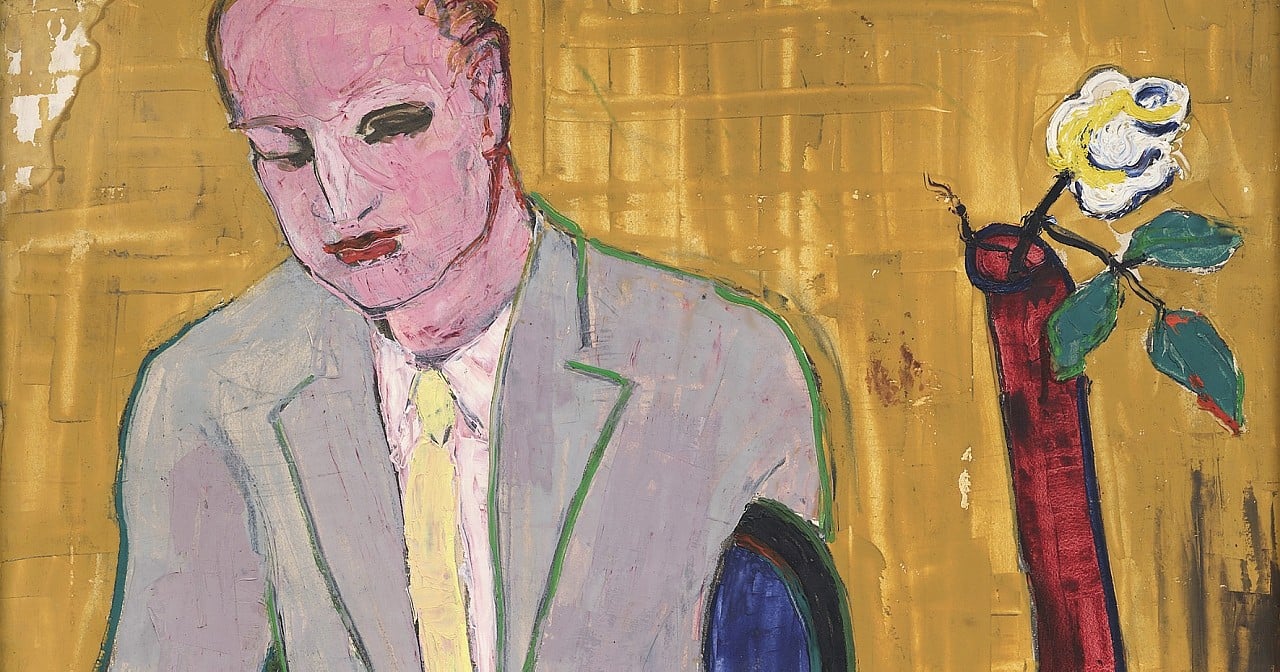
The little colorful painting could also be read as “Small Man, What Now?” since it shows a relatively small man between two mighty queens of the night, properly dressed in a suit. Is it meant symbolically? I’d rather not attempt a psychological reading, but I admired it nonetheless. The artist had a fondness for the surreal. One of his other works depicts a figure on a red ground, with countless eyes of varying sizes scattered across the body. And beside a portrait of a friend with a pink face and blood-red lips sits a dark phallic vase containing a single white-yellow rose. What could one say about that? My imagination can fill in a lot of possibilities.
Works by a total of nine artists
Staying with this artist for a moment, his vividly colored portraits, which are on view at KVOST, date from the 1950s and quietly affirm that we certainly have an eye for queer art. It concerns not only the artistic side but the audience’s gaze. Because it is the habitus of these young men, their casual posture, their lowered gaze, the slight turn of the head. All of it as if lifted straight from the picture-book of longing melancholy. Gay life, by the way, was dangerous at the time. The DDR, like the BRD, had Paragraph 175 in its penal code, but unlike the West, it at least removed the hardening from the Nazi era.
The expansive exhibition features works by nine artists from at least four generations, who today are presented under the label “queer art” without ever having used that label for themselves. After all, the term is still too young to have truly encountered the old DDR. But as a guide for today’s audience, it’s perfectly fine. Nobody has to spend long deciding which chapter of the great DDR art book is being opened. The opening events, in any case, were crowd magnets.
What is queer art anyway?
Still, the question remains: What is queer art, exactly? What makes it recognizable as such? Is it enough that the artists were gay or lesbian or trans and thus, in our sense, queer? But what would a female sculpture be queer about, next to the countless other naked female bodies in art history? Or what would be queer about abstract art — compositions of color fields and geometric shapes? Or about delicately crafted ceramic vases and bowls whose thin-walled forms, opened with frayed edges, resemble bizarre natural forms?
We probably won’t arrive at a truly satisfying answer, but we can take pride in the creativity of the queer community. Because it contains at least a huge dose of resistance to a society and a state that regarded ongoing discrimination as “normal.” And it’s a fact that the DDR was no gay paradise — lesbians and transgender people included. Even so, subcultural niches, private networks, all those apartments as gathering places, and the risk that the Stasi might be sitting on the sofa were what sustained resilience.
Photos that smell like the GDR
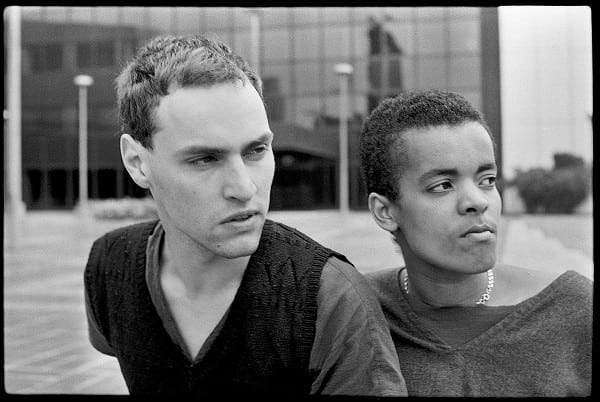
Among my personal highlights are certainly the photographs by Andreas Fux (born 1964) from the early 1980s. And as if it were some law of DDR photography: there is no smile, and there is certainly no laughter. All of these young men (mostly in portraits, and it’s repeatedly a “Jörg”) mirror a strange and seductive mix of heroic and melancholic bearing, with gazes that mostly look toward the distance. Added to that are photographs of urban life around Alexanderplatz and in other neighborhoods. These photos almost make the DDR smell — the air thick with the two-stroke mix of Trabis.
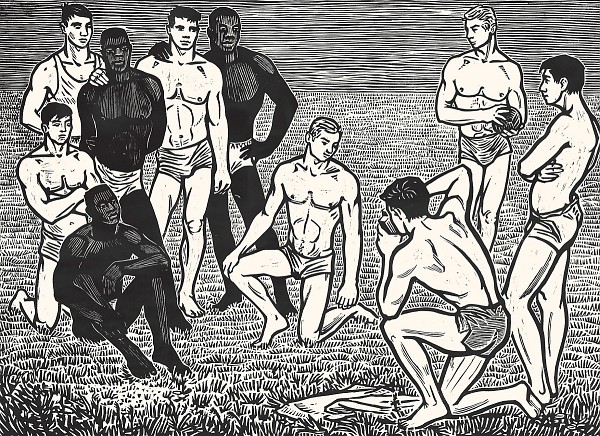
The photographs shown at the Mitte Museum correspond with graphic works by Jürgen Wittdorf (born 1932), who worked as a drawing teacher and in arts education. I was struck by a series of woodcuts titled “Cycle for the Youth” from 1963, including one with the caption “Noch kein Bartwuchs und schon Vater” (Not Yet Beard Growth and Already a Father). It shows a young man with a child in one arm and a shopping bag in the other. Elsewhere, leisure-time scenes appear: “Group with a suitcase radio,” “Summer vacation,” “Group with bicycles.”
A further series of woodcuts shown at the nGbK depicts young men in the shower, a training chat at the poolside, a construction crew of sport students, in the changing room, plus an image of friendship between Black and White. Everywhere there is harmony. The male figures are all slim and handsome. The idealization of the bodies basically erases human reality. It seems to me that within the recurring stereotyped habitus a desire is frozen, and that creates a strange tension. A tension that also stems from the almost propagandistic character of these series.
A long overdue exhibition
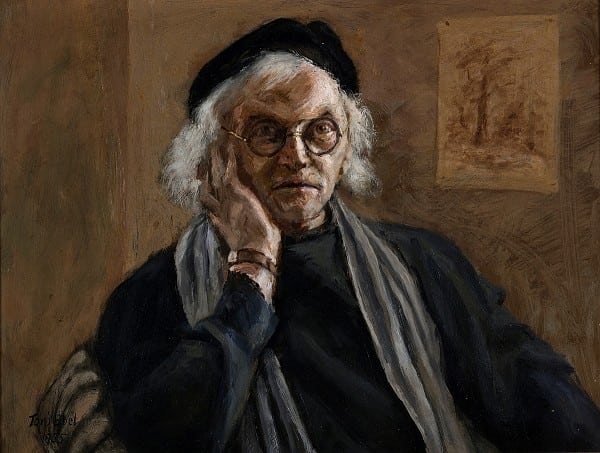
Not to be overlooked is the small section at the nGbK dedicated to the trans woman Toni Ebel (1881-1961). Among them are two lesser-known self-portraits — one with a hat and a blue ribbon and another in which the artist is shown in profile, indeed from a slightly lateral perspective, truly an unusual angle. Ebel helped write trans history. At the end of the 1920s she belonged to the circle of trans women at the Institute for Sexual Science, founded by Magnus Hirschfeld.
There is still a lot more to discover at each individual exhibition site. The exhibition is absolutely worth seeing — and honestly, it was overdue. It runs until June 28.
In the exhibition, there is helpful information available — a booklet with detailed biographies and a flyer titled “Timeline” that lists important dates and developments in queer history from 1869 to the present with brief explanations. Additionally, the Distanz Verlag published a sky-blue catalog that, in several essays, describes the life of queer people in the DDR between identity formation, adaptation, and defiant self-assertion, and of course showcases the exhibited art.